
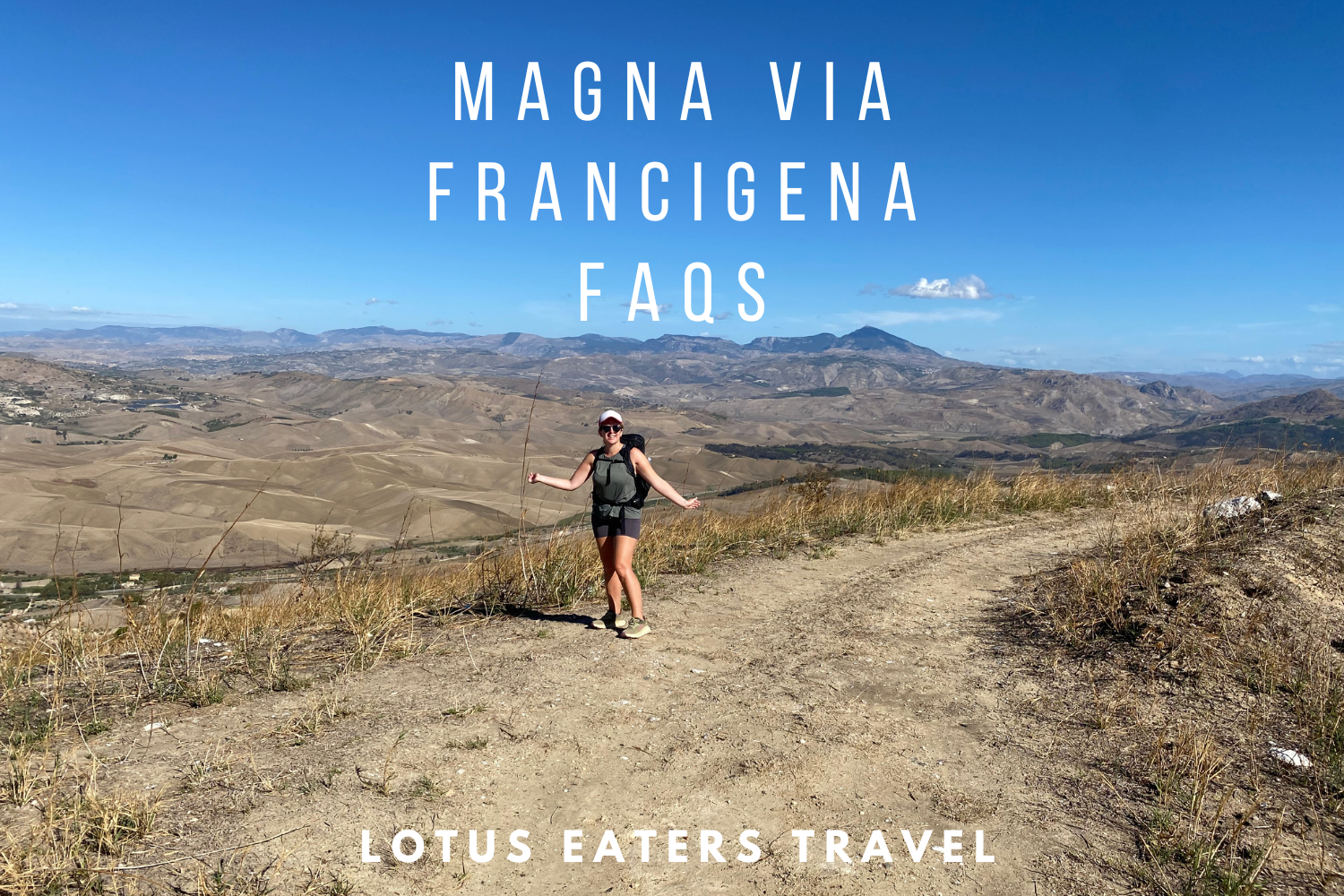
WALKING THE MAGNA VIA FRANCIGENA: ALL YOU NEED TO KNOW.
In 2023, we walked the Via Francigena from Lucca to Rome through the rolling hills and vineyards of Tuscany. Since then, we have been on the look out for another long-distance walk in Italy. And, when we heard about the Magna Via Francigena – a 186km trek from Palermo to Agrigento in Sicily – well, we knew that we would be donning our hiking shoes and making for a flight to the idyllic island. In September 2024, we did just that.
As we fell into a daily ritual of morning Cappuccino in quaint village squares and buying our fruit from the back of retro Piaggo vans, it felt that through our nine days on the Magna Via Francigena we had been transported back in time. A magical journey through Sicily, but not without some practical challenges to overcome.


In this blog post, we hope to provide all the useful information that you need to make your dream of walking the Magna Via Francigena come true.
Where does the Magna Via Francigena start?


The Magna Via Francigena starts in the buzzing city of Palermo to the North of Sicily. The route offers the chance to follow in the steps of Frankish knights, from the spectacular Cathedral of Palermo.
It is also possible to start the walk in Monreale or in Altofonte, to avoid the suburbs of Palermo.
Find our guide to the best things to do in Palermo here.
Where does the Magna Via Francigena finish?


The Magna Via Francigena finishes close to the South coast of Sicily in the city of Agrigento.
Unlike other pilgrimages that we have walked, it didn’t feel like there was an official “end point”, particularly because the trail markings close to the city are not reliable. We chose to walk to Cattedrale di San Gerlando to end our walk and take the all important photos.
Close to the Cathedral is the Mudia museum, where you can get a stamp for your credential and have the chance to purchase the pilgrim testimonial.
Agrigento is known for the Valley of the Temples, an outstanding UNESCO site, well worth a visit. If you wanted to continue your walk, you could finish the Magna Via Francigena at the Temples.
How long is the Magna Via Francigena
The Magna Via Francigena in Sicily is 186km or 115 miles long from Palermo to Agrigento.
How many days does the Magna Via Francigena take?
The majority of people complete the Magna Via Francigena in 9 daily stages. This requires distances of between 15km and 26km each day.
It could be possible to combine a couple of daily stages and walk the route in 8 days potentially. But, we wouldn’t really recommend this for a few reasons. Firstly, the towns where you can stay overnight are a highlight and it would be a shame (we think) to miss out on any. Secondly, whilst the distances aren’t super long – the elevation gain can be quite gnarly. Walking the route quicker than 9 days could be exhausting.
Walking the route in more than 9 days may also be difficult, simply due to the availability of accommodation and amenities along the way.
You can find our guide to the daily stages here.
Is the Magna Via Francigena difficult?


Whether or not a long distance hike is difficult is a tricky question to answer, because “difficulty” can be subjective. What I would say is that this hike require a good level of fitness, particularly to tackle some of the challenging hill climbs. You don’t require any technical skills, there’s no rock scrambling for example. But, I wouldn’t recommend this hike to a beginner.
The daily stages distances are not too crazy – between 15km and 26km (up to 16 miles each day.) That said, you can expect to climb in the region of 2,500 to 3,000 ft each day. Which means in reality you are walking for between 5 and 7 hours per day.
As always, long-distance trails come with additional challenges – walking each day with a backpack can start to take it’s toll on the body. Personally, I always find that my muscles (and feet) get used to daily walking after around day 4 or 5, and by day 9 I am always ready to continue. So, if anything, 9 days on the Magna Via Francigena felt a bit short to me.
Is the Magna Via Francigena well sign posted?


The Magna Via Francigena is sign posted with red and white trail markings, as well as some bespoke MVF distance markers.
In our opinion, the sign posting is fair but not excellent. We used the All Trails app to check our route multiple times, when we weren’t too sure about the trail markings.
This route is not one where you can totally switch off and rely on sign posting – as soon as you do this, you’re likely to go the wrong way!
Where can you stay on the Magna Via Francigena
Accommodation on the Magna Via Francigena is in B&Bs at the end of each daily stage. There are no hostels/ albergues along the way.
We’ve written a separate guide to accommodation on the Magna Via Francigena and sought to include all accommodation on route, because this was something we really wanted to find before we walked. You can find that guide here.
Where to buy food and drink on the Magna Via Francigena


Ahhh, to the real reason that we chose to walk in Sicily – the food!
On the Magna Via Francigena, you’ll spend your evenings in a town or village in rural Sicily. Invariably, there will either be a pizzeria or trattoria for you to eat out at night. Or, if you’re feeling exhausted – grab a pizza and enjoy it in your B&B. Towns will also tend to have one or two bars offering snacks, and of course – wine!
In the mornings, you’ll notice that coffee shops or bars open early to serve up pastries and coffee – often from 07:00. Which is ideal for walkers starting promptly in the morning. Alternatively, you might be offered a self-service breakfast in your B&B.
Supermarkets and mini-markets are occasionally found along the way in towns, but keep in mind that opening hours are often limited. You will more frequently see fruit sellers though, even early in the morning.
There are one or two days on the Manga Via Francigena where you’ll encounter towns or villages during the walk, but more often than not, there are no amenities to be found on route. For this reason, we recommend stocking up on snacks and water for the day before you leave town in the morning.
Top Tip – we tended to buy Arrancini to take away from cafes in the morning. These rice balls are incredible for sustaining hiking energy – and so so tasty.
Is the Magna Via Francigena safe?
We felt that the Magna Via Franigena was generally as safe as similar remote long-distance hikes that we have completed. That said, there were a few hazards that we encountered on route. These were:
SNAKES
There are snakes in Sicily, but most are harmless and not poisonous. Over the course of the walk, we encountered two snakes – both were a harmless variety. But, if you are scared of snakes (as I am), sections of the route which are quite overgrown may not feel too comfortable.
WALKING ON ROAD
There are two or three sections of the Magna Via Francigena that require walking on road. Now, I don’t mean to stereotype, but in our experience (and echoed by locals we spoke to) Sicilian driving can be a bit crazy!
Thankfully, most stretches of road that we walked on were not busy, but cars were going quickly (70km/h). Only on the last day walking into Agrigento did we feel a little unsafe as the road was busier.
MUD + RAIN HAZARDS
The weather, specifically rain, can make conditions on the Magna Via Francigena a little tricky. There are steep hills that quickly turn to mud paths. And as the mud sticks to your shoes in clumps, it can feel like walking in moon boots. In some areas there are “winter” routes, which provide alternative paths when it has rained.
We also encountered one creek, which we had to cross. Owing to recent rain, it was quite deep.
DOGS
By far the hazard that we felt most concerned about on the route was dogs. I should preface this to say that I have had domestic dogs and am quite familiar with the non-aggressive ones at least. However, along the way, we encountered a fair few aggressive dogs.
Every day, we met with at least one dog – the majority of which are farm dogs that are not fenced in and tended to immediately come charging out onto the path to bark and snarl at us.
Just to give you a bit of a taste of this, of our experiences with dogs, we had three incidents that stand out. Two of these involved large packs of white sheep dogs (Maremmano-Abruzzese sheepdog), that were guarding sheep. Now, one or two dogs barking may not be so scary, but these were groups of 10+ dogs. Thankfully, in both cases the shepherds eventually turned up to help us. But despite this, we were still chased by these aggressive dogs and it didn’t feel that the shepherds were in full command and control of the dogs.
The final incident involved three domestic dogs close to Agrigento, all of which were unfenced. One dog ran towards us and bit John, in a completely unprovoked attack. Thankfully, this seemed to just be a warning and the dog retreated after this.
I want to also emphasize that these are not stray dogs. We did encounter 5 or 6 strays, all of which were very sedate and caused no issues.
I have heard that the MVF organisation have tried to crack down on loose dogs, but based on our experience in September 2024, the issue has not been resolved.
NO PHONE SIGNAL
There are areas of the route that do not have phone signal. This may be something to keep in mind if you walk the route alone.
What time of year to walk the Magna Via Francigena
Sicily is seriously hot in the summer – ideal for sunbathing on the beaches and drinking Aperol on balmy evenings, but not ideal for walking through the countryside. The best time to walk the Magna Via Francigena is either spring – April to June, or autumn – September to November.
We walked this route in September, starting in the second week of the month and the heat was quite challenging for the first few days, but temperatures had dropped significantly by the end.
Winter is also not recommended, as the trail can become very wet and sometimes there is snowfall.
What to pack for the Magna Via Francigena
When packing for the Magna Via Francigena, we recommend considering the weather conditions carefully. Much of the trail is exposed and remote, so weather has a significant impact. Beyond this, we suggest packing light to allow you to fly up the hills like a goat and not plod like a mule.
You can find our packing list for the Magna Via Francigena in a separate blog post.
Our top tips for walking the Magna Via Francigena
Based on our recent experience, here are 14 tips for walking the Magna Via Francigena in Sicily.
1/ Stick to the set daily stages
When it comes to daily stages, the Magna Via Francigena is one of the least flexible long-distance trails that we have done. This is because there is often only one town each day with accommodation. The exception is on the last couple of days of the hike, where there are a few small tweaks that you can make to personalize the daily stages.
This means that you need to set aside 9 days to walk the Magna Via Francigena and there isn’t much flexibility to complete the walk faster or slower than this.
2/Book accommodation in advance
We loved the accommodation on the Magna Via Francigena – we stayed in many quaint B&Bs along the way. That said, there are a few towns and villages where accommodation is in short supply. There may only be one room available in the village. For this reason, we recommend always booking in advance – we booked all of our B&Bs about 6-8 weeks in advance.
3/ Be sure to get an Italian SIM card
Much of the Magna Via Francigena is very remote and it is important for safety reasons and practicality to have access to a mobile phone with data along the way.
We use Airalo eSIM cards for all our travel and would recommend this service. As it is an eSIM, you can easily switch from one SIM To the other, without much faff.
4/ Carry a power bank
As always when hiking, we took power banks with us. On the Magna Via Francigena, having one is a useful back up in case you get lost or something goes wrong. The route is remote and often you won’t see houses or people for miles.
5/ Stay in contact with your B&B hosts
B&Bs along the Magna Via Francigena tend to be small and family run, so they don’t have a reception or check in desks. It is best to contact the hosts in advance to give them a heads up of your arrival time. We suggest doing this before you start walking, as often there is no phone signal on the trail.
In our experience, most hosts prefer you to tell them when you are 30 minutes or a few kms away, then they will meet you at the accommodation.
6/ Always carry enough water and food
Many days on the Magna Via Francigena have little or no amenities. Or, if there are towns on route, opening hours may be restricted. For this reason, we recommend carrying sufficient food and water to get through your day.
When we walked the Magna Via Francigena, each of us carried between 3 and 4 litres of water per day.
Top tip – you’ll find restaurants and bars may be closed between about 14:00 and 18:30, which is normally when you arrive to your accommodation. We got into the habit of packing an extra snack so that we could eat something when we arrived.
Much of the route is remote and there are gaps in phone signal along the way. During our entire 9 day walk, we did not encounter any other hikers.
For safety, we recommend that solo walkers share their location – either via GPS, or informing someone of your movements.
8/ Be cautious of farm dogs
The one thing that we really disliked about the Magna Via Francigena was how many farm dogs we encountered.
On at least two occasions, we came across packs of dogs belonging to shepherds. These dogs were particularly aggressive – often snarling and showing teeth – as we tried to pass them. Shepherds were willing to help but didn’t always seem to be in full control of the dogs. And, had the shepherds not been in ear shot, we think the situation could have been quite dangerous.
We also encountered a few domestic dogs that were not fenced and would charge towards us as we passed their property. One one occasion, one of these dogs bit one of us in an unprovoked attack.
Along the way, we also saw a few stray dogs. These never caused any issues and didn’t even bark as we passed. The main issue is un-fenced farm and domestic dogs.
We don’t really have advice on how to manage this situation, other than being cautious. Walkers sometimes choose to carry sticks. Or, with one aggressive dog, throwing stones can distract them. But I don’t know how this strategy would fare with a pack of dogs.
9/ Pay attention on busy roads
A few stretches of the route involve walking on roads. Cars can travel quickly and, at times, it felt that many drivers weren’t paying attention. We saw many on mobile phones, or just getting a little too close to us for comfort.
10/ Speak to locals
Hands down, one of the highlights of this route was having snatched conversations with locals. Although we speak only a little Italian between us, and Sicilian is a language unto itself, we loved exchanging a joyous few words with locals who always seemed happy to see us.
11/ Keep an eye on weather conditions
Much of the Magna Via Francigena is on trails that are quite exposed to the elements. You’ll want to keep a keen eye on the weather forecast to ensure you are safe on the trails.
If it is raining or has been raining recently, a few sections of the trail can become difficult, or even impassable. Look out for “invierno” (winter) alternative routes which will be sign posted.
You can find more information on this in our daily stages guided (published soon.)
12/ Use the All Trails App
Whilst the Magna Via Francigena is sign posted, there are moments when having a secondary source of navigation is key. We recommend the All Trails app, which allows you to navigate even offline when there is no phone signal.
13/ Carry some cash
We recommend taking some cash with you to walk the Magna Via Francigena. It’s likely you’ll need it to pay for some accommodation – 3 of the 9 B&Bs that we stayed in required cash payment. Most restaurants and cafes will accept card payment, but it’s likely you’ll come across a few pizzerias or cafes in smaller villages where you need Euros.
It’s worth noting that there are not many ATMs on route either – larger towns like Corleone and San Giovanni Gemini do have cash points, but otherwise you won’t find them.
14/ Pack light
With some serious hills to contend with, our final tip is to pack light. There’s nothing that holds you back more on a hill climb than a heavy backpack!
You can find our packing list for the Magna Via Francigena in a separate blog post.
Magna Via Francigena Guide Book

If you’d like all the information about the Magna Via Francigena in one place, you can find our e-book available for only $5.99.
Written by Emma
Wine Lover. Yogi. Hiker. Writer.


Corfu or Sicily: which Mediterranean Island should you choose?
CORFU OR SICILY: WHICH MEDITERRANEAN ISLAND SHOULD YOU CHOOSE? If you’ve ever found yourself staring at flight searches or holiday deals wondering whether to book a trip to Corfu or Sicily, you’re not alone. They’re both Mediterranean, both steeped in history, both drenched in sunlight… and yet they couldn’t feel more different once your feet…

15 best hikes in Europe for April
15 BEST HIKES IN EUROPE FOR APRIL. April is a wonderful month to enjoy hiking in Europe, whether you’re looking for a long distance trail or a few days of trekking. But, you have to pick wisely to find the best hiking weather. In the north, trails might still be snowbound. But head a little…
How to spend a wonderful day at Lake Bolsena
HOW TO SPEND A PERFECT DAY AT LAKE BOLSENA. We arrived at Lake Bolsena as part of our journey along the Via Francigena from Lucca to Rome, and after days of walking, this serene volcanic lake provided the perfect backdrop for a day of relaxation. Whether you’re a pilgrim like we were, on a road…
Most of our planning is done using other blogs, but you can’t beat a guide book at the bottom of your case.
Find them here on Amazon.


USEFUL LINKS FOR FLIGHTS, ACCOMMODATION AND TRANSPORT


CHECK LATEST FLIGHTS
ACTIVITIES TO CONSIDER
FOLLOW US ON SOCIAL MEDIA
Please note that some links on our website are partnered with affiliates. Using an affiliate links does not make it more expensive for you to purchase. We receive a small commission whenever you buy something which in turn allows us to keep writing independent travel guides and your support is greatly appreciated.
2 responses to “Walking the Magna Via Francigena: All you need to know”
[…] Magna Via Francigena FAQs […]
[…] Magna Via Francigena FAQs […]