
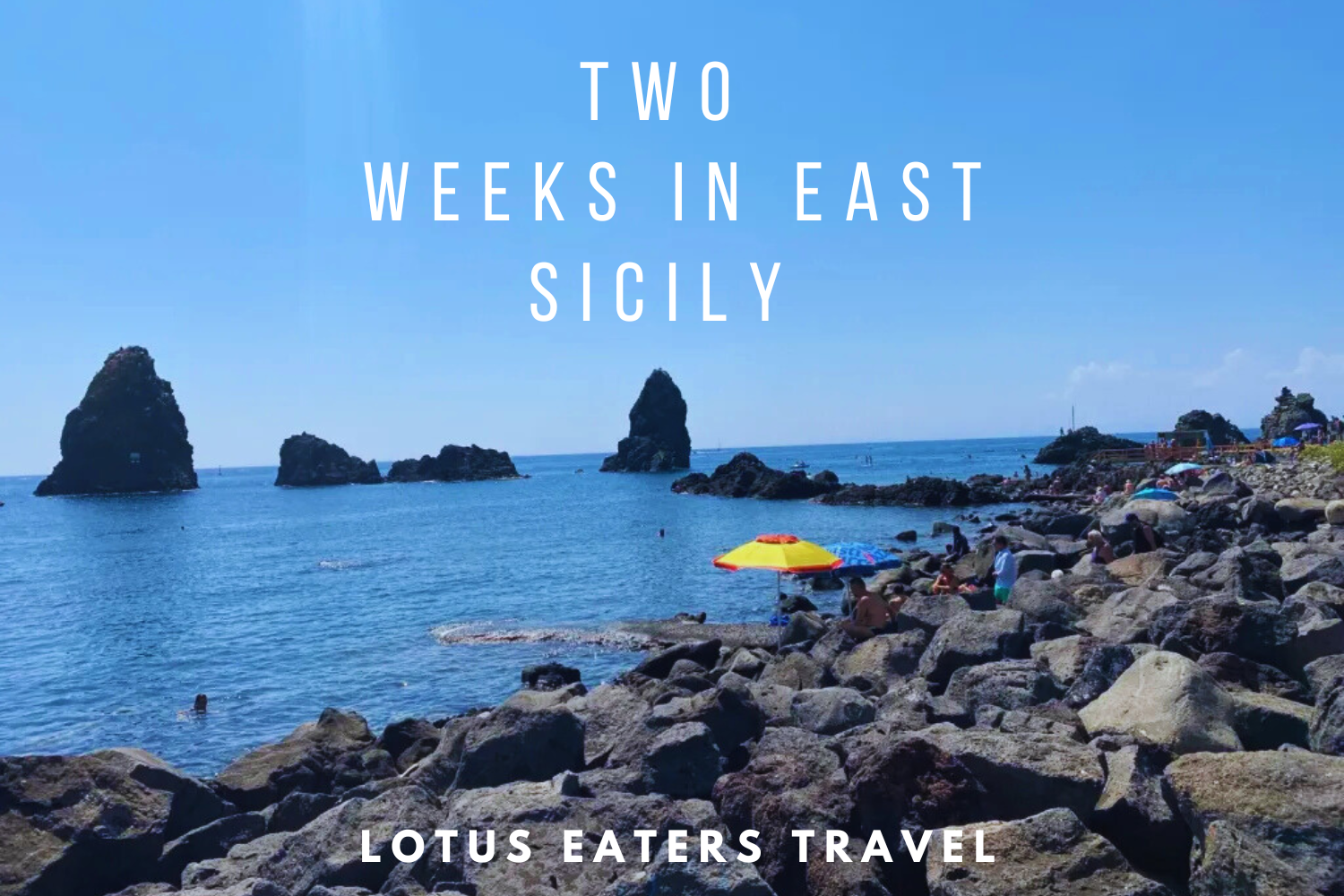
TWO BLISSFUL WEEKS IN EAST SICILY WITHOUT A CAR.
Where possible when we travel we try to do so without hiring a car. This is partly something we do to reduce our environmental footprint. But mainly we avoid hire cars because we find the whole ordeal disproportionately stressful – collecting the keys is always a saga, driving in a new car in a new country a bit terrifying, and then there’s the constant worry that we will end up pranging the car and being charged a small fortune.
All of that said, we always want to see as much as possible of any country we visit and explore with a sense of freedom. And we did just that during a month long trip in Sicily – but without a car. By bus, by train and on foot – we were able to travel to the West of Sicily to Palermo, Cefalu and more, all along the East coast and we also walked from the very north of Sicily to the very south in Arigiento. But that’s another story for another blog post!
Based on our experience of travelling on public transport in Sicily, in this blog post we will set out what we think is an ideal two week itinerary in Eastern Sicily. We include where to go and how to get there, what to do and where to stay.
Sicily top picks
Sicily top picks 😍
Short on time? Some of our top recommendations for Sicily are:
Accommodation 🏨
- Etnea Boutique Hotel – Catania
- Case Triscele – B&B – Syracuse
- Terraze Sul Mare – Pozzallo
- La Scala Verde – Ragusa
Tours & Activities 🎫
- A fun coastal tour of Taormina for White Lotus Fans
- Mount summit hiking tour with cable car included
- Boat tour with fizz in Syracuse
- Walking tour in Catania
Transport 🚌
Buses and trains make getting around the east of Sicily quite easy. We recommend buses over trains where possible. And the Omio app to help you plan your journeys.
Our East Sicily two week itinerary without a car: route & map

We were actually in Sicily for one month, but we spent around two weeks of that on the Eastern side of Sicily.
So, why have I focused this itinerary on just one bit of Sicily? When visiting Sicily, whether you have one week, two weeks or even four weeks, you can’t see the whole island. Sicily is not a piddly little place – it’s actually the largest island in the Mediterranean. Or, for American readers – approximately the same size as Massachusetts. Subsequently, it’s best to zoom into one section and aim to explore well, rather than in a hurry.
And, why the East? For me, it has everything you could want in a two week escape. A buzzing city in Catania, beautiful spots like Taormina, history in Syracuse, the sandy beaches of the South Coast, and the awe invoking architecture of the Val di Noto.
Below you can find all the highlights of our itinerary in one map.
Our East Sicily itinerary day by day
Our East Sicily two week itinerary starts and finishes in Catania, so you can fly into and out of the Aeroporto Internazionale Vincenzo Bellini, just outside the city.
We’ve suggested five places to base yourself during the two week trip. We think this is an ideal balance to allow exploration, but without feeling hectic.
It would be possible to opt to stay in just three places – skipping the coast of the South. Or to knock off a few days in Catania and stay in Taormina. It is a flexible itinerary, one that you can follow north to south, or the other way around.
Day 1: Arrive in Catania
Many tourists visiting the East of Sicily choose to skip Catania and opt to stay elsewhere, for example Taormina. Our recommended itinerary includes five nights in Catania, which to some people, may seem a little bold!
The reasons we recommend basing yourself in Catania are threefold. Firstly, Catania is well connected by public transport to pretty much everywhere you could want to go in the area, ideal for taking day trips and exploring the wider area.
Secondly, Catania is an inexpensive place to stay – comparative to Taormina or the coastal resorts. I’m going to go ahead and make an assumption that if you, like us, don’t want to hire a car then you might be budget conscious travellers too.
Last but not least, we just think that Catania is a really cool city and mega underrated. Being totally honest, I don’t think there’s enough to do for tourists in Catania for more than a day or two. But, as a base for day trips elsewhere, it is ideal. Even more so, because it has super nightlife and a great restaurant scene.
How to get there
Getting to the city from the airport in Catania (Aeroporto Internazionale Vincenzo Bellini) is easy. From just outside the airport tunnel, you can take a bus direct to the city centre (the central train station) which takes only 15-20 minutes. The buses run regularly and are operated by Alibus and times show up on Google Maps. Expect to pay 4€ for your journey.
Where to stay
In Catania, we recommend staying in and around the historic centre. Although for day trips from Catania it may be more practical to stay near to the central train and bus stations, this is not a pleasant area. It’s best to stick to the brighter bits of the city, towards the main tourist sites and nightlife. Here are a few recommendations:
BUDGET: Living Suites Catania are an ideal location if you’re looking for good nightlife, but perhaps a little noisy if you’re not. B&B Sciara Larmisi is in a central location and offers neat budget accommodation.
MID-RANGE: Etnea Boutique Hotel is as central as you can get, right on Via Etnea. Aitna B&B is a smart B&B wtih plenty of character.
LUXURY: Liberty Hotel is a centrally located hotel with luxury features, including a beautiful garden.
Day 2: Explore the city


Things to do
Catania is a very walkable city and we think setting aside a day is ideal to explore the main sites. This includes, the quite memorizing morning market Mattutino di San Gaetano, where you can find literally anything you want (and plenty of things you wouldn’t.) It seems that much of Catania’s life revolves around this market, in the morning you will see many locals rummaging through the clothing stalls, or buying fresh produce.
Next, you could consider either taking an organised walking tour with a local guide. If not, take time to visit the main sites, such as the fish market and the splendid Basilica Cattedrale di Sant’Agata.
Day 3: Visit Aci Castello & Aci Trezza


Although Catania is on the coast and does have a city beach, they are (in our opinion) not the prettiest, and probably not the type of beaches that you’d want to spend much time one.
Instead, head just 30 minutes north of Catania to the seaside villages of Aci Castello and Aci Trezza. These two twinned villages are ideal for a peaceful seaside escape from the city.
What to do
Aci Castello boasts a dramatic Norman castle perched on volcanic rock, offering sweeping views of the Ionian Sea. In nearby Aci Trezza, you’ll find the famous Isole dei Ciclopi – striking rock formations.
I should caveat, as with much of Sicily, the two Acis do not exactly have beaches. In keeping with Italian tradition, instead you’ll find plenty of rocky outcrops from which to relax. As well as purpose built Lidos to accommodate more refined sunbathers.
Our recommendation is to start with Aci Trezza in the morning – head to the bustling cafe of Mythos to try one of their popular granitas with warm brioche. After exploring this area including the pretty harbour and interesting rock formations, take a stroll to Aci Castello. For us, the more impressive of the two.
The best swimming spots in Aci Castello can be found close to the castle, just follow steps down to the ocean. Finish off your day with a late lunch, at a restaurant like Al Tubo taking in the azure sea below you.
How to get there
🚌You can take bus 534 from Catania’s main bus station, which runs directly to Aci Castello and Aci Trezza. The journey takes around 30 minutes. You can find up to date times on Google Maps. When it comes to tickets, we were a little confused – the driver wouldn’t allow us to buy them onboard, so we ended up with a free ride. But I think you can buy tickets in the station.
Day 4: Visit Taormina & Naxos


Taormina is a popular destination in Sicily for many travellers to the island. Made even more popular by Series Two of White Lotus.
What to do
Morning in Taormina
We recommend heading to Taormina early in the morning to beat the crowds.
Taormina is a picture-perfect town perched on a hill overlooking the sea, famous for its ancient Greek theatre, stunning views of Mount Etna, and elegant pedestrian streets lined with chic stores. Spend the day wandering through its historic center, visiting the Teatro Greco, or taking in the views from Piazza IX Aprile.
Now, just a little word of warning – in peak summer, Taormina can be heaving with tourists. Popular hot spots like Cafe Bam Bam (famed for it’s granita), will have queues around the block. If you want to explore the town with less crowds, then visit off-peak, or as I’ve suggested arrive early in the morning.
For something a little different, fans of White Lotus may wish to consider a fun coastal tour which takes in many of the filming locations from the tv series.
Afternoon in Naxos

In the afternoon when Taormina becomes a little hectic, you may want to consider catching the bus for about 5-10 minutes along the coast in the direction of Catania, to the town of Naxos.
For a beach day, Naxos offers long sandy stretches, crystal-clear waters, and a lively promenade lined with cafes and restaurants. It’s a more laid-back alternative to nearby Taormina and is perfect for sunbathing or swimming. We spent a blissful afternoon on the sandy beaches of Naxos, dipping in and out of the warm ocean. Before a lowkey lunch at a beachfront pizzeria, complete with local wine (all for under 20 Euros.) A stark contrast to nearby Taormina, where one dish might cost you the same price as our entire meal.
Naxos offers Lidos with paid for access to loungers and umbrellas. Or, you can freely lay a towel down without any bother.
How to get there
🚌 You can easily take the Interbus from Catania to Taormina. The bus journey takes around 1 hour and 15 minutes. It’s best to book the bus ahead of time – we use the Omio App. But, you can pay for tickets on the bus if needed. We recommend alighting from the bus once it has travelled up the hill to the old town, rather than by the coast.
To return from Naxos, simply wait for the Catania bus here and catch it on it’s way back from Taormina.
Day 5: Climb Mount Etna

What to do
No visit to Catania is complete without a trip to Mount Etna, Europe’s tallest active volcano. Whether you’re looking to hike or take a cable car to the higher altitudes, the surreal landscape of black lava fields is unforgettable.
I will hold my hands up and admit that you can’t actually get to Mount Etna on public transport. It’s possible to visit independently if you have a car, otherwise a tour is required.


When choosing a tour, keep in mind that tours heading to the summit of Etna sometimes do not include the cost of the cable car, so you’ll need to factor this in. Tours to around 2,500ft (i.e. not the summit) are less expensive and can still be a fantastic experience. You can find some of the best tours recommended below.
How to get there
Take a tour – summit hiking tour with cable car included. The tour we did was a Half day hiking tour on Etna, including a wine tasting. This is ideal if you don’t want to commit to a full day, and just want a taste of Etna.
Day 6 to 9: Syracuse & Ortigia


Syracuse and Ortigia are, I think, the definition of beauty. Everywhere I looked during our five days in Ortigia, I would just stop and marvel at how gorgeous everything was. For me, it has the perfect combination of culture, history, food all wrapped up in an azure ocean.
In our perfect two week itinerary, I have recommended three nights in Syracuse & Ortigia. This may seem a long time, but I think it’s good to balance out the two week schedule with a bit of “sitting in one place” time. In Syracuse, there are no day trips or buses to catch – it’s just morning cappuccinos, slow meanders through the market and swimming in the sea in the afternoon.
A quick explanation – Syracuse & Ortigia are essentially the same place. Ortigia is the old town of Syracuse and happens to be an island attached by a bridge. With one day in the area, you are likely to spend most of your time in Ortigia.
What to do
A visit to Syracuse and Ortigia is all about taking things easy.
Start your days walking the narrow streets of Ortigia, stopping for coffee in a piazza. In the old Jewish quarter of Ortigia, we recommend Cafe Giudecca. A friendly cafe with a small outdoor courtyard, perfectly placed to enjoy Ortigia’s street scenes. But far enough away from the main thoroughfare to feel peaceful.
Spend some time in the historic centre around Ortigia. This ancient district is a bit of a labyrinth – turn a corner and who knows what you’ll find. From hidden churches, to art galleries and the occasional feline friend stretching out in the sun.

Visit the utterly impressive Syracuse Cathedral and the quite dramatic Fountain of Diana in Piazza Archimede, before browsing artisan stores along Via Roma.
We recommend heading to the Old Market of Ortigia at least once, pausing to see the Temple of Apollo. In our five days of visiting Ortigia, I think I visited the market three times – food lovers will be able to while away literally hours. Especially if you sit at one of the stalls and try local specialities.
Any warm afternoon in Syracuse & Ortigia is best spent at the beach (in my view). For us, this was invariably Spaggia di Cala Rossa, which enjoys a rare mix of warm sea and shaded beach in the late afternoon, followed by Spiaggia Diana nel Forte for the early evening sun.
Evenings in Ortigia are a delight, you can watch the sunset as you stroll along the sea. We found the restaurant scene a little mixed, with a few tourist traps out to get diners. You can find our top tips for the best restaurants in Ortigia here.
Where to stay
We would always recommend staying in Ortigia, rather than Syracuse. There’s much more of an atmosphere in Ortigia, plus this is where you’ll find the man tourist attractions.
BUDGET: For a room with a view for the money conscious, consider Maison Ortigia. Found in the centre of town, these cute double rooms have terraces looking out onto the pretty streets. Approx 50€ per night.
MID-RANGE: It’s all about the sea view terrace at Case Triscele – B&B, which is found close to Cala Rossa Beach. Large rooms range from 100 to 120€ per night.
LUXURY: Grand Hotel Des Etrangers is the most luxurious hotel in Ortigia. Rooms are impeccably opulent and offer sea views over the Lungomare. Room rates in the region of 600€ per night.
How to get there
Getting to Syracuse from Catania is straight forward. There are two choices, the bus or train.
Buses run from Catania Bus Station (here) to Syracuse bus stop every 30 minutes and take one hour approximately to the outskirts of Syracuse (here). Tickets can be purchased online via Omio, or at the bus station in Catania and cost about 8 Euros.
Trains also take around one hour from Catania to Syracuse, but are less frequent than the bus. Tickets can be bought in the train station, or online via Omio.
We opted for the bus because they tended to be more reliable than the train.
Day 9: Noto


What to do
Noto is one of Sicily’s Baroque gems, with its honey-coloured buildings, grand churches, and elegant streets. Honestly, we just couldn’t get over how stunning Noto is. As UNESCO World Heritage Site, the town is a must-visit for architecture lovers.
Visit the Cattedrale di San Nicolò and take a stroll along Corso Vittorio Emanuele for some of the best sights. Allow yourself enough time to wander and get lost.
We would also recommend at least two long coffee stops – purely so that you can position yourself in a cafe in front of the most spectacular buildings in Noto and spend time gawping at them. Try Cafe Sicilia and Il Tagliere di Don Mario.
Where to stay
For one night in Noto, it’s best to stay near the centre of the town.
BUDGET: A casa tua Affitti brevi, Villa Ambra, and Room 55 are all well presented B&Bs in the centre of town offering an inexpensive room for a night.
MID-RANGE: The location of Hotel Porta Reale is hard to beat – right on Corso Vittorio Emanuele. Aria Rooms also has stunning Cathedral views.
How to get there
🚌 Intercity buses run from Syracuse to Noto, and the journey takes approximately 1 hour. Book tickets via Omio or pay onboard.
Day 10 & 11: Ragusa & Modica


What to do
Ragusa and Modica are two stunning towns in the hills of the Val di Noto. A visit to each will entail much mooching around, pausing in stunning cathedrals, ogling at the baroque architecture and of course, eating and drinking incredible food. Both towns are real foodie meccas.
The towns are 25 minutes apart, so you can either stay one night in each, or two in one town and take a day trip to the other.
Find our full travel guide below, which include restaurant recommendations and tips for thing to do.
- A guide to visiting Modica
- A guide to visiting Ragusa
- Undecided – find out which is best, Ragusa or Modica?


Where to stay
You could choose to stay in either Ragusa or Modica. Personally, we prefer Ragusa as a base, as it is a bigger town with more accommodation and broader choice for dining out and nightlife.
Ragusa is split into two halves – Ragusa Ibla and Ragusa Superiore. We chose to stay in Ragusa Superiore, because it has a more local feel with better choice of traditional restaurants and accommodation is less expensive. Crucially for anyone travelling without a car, the main bus station is found in Ragusa Superiore. Here are a few ideas of where to stay in this area:
BUDGET: Le Stanze del Sole is a good value B&B with rooms. The location is great, on the outskirts of Superiore, but towards Ibla. Perfectly located if you plan to visit both areas.
MID-RANGE: We stayed in La Scala Verde and it was one of our favourite stays in Sicily. The hosts are so helpful and welcoming, plus each room is uniquely designed to one of four seasons.
LUXURY: Relais Antica Badia is the height of opulence in Ragusa Superiore. The location is close to Ragusa Ibla, but also in the action of Superiore – an easy stroll to the Duomo.
If you’d rather stay in Ragusa Ibla, you can find our guide here. You can also get our recommendations for where to stay in Modica here.
How to get there


🚌The bus from Noto to Ragusa takes about 2 hours 15 minutes. You can find details on the AST website. You’ll notice that the bus goes via Pozzallo, so if you wanted to you could switch day 12 and 13 with day 10 and 11 and go to the coast first.
Day 12 & 13: Pozzallo or Marina di Ragusa


We have suggested spending two nights at the end of two weeks in Sicily at the beach. If you’re not a beach lover, you could easily extend your time in Ragusa or Noto. Personally, I love nothing more than a few days of totally downing tools at the end of a vacation. A last chance for total R&R.
Marina di Ragusa is a small beach town, a suburb of Ragusa, but around 20km away. Pozzallo is a little further along the coast facing Malta to the south. Both towns are authentic, good and proper beach towns. Each has a handful of seafood restaurants, bars and crucially – a long sandy beach. Take your pick of either.
We opted for a few days in Pozzallo, it felt to me like the ideal beach town. Few tourists visited and we were able to enjoy days on the sand, and nights filled with aperitivo.
Find our full guide to the best things to do in Pozzallo here.
How to get there
🚌Local buses between Ragusa and Marina di Ragusa take about 30 minutes and leave regularly throughout the day. Pozzallo is a little further, around 1 hour 10 minutes on the bus from Ragusa. AST operates buses on this line.
Where to stay
BUDGET: We stayed in MarMare B&B, which is about 450m from the beachfront. A charming B&B with comfortable rooms and a breakfast offering. It comes highly recommended for anyone on a budget visiting Pozzallo.
MID-RANGE:
Terraze Sul Mare is an understated hotel with a beachfront location and bright rooms. A budget to mid-range choice in Pozzallo.
Acquaduci is about as close to the beach as you can get. The apartments offer balconies with sea views and comfortable terrace furniture. As well as kitted out kitchens and well designed bedrooms.
Day 14: Return to Catania
How to get there
🚌You can take a bus directly from either Marina di Ragusa or Pozzallo to Catania Airport, making it an easy connection back to your flight. The bus takes around 2 and a half hours and costs approx 10€. In summer, this bus leaves more regularly, but off-peak only once a day. Check times and book via the Etna Transporti website.
So, how was it to travel in around Sicily without a car?
I’ll be honest and say that we didn’t have a huge amount of faith in Sicily’s public transport system before we visited. When one thinks of Sicily – ‘efficient’, isn’t exactly the first adjective that comes to mind.
All of that said, we were very much pleasantly surprised by the transport system in Sicily. In particular, airport buses to/from major cities are very reliable and affordable. Longer trains, such as the one we took from Palermo to Catania, were also on time, comfortable and good value for money.
During a month of travelling in Sicily, buses were on time (give or take 10 minutes or so). There were a few occasions when we couldn’t figure out how to pay for the buses, and ended up getting free rides. More on that below! As well as the odd occasion when the bus suddenly appeared on the wrong side of the road to what we expected. Cue furious running and arm waving at the bus driver.
Things got a little stickier when it came to train travel along the east coast and across the country. For example, we showed up to a train station in Pozzallo looking for a train, only to discover that the train station had been abandoned.
In Agrigento our online research showed that trains were running to Palermo regularly, but when we asked locals we were informed that repairs on the train line meant that the trains hadn’t run for months! Alas, this is why we have come to recommend buses over trains.
Our tips for travelling in Sicily without a car
Based on our experience of travelling in Sicily on public transport, here are our best tips.
1/ Use the Omio App: Generally speaking, we found the Omio App a reliable way to plan and book our transport in Sicily. With a few caveats (below). There is a small booking fee, but we felt it was worth it for the peace of mind of knowing tickets were booked and we had a confirmed departure point (see point 5 below.)
2/ But don’t just rely on that: We noticed that a few bus routes weren’t listed in the app and it wasn’t always 100% accurate on times. For this reason, we recommend cross-checking with Google Maps and if all else fails, asking at the local bus station.
3/ Plan ahead: Some bus lines are frequent, for example the connection between Catania and Syracuse. Less popular bus routes don’t run as often – for example, the bus between Ragusa and Modica may only be timetabled for a few trips per day. For this reason, we recommend planning connections well ahead of time rather than trying to wing it with public transport in Sicily.
4/ Buy tickets at bus stations: This is a tip for when you’re getting public/local buses for shorter trips, for example from Catania to Aci Castello. Quite a few times during our trip in Sicily, we found that drivers either didn’t want to or couldn’t sell us tickets on the bus. Often the driver would just wave us onto the bus without paying, but we felt a little uncomfortable doing this. If you want to avoid this scenario, we suggest taking local buses from their original departure point i.e. the bus station, so that you can buy a ticket.
5/ Triple check bus departure points: From bitter experience, we have learnt that buses in Sicily don’t always depart from where you expect them to. If you purchase a ticket via Omio, you’ll be given an accurate and reliable departure point and time. If you plan to buy a ticket on the bus, it can be a little more hit and miss as google maps isn’t always accurate about the departure points. Ask locals or someone else at the bus stop to confirm if you can.
6/ Think twice about trains: In our experience buses are more reliable than trains. There are often line repairs on train lines in Sicily, meaning that services may not run. The other consideration is that buses can move more directly around the country than a train – the train line runs along the coast. Therefore trains take longer and cost more than buses in general.
Where to next in Sicily?

We’ve got loads of similar guides to help you explore Sicily more. Find them below:
- One day in Palermo: A guide to seeing the best bits
- Visiting Mondello Beach from Palermo
- One day in Cefalu: A day trip from Palermo
- One idyllic day in Syracuse & Ortigia
- Palermo or Catania: Where should you start your Sicily adventures?
- One day in the city of Catania: An unexpected gem
- Day trips from Catania: 9 of the best
- Best things to do in Modica for the day
- A guide to Ragusa: things to do and where to stay
- Modica or Ragusa – which is better?
- Pozzallo Beach – the traditional sandy beach town dream
- Best things to do in Sutera, Sicily
- Walking in Sicily on the Magna Via Francigena
- A two week itinerary in Sicily – how to travel without a car
Written by Emma
Wine Lover. Yogi. Hiker. Writer.


Sicily in September: what to expect & where to visit
SICILY IN SEPTEMBER: WHAT TO EXPECT & WHERE TO VISIT. We spent one month in Sicily in September, and it remains one of the most enjoyable trips I’ve ever taken. Not because everything was perfect (it wasn’t), or because Sicily suddenly became calm and well-organised (it didn’t), but because September is the moment when the…

18 best long distance hikes in Europe for June
18 BEST LONG DISTANCE HIKES IN EUROPE FOR JUNE. June is one of the very best months for hiking in Europe. Summer has arrived, the days are long, and most trails are finally free of winter snow. But, if you head out for a long distance hike in Europe, you’ll be beating the crowds of…
Corfu or Sicily: which Mediterranean Island should you choose?
CORFU OR SICILY: WHICH MEDITERRANEAN ISLAND SHOULD YOU CHOOSE? If you’ve ever found yourself staring at flight searches or holiday deals wondering whether to book a trip to Corfu or Sicily, you’re not alone. They’re both Mediterranean, both steeped in history, both drenched in sunlight… and yet they couldn’t feel more different once your feet…
Most of our planning is done using other blogs, but you can’t beat a guide book at the bottom of your case.
Find them here on Amazon.


USEFUL LINKS FOR FLIGHTS, ACCOMMODATION AND TRANSPORT


CHECK LATEST FLIGHTS
ACTIVITIES TO CONSIDER
FOLLOW US ON SOCIAL MEDIA
Please note that some links on our website are partnered with affiliates. Using an affiliate links does not make it more expensive for you to purchase. We receive a small commission whenever you buy something which in turn allows us to keep writing independent travel guides and your support is greatly appreciated.