
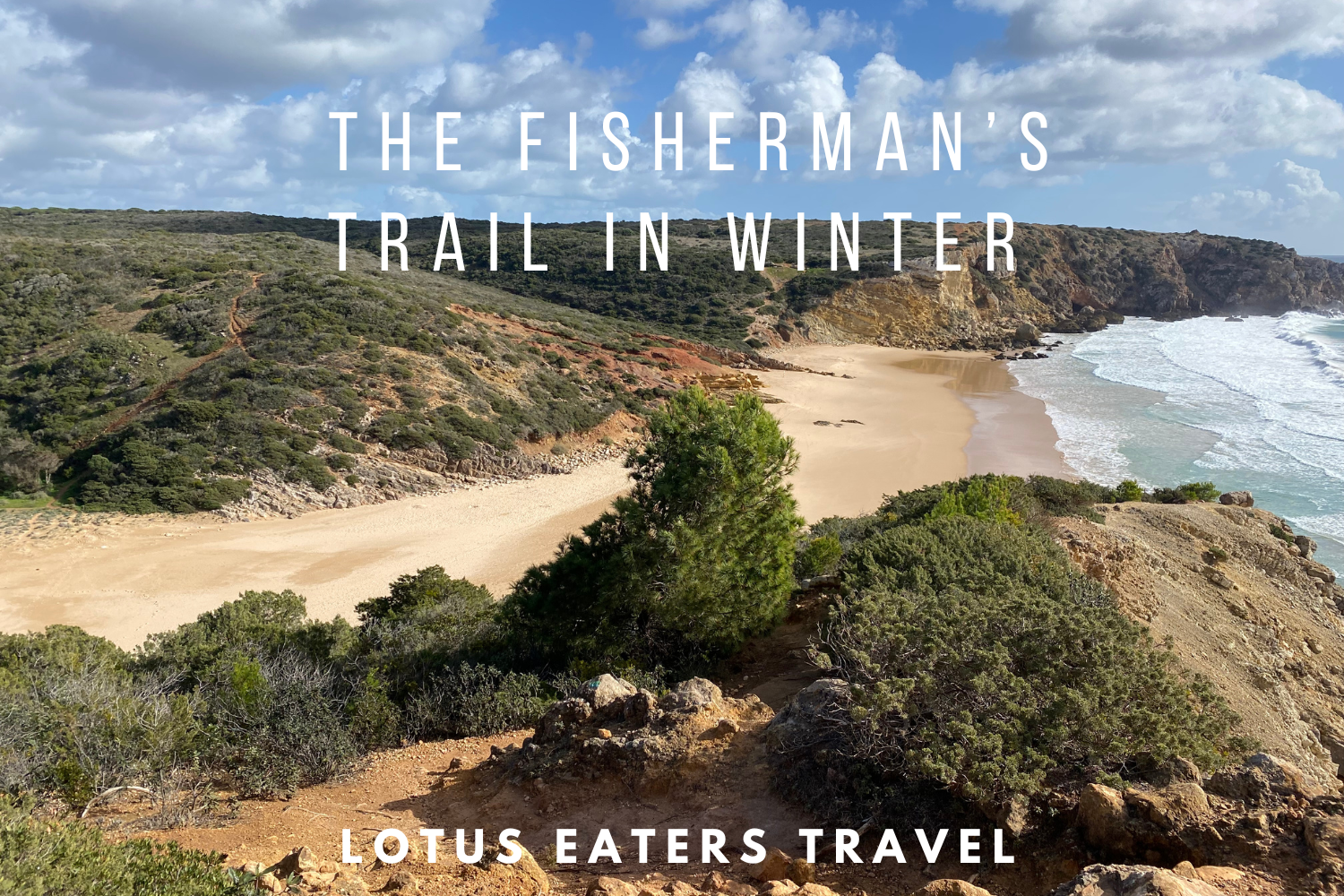
A GUIDE TO WALKING THE FISHERMAN’S TRAIL IN WINTER.
The fishermen know that the sea is dangerous and the storm terrible, but they have never found these dangers sufficient reason for remaining ashore.
Vincent Van Gogh
On a late December morning, we set out to walk the historic paths from Alentejo to the Algarve. The Fisherman’s Trail, so called because these trails were (and still are) used by those heading out with their rods and buckets to seek out the daily catch. Sand under our feet, nothing but blue sea and sky on the horizon for days on end. We could not have chosen a better way to welcome in the new year.


In this blog post, you’ll find our guide to walking the Fisherman’s Trail in the winter. You can find our top tips for walking and the answers to FAQs about the Fisherman’s Trail in the off-season.
Why we think you should walk the Fisherman’s Trail in winter
We think that the winter months, specifically December to February are an ideal time to walk the Fisherman’s Trail in Portugal.
Having now walked the Fisherman’s Trail, I can wholeheartedly say that I would not want to tackle it in the heat of the summer. Many of the trails are exposed and with barely any shade, meaning that the trails could feel quite unbearable in peak summer.
Whilst spring and summer may bring warmer temperatures and more chances to swim, or laze on the beach in the Algarve, the winter has a certain special quality. There are less people on the trail – making the adventure feel a little more unique. And, I couldn’t quite escape the feeling that I was getting to walk every day, in the sun, whilst cold temperatures set in elsewhere in Europe.
The Algarve offers a small glimpse of winter sun, without flying further afield. The ideal walking weather – not too hot and not too cold. Whilst the evenings are cooler, they felt cosy and delightful in their own way. A chance to enjoy a glass of Portuguese red wine and some hot food, tuckered up in a pretty taverna.
For budget travellers, the winter presents an opportunity to stay in hotels that otherwise may be prohibitively expensive. Rooms in basic B&Bs for 30-40€ are available in winter, whilst more upmarket hotel rates are perhaps 50% of the price you’d pay in spring or summer.
And, I must admit that I did feel a little smug returning to the UK in early January with a slight tan. Alas, this too shall pass!
Our tips for walking the Fisherman’s Trail in winter


Based on our experience of walking in December & January, here are our top tips for walking in winter.
1/ Pack well
Whether you pack well, will make a big difference to the experience you have. You’ll need warm clothing, as well as cool layers for hiking. Don’t forget rain gear too – including a backpack cover. You can find more suggestions in the FAQs section below.
2/ Book accommodation in advance
On our first day walking the Fisherman’s Trail, we met a couple of hikers who hadn’t booked any hotels on the route. We didn’t see them again after our first day and I keep wondering if they were able to get any accommodation!
The thing is, when you walk the Fisherman’s Trail in the winter, a few hotels may be closed or be operating with skeleton staff. So overall, there are less spaces available. And, I’m not sure how responsive staff would be to last minute bookings or walk-ins. That’s not to say that it’s impossible to get hotels or hostels, but we would recommend booking in advance – especially if you’re walking over the festive period.
A few of the towns you’ll visit on the Fisherman’s Trail are small and may only have one or two options. So it’s best to snap up your choice of room, especially if you are budget sensitive.
Find our guide to accommodation on route here.
3/ Pack lunches and snacks
Most days on the Fisherman’s Trail, you will pass some sort of amenity, such as a café or bar. Unfortunately in winter, these are not always open – especially those close to the beach.
Chances are, your best bet for grabbing food will be in the town before you leave the morning. For this reason, we recommend packing snacks and maybe lunch for the route – just in case you don’t pass anything that’s open.
4/ Stay hydrated
Even experienced hikers can forget to drink enough water when walking in the winter. When the weather isn’t as hot, we often neglect to drink enough water. But of course, we are still sweating and need to stay hydrated.
Carry enough water with you and take frequent water breaks, even if you don’t feel thirsty.
5/ Prepare for the sun
Even in the winter, the sun will be shining in the Algarve (yes!) Be sure to pack sunglasses, a sun hat and sunscreen – and reapply frequently.
6/ Connect with other hikers
We encountered up to 10 hikers each day walking the same direction as us. Winter is not the busiest time on the Fisherman’s Trail, but there are people out there walking.
It can be tempting to rush by others, or to avoid socializing in the winter – especially in the cold evenings. But we would really recommend making an effort to connect with others during the day when you have a chance. It can really enhance the experience.
If you are walking solo, you could post on Reddit or Facebook before you set off – there may be chances to coordinate your walk with a fellow hiker.
7/ Consider public holidays
Do keep an eye on public holidays in the winter – Christmas Day and New Years Day are obvious ones. Supermarkets will also start to shut on Christmas Eve. You’re likely to find restaurants open on New Years Day, but not on Christmas Day.
8/ Consider hotels with breakfast
We stayed in a few hotels which had breakfast included and we found this to be really convenient when walking in the winter. This meant we could have a hot nourishing breakfast, and crucially coffee, and still get onto the trails nice and early. On days when we had to hunt for an open café, we tended to have later starts as we had to wait for them to open.
9/ Don’t be too discerning about restaurants
Restaurants in the most touristic areas of the Algarve may shut down for the winter or reduce opening hours. In most towns we visited, we found one or two restaurants that we really wanted to dine at, but they were closed.
That said, we were always able to eat somewhere, we just couldn’t always get into our ideal restaurant.
10/ Be aware of daylight hours
It’s a pretty obvious point to make, but walking in winter means less daylight. The Fisherman’s Trail is a tricky walk, often on cliff-side trails – not a route that you would want to tackle in the dark.
We recommend checking sunrise and sunset times each day so that you’re aware of them. And, plan your daily stages knowing that you may only have about eight hours of sunlight during the day.
11/ Enjoy the spectacular sunsets


I don’t know if this is in any way science backed, but I just think that sunsets in the winter in Europe are so special. As you walk along the west coast from Porto Covo down to the most southerly tip, you’ll be able to witness some spectacular sunsets.
Fisherman’s Trail in the winter: FAQ’s
Below you can find frequently asked questions about walking this route in the winter, and answers based on our experience and research.
What weather can you expect in the winter on the Fisherman’s Trail?


The weather in Southern Portugal makes it ideal for winter walking. Whilst temperatures won’t reach “sunbathing” peaks, you can expect warm temperatures and blue skies. My research suggests that December is the wettest month, with about 100mm of rain.
From December to February, you can expect between 16°C to 20°C during the day with temperatures of 8°C to 10°C at night.
Our experience was 90% blue sky and calm weather. We had one full day of terrible rain and storms, then a few flashes of rain. But otherwise, we were treated to warm temperatures and sunshine by day.


Will you meet other walkers on the Fisherman’s Trail in winter?


Boarding a 07:00 bus from Lisbon to Sites in late December, I spotted four other travellers carrying backpacks and sporting the unmistakeable smug smile of someone about to start walking a long-distance trail. As we stepped off the bus (after a quiet snooze), we confirmed that they were fellow Fisherman’s Trail hikers!
We met so many more walkers than we had expected when we walked the Fisherman’s Trail in December and January. Each day, I would estimate that we encountered around 5-10 walkers who were also tackling the route North to South. As well as crossing paths with a similar number walking South to North.
This means that there are plenty of chances to meet other walkers, even in the winter. What I would say, is that unlike walking in the summer, the evenings aren’t as sociable. There are no opportunities to sit out on a terrace, or hang out in a hostel garden. Instead, the colder nights mean that there’s a tendency to hibernate a bit. Whilst on a summer walk we might while away the long evening in a bar, socialising, we spent a fair bit of time tucked up inside a restaurant or even watching movies back in our B&Bs. For us, it was a slightly different experience – but an enjoyable one nonetheless.
For anyone who wants to meet other hikers, there are chances to do so. But you may have to be a bit more deliberate in your efforts to chat and socialize than you might in the summer.
Are restaurants open on the Fisherman’s Trail in winter?

If you are anything like us, one aspect of walking a long-distance trail that you look forward to is a nourishing supper in the evening. Probably accompanied by a glass of wine or beer. Luckily, this is very much possible on the Fisherman’s Trail in the winter.
In every town we stayed in, we found at least one restaurant open of an evening. There were also coffee shops and cafes open during the day. We were perhaps less discerning than we normally would be, taking opportunities to eat and drink when we could, rather than being fussy about which restaurant we visited.
One thing we did note, is that a few restaurants had reduced opening hours during the winter. For example, you may find some that are open only on the weekend, or closed on a Sunday or Monday.
We also found a few that were temporarily closed for the entirety of the winter. This mainly impacted cafes and bars near to the beach – often meaning that there were no amenities during the day on the walk. Because of this, we frequently packed lunch to take with us during the day.
As we were finishing up the trail in early January, we met a few restaurant owners who were about to close for a few weeks to take vacation. This wasn’t wide-spread, but it is something to be aware of if you plan to walk in the middle of January.
Finally, keep an eye on bank holidays that will result in more wide-spread closures. Christmas Day and New Years Day for example. It will be virtually impossible to find a café or store open in the morning on New Years Day, but restaurants will open up gradually once the hangovers have dissipated.
Is accommodation available on the Fisherman’s Trail in winter?
When we decided to visit the Algarve to walk the Fisherman’s Trail in the “off season”, I had envisaged us as two lone hikers braving the coast, begging for overnight stays wherever we could. This could not have been less accurate. In truth, there is no real “off season” in the Algarve.
Winter is a popular time for sun-seekers, surfers and all else in between to visit the area. Hence, you are going to have no issue finding accommodation if you choose to walk the Fisherman’s Trail in winter.
There are a few small caveats – some hoteliers do choose to shut down over Christmas or for a few weeks in January. Others may not open for the winter at all. But, there is so much accommodation available in the Algarve that you will still have a good selection of hotels, B&Bs and even campsites (yes in the winter) to choose from.
You can find our full guide to where to stay on the Fisherman’s Trail here.
What to pack for the Fisherman’s Trail in winter


Invariably, I was putting on clothes and taking them off again multiple times during the day when I walked the Fisherman’s Trail in winter. My mornings would start with a base of leggings, a sweater and a coat. Normally decorated with a bobble hat and gloves.
Yet by afternoon, I had stripped down to shorts and a t-shirt with a sun hat and sunglasses to keep the winter rays off my face. After a few days, the penny dropped and I started wearing shorts under my leggings ready to whip them off on the trails without skipping a beat.
Suffice to say, layers are absolutely your friend when you walk the Fisherman’s Trail in winter.
You will need warm clothing for morning walking and for the evening when you head out for dinner or drinks. But you will also need comfortable and light walking layers that allow you to trek freely in 18 to 20 °C. Don’t forget rain layers – we had one or two patches of wet weather and on exposed trails, you will want to avoid getting soaked.
Finally -don’t forget pyjamas and socks! Portuguese buildings are not so suited to the winter. Many small B&B’s will not have heating or particularly warm bedding. Those beautiful Portuguese tiled floors that feel wonderful in the summer, will freeze your feet in the winter. I was so grateful to have some warm sleepwear and I hereby pass this tip on to you. If you too are a cold bod in bed, don’t forget PJs and socks.
*A note on footwear – I’d read that walking boots are recommended for this route in winter. I walked in my trusty Hoka trail shoes and these were ideal. I wouldn’t have wanted the extra bulk of walking boots and the terrain or weather did not require them.
You can find our full guide to packing for the Fisherman’s Trail here.
EVERYTHING ABOUT THE FISHERMAN’s TRAIL IN ONE PLACE
Want all the info you need about the Fisherman’s Trail in one place? You can find our Fisherman’s Trail ebook in our shop for only $5.99. Download and flick through on your phone.

Fisherman’s Trail YouTube Video
Find our video guide to walking the Fisherman’s Trail below.

Would you like us to plan your walk for you?
Embark on a journey of a lifetime with Lotus Eaters Travel Planning, where we turn your dream of long-distance walking into a meticulously planned reality.
Our passion for exploration, love for diverse cultures, and commitment to providing an unparalleled experience drive us to offer personalized consultation services for some of the world’s most iconic walking trails


<<<ALL FISHERMAN’S TRAIL BLOG POSTS
Written by Emma
Wine Lover. Yogi. Hiker. Writer.


15 best hikes in Europe for April
15 BEST HIKES IN EUROPE FOR APRIL. April is a wonderful month to enjoy hiking in Europe, whether you’re looking for a long distance trail or a few days of trekking. But, you have to pick wisely to find the best hiking weather. In the north, trails might still be snowbound. But head a little…

10 Hiking Routes in Europe for December: chasing the sun
10 HIKING ROUTES IN EUROPE FOR DECEMBER: CHASING THE SUN. Late last December, we set out to walk the Fisherman’s Trail. A long distance hiking trail that wraps around the very south western point of Portugal and takes in the best of the Algarve. Not a day went by when we didn’t pinch ourselves, feeling…
13 Best Places in Europe to Hike in September
THE BEST PLACES IN EUROPE TO HIKE IN SEPTEMBER. There’s something satisfying about hiking in September. Catching the last of the summer weather, but travelling once the crowds are long gone. Call me selfish, but I’m currently researching our next hiking trip for later this year. We hope to take on a new long-distance hiking…
Most of our planning is done using other blogs, but you can’t beat a guide book at the bottom of your case. Find yours on here and get the travelling started!


USEFUL LINKS FOR FLIGHTS, ACCOMMODATION AND TRANSPORT


CHECK LATEST FLIGHTS
ACTIVITIES TO CONSIDER
FOLLOW US ON SOCIAL MEDIA
Please note that some links on our website are partnered with affiliates. Using an affiliate links does not make it more expensive for you to purchase. We receive a small commission whenever you buy something which in turn allows us to keep writing independent travel guides and your support is greatly appreciated.