
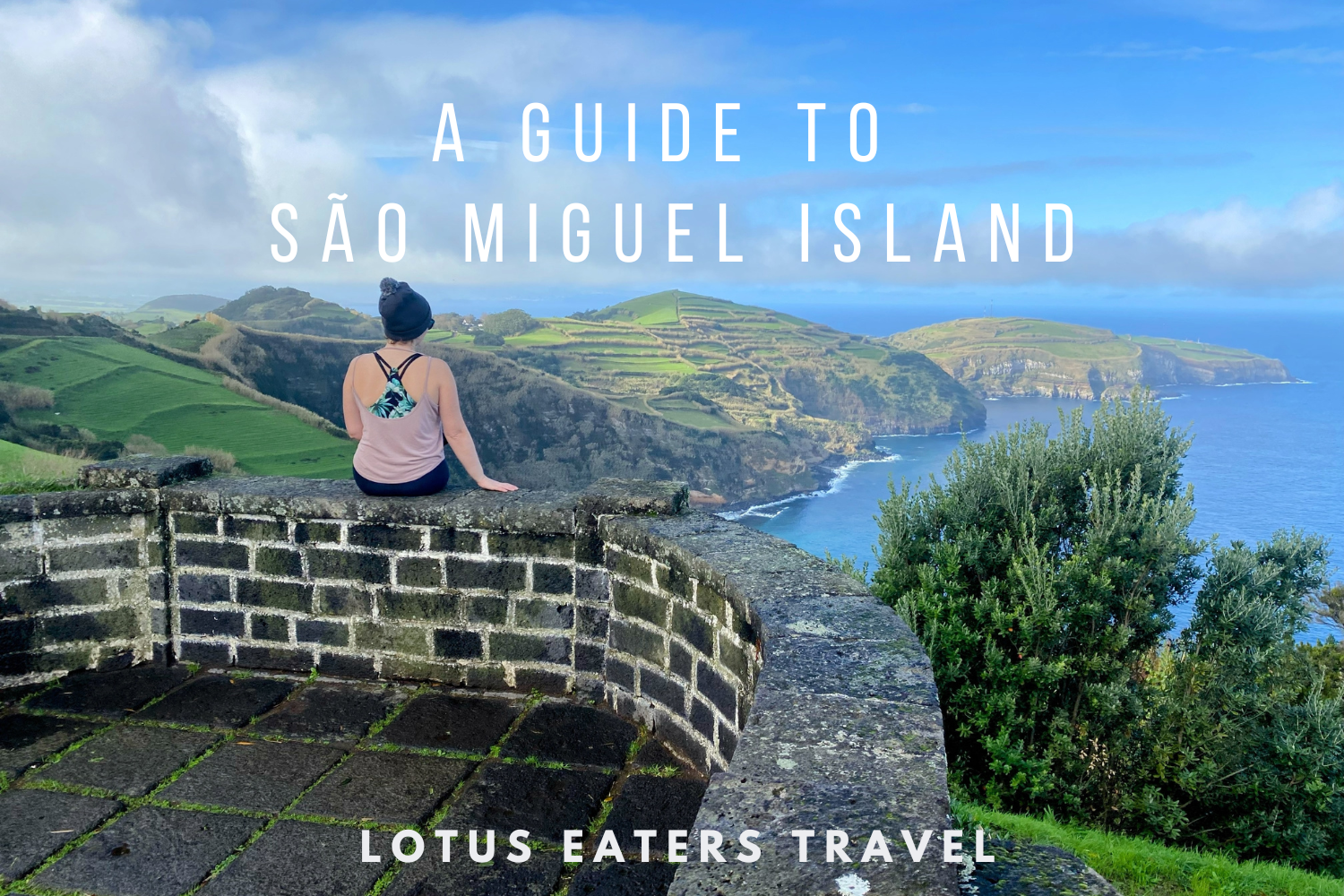
THREE DAYS ON SAO MIGUEL: AN ISLAND GUIDE.
São Miguel is often described as the greenest of the Azores, a place where volcanic landscapes meet the Atlantic in dramatic fashion. But beyond the postcard-perfect views, what does it actually feel like to visit?
The island has a bit of everything, crater lakes, hot springs, black sand beaches, and some great food. It’s well set up for travellers, with good roads and plenty of tours, but it’s also a working island, not just a tourist destination. That means it’s not always polished, and (as with all the Azores) the weather can throw your plans off.
That said, it’s a special place and we will remember our visit to São Miguel for years to come.


In this blog post, you’ll find our guide to making the most of your visit to the island. And, our three day itinerary to help you see the sights in a structured way.
Is São Miguel worth visiting?
Yes, but it depends on what you’re looking for. São Miguel is the largest and most accessible island in the Azores, and it has the best infrastructure for visitors. The landscapes are impressive – volcanic craters, lush forests, rugged coastlines – and the island’s geothermal activity makes for some unique experiences, like soaking in hot springs surrounded by jungle.


That said, it’s not an untouched paradise. Tourism has increased in recent years, and while it’s nowhere near as crowded as mainland Portugal, some of the more famous spots can feel busy, especially in peak season. If you’re expecting a quiet, remote getaway, you’ll find that harder to achieve here compared to some of the smaller islands like Faial and Sao Jorge.
Weather is another factor. São Miguel is in the middle of the Atlantic, and the climate is unpredictable. Even in summer, you might get a day of solid rain, and the famous viewpoints can be completely fogged out. If your heart is set on perfect hiking conditions or clear blue skies for photos, prepare for some disappointment.

Ultimately, São Miguel is worth visiting if you’re open to a bit of spontaneity. If you like road trips, dramatic landscapes, and don’t mind swapping plans around when the weather shifts, you’ll enjoy it. But if you prefer everything to go exactly as planned, it might not be the best fit.
How many days to spend on São Miguel

We chose to stay on São Miguel for three full days and four nights, which felt like the right amount of time for us and our goals. We wanted to see as much of the island as possible and try some of São Miguel’s unique experiences.
That said, three days is fairly fast paced and if you wanted to explore in a more leisurely way, you may want to take four or five days. If you were visiting in summer, you could easily linger longer in many of the swimming spots or beautiful places.
Personally, I would prefer to take three days on São Miguel and spend longer on the smaller islands, like Pico and Faial. These islands have a different charm and offer a contrast to São Miguel’s busier atmosphere.
How to get to São Miguel
Most travellers arrive at São Miguel via Ponta Delgada International Airport (PDL), which has direct flights from mainland Portugal, the UK, and various European cities.
Getting from the airport to the main city is easy, there are taxis waiting outside the airport and the fare is capped at €10. As of 2024, there were no buses running. You can of course also hire a car at the airport.
There are also domestic flights from other Azorean islands. Flights tend to be inexpensive (less than €100) and are super quick.
Historically ferries operated to other Azorean islands, but we were told by locals that these no longer exist.
Do you need a car to visit São Miguel

Yes and no. If you want to see the whole island, I would suggest hiring a car. It’s easy to do hire a car from the airport or downtown Ponta Delgada. And the roads on São Miguel are probably the best (properly paved, maintained and quick), of the Azorean islands.
If you do hire a car, consider where you might park it in Ponta Delgada. Some properties have parking, but others will not. We found a free car park (tagged on our map) that we were able to use to park our car overnight.
That said, São Miguel has really good tourist infrastructure in the form of guided tours. We met a tour guide who regularly takes travellers around the entire island, one day at a time. We decided to take a tour for one of our three days to see what it was like.
The main downside of a tour is the cost, which is considerably higher than hiring a car. But you do get the added bonus of a guide’s local knowledge, which can enhance your experience. See the section below for more details.
Where can you travel in São Miguel without a car?
If you wanted to take tours, you can pretty much travel anywhere on the island.
1/ Sete Ciades – tour guides can take you on a four hour jeep tour to this famous lake. Includes transport from Ponta Delgada.
2/ Furnas – a full day tour including a trip to Furnas, one of the most popular sites.
3/ West & east tour – a full two day tour seeing large sections of the island. Ideal if you don’t want to hire a car.
4/ Whale watching – head out to sea from Ponta Delgada to see whales. Find a top rated tour here.
5/ Ponta Delgada food tour – a tour of the capital, ideal for foodies.
6/ Wherever you want – finally, you can contact Pedro at Azores Tours. He can pretty much tailor any trip you want. And promises to get you around the entire island in three days.
Three days on São Miguel island: a guide + map
Here’s exactly how we spent three days on São Miguel island. All locations mentioned in this blog post can be found in the handy map below.
Day One: The west + Ponta Delgada
Our first day focused on the western side of the island, home to São Miguel’s most famous natural attractions, particularly Sete Ciades and Termas da Ferraria.
Coffee + pastry
We started our first day in a way that would quickly become tradition. With coffee and pastry in Cafe Lisbonese.
As much as we enjoyed the centre of Ponta Delgada, we found that some of the cafes and restaurants closer to the main square were a little bit sub-par. This cafe has queues in the morning with locals buying bread, and I know it sounds a cliche, but following the locals has never steered us wrong.
I’d really recommend grabbing breakfast in Ponta Delgada before you head off exploring on Sao Miguel. Especially for anyone food driven like me .The more remote locations won’t have cafes or grocery stores. This is particularly important in winter, when many rural eateries are closed.
Termas de Ferraria

Termas de Ferraria is a very unique phenomenon, only found on thi island. It is a thermal pool, but in the ocean! How crazy is that.
So when you get in, you can expect a warm temperature, a bit like getting into a bath. Even when the rest of the sea is cold. Keep in mind that the tide can change the temperature, but when the tide is relatively low, you’ll find the water quite welcoming.
It was created by volcanic eruptions, I don’t quite know how the science works, but I do know that it’s a very dramatic area of the island to visit.
We visited in winter and had the place to ourselves, with a few nearby fisherman. There are changing rooms and toilets open year round to access and parking is easy. That said, this place can be crowded in summer.
Visit when the tide is low only. Otherwise, you’ll just be in the sea!
Farol da Ferraria

Just a short drive away, this lighthouse offers spectacular views of the rugged coastline. The surrounding landscape is a great place for a short walk or a peaceful moment overlooking the Atlantic.
Miradouro da Ponta do Escalvado
As you drive around São Miguel, there are numerous “Miradouros” or view points. Normally there will be car parking, so you can just pull up on a whim and take it all in. You can’t enter the lighthouse, it’s more of a viewpoint.
We loved Miradouro da Ponta do Escalvado, a dramatic cliff top view point. You can find it between the thermal ocean point and Mosteiros, our next stop.
Praia dos Mosteiros


This black sand beach is a great place to relax and see the iconic rock formations offshore. The day we visited was particularly stormy and the scenery here felt quite iconic. In summer, there are snack bars and a lively vibe.
Sete Ciades

One of the most famous locations in the Azores, Sete Cidades is a breathtaking volcanic crater with twin lakes. We took our time exploring various viewpoints, including Miradouro da Boca do Inferno and Miradouro da Vista do Rei, before heading down into the village to grab a coffee by the lakeside. The village itself is worth popping into, especially to see the church.

If you have clear views and good weather, I’d recommend dedicating your day to walking or cycling around the lake. A 20km hiking route promises better views than you get at a Miradouro.
In summer you can hire electric bikes and spend the day exploring this area. That would be my pick!
Kayaking on the lake is also possible, and an inexpensive option.
I’ll be honest and say that the cafes in Sete Ciades did not inspire. If you have the will and foresight, I’d recommend putting together a picnic that you can take and enjoy by the lake, or at a viewpoint. Delightful if you have the weather on your side.
Ponta Delgada


We decided to spend the afternoon into evening exploring Ponta Delgada. Obviously if you do choose to hike, cycle or spend time on the beach, you may not have time for this.
Highlights for us included the Jardim António Borges, a beautifully maintained botanical garden with exotic plants and hidden grottos, the Igreja Matriz de São Sebastião, an impressive 16th-century church with a striking facade, and the Forte de São Brás, a historical fort with ocean views.
We ended the day with sunset drinks by the marina and a tapas-style dinner at one of the local wine bars(Reserva).
Ponta Delgada – the capital of the island is buzzy with plenty to see and do. That said, it is quite well documented that there are issues with drugs and homelessness in the capital. This is widely attributed to the famous incident in 2001 when a huge haul of cocaine washed up on the island (well depicted in the Netflix show Turn of the Tides). Generally, this is a safe city, but I would exercise caution during hours of darkness. As a woman I would not have felt comfortable out and about on my own at night or early in the morning.
Day Two: The middle of the island
Our second day focused on the central region of São Miguel, which is packed with surprises.
Miradouro do Pico da Barrosa

This viewpoint provided stunning views of Lagoa do Fogo, one of the most picturesque crater lakes on the island. The drive up is scenic, with many winding roads. The views are really quite special.
We had planned to do the 10km PRC02 Lagoa do Fogo hike, which starts to the south of the island and travels inland to the lake. It’s not advisable to do this hike when the ground is wet, so we weren’t able to. If you want to do something active in this area of the island and have good weather, then you can find the full details of the hike here.
Thermal Pools
One of the main reasons we wanted to visit São Miguel was to explore the natural hot springs. Caldeira Velha is one of the best on the island, set in a national park you can enjoy the water surrounded by lush jungle-like vegetation.
The pools can be booked in advance in 90 minute time slots. Unfortunately, because this is a natural pool, you’ll find that it is closed when there has been any rain. As is typical in the Azores, sometimes plans have to pivot!


Instead, we drove to Termas das Caldeiras da Ribeira Grande. This is a private thermal pool, a little more expensive than the other. The drive to it is along a long winding cobbled road, but worth it for the inviting warm water.
Ideally, try to get into the Caldeira Velha or the Furnas pools (see day 3), but Ribeira Grande is a solid plan C.
Ribeira Grande


Ribeira Grande is a large town to the north of the island. It’s a lovely place to have a quick nose around, perhaps taking coffee on the main square. There’s also a lovely tidal pool.

Just outside the town is A Mulher de Capote, a local liqueur factory. It’s free to enter and you get a short tour and tasting – passion fruit is the most famous flavour, but we were quite partial to the festive cinnamon flavour. You can buy small bottles to take away (or large if you wish), but the small ones are hand luggage friendly.


Miradouro de Santa Iria
Onward around the north coast, and this Miradouro caught our eye. A fantastic viewpoint along the northern coast, offering dramatic cliff side vies and a perfect place for photography enthusiasts.

Gorreana Tea Factory
The Azores are home to some of the only tea plantations in Europe, and I believe the largest. We visited Gorreana Tea Factory, took a short scenic hike through the fields, and sampled some fresh tea while. There’s also a little cafe here with lovely views across the tea fields. And you can buy tea to take home (in fact, I’m enjoying a cup just now!)

The factory is free to enter, but it’s nice to buy something or leave a tip if you do visit.
Details of the hike around the tea fields and surrounding area can be found here. Expect the walk to take around 90 minutes.
Azores Brewery


One of our rules when we travel is that if there’s a local independent brewery, we we always try to visit. The Azores Brewery is a family owned business, a little way out of town. It’s a great spot for one or two crafty beers (as long as you have a designated driver.)
Pineapple Plantation
Perhaps the third thing that Sao Miguel is famous for, behind the lakes and thermal pools, is pineapples. Our last stop before dinner was a visit to a local pineapple farm, where we learned about the unique way pineapples are grown in the Azores and sampled some delicious pineapple liqueur.


The visit here is free, we popped in for around 15 minutes. You can buy drinks and stay longer, but in all honesty, the prices are OTT.
Dinner at Apito Dourado
Ponta Delgada has a thriving restaurant scene. There are plenty of fancy restaurants, if that’s your thing. But we are always on the look out a more local bolthole, somewhere rustic with hearty food.
I think we found that at Apito Dourado – an unassuming venue, it looks more like a little pub. The food here is fresh, well priced and just the right amount of heft to replenish us after a day of sightseeing.
Day Three: The east
The eastern side of São Miguel feels more remote and less developed, with lush forests and waterfalls.
We decided to take a tour rather than driving to the east. In part because the driving distances are quite significant, but we also wanted a tour guide to add to the experience of visiting this remote area.
Furnas
Furnas is a vast lake and seen as a must-visit destination on the island. It is famous for its geothermal activity. You can hike around the lake, visit a restaurant to try the renowned stew (cooked in the furnas), or soak in the thermal pools at Terra Nostra Gardens.
Tip – the thermal pools here stay open late in the evening, so if you’re looking for a different way to spend the night, this might be it. I imagine it’s quite romantic at night.
Povoação


This small coastal town was the first place settled on the island. We wandered through the historic streets. visited the church and stopped at a local liquor shop to sample homemade fruit liqueurs.
If you are here in summer, check out the pools in this village.
Miradouro da Ponta do Sossego


This is one of the most beautiful viewpoints in the Azores, with gardens, picnic spots, and sweeping views of the cliffs. There were about ten cats milling about here when we visited, it was a little like visiting the feline version of Mount Olympus.
Nordeste
A quiet town, worth stopping by to see. The church in particular is quite pretty, as is the park area with a grandstand.
Parque Natural da Ribeira dos Caldeirões

Our final stop of the day was Parque Natural da Ribeira dos Caldeirões. The waterfalls here are reqully quite spectacular. Hiking trails take you around the park area. We spent around 90 minutes here exploring and taking photographs.
Parque Natural da Ribeira dos Caldeirões
Our final stop of the day was Parque Natural da Ribeira dos Caldeirões , a beautiful park and home to mesmerizing waterfalls, hiking trails, and old water mills. We thought we had seen spectacular waterfalls in Madeira, but this one is really quite special.
We spent around 90 minutes exploring the park area and taking photos.
You can find full details of the tour that we did with Pedro from Azores Tours here.
Where to stay in São Miguel
Ponta Delgada is the most popular and most logical place to stay on the island. This gives you access to restaurants and nightlife, and ease of driving around the island, or taking tours.
Here are our top picks for where to stay:
BUDGET: We stayed at PDL Green House, which offers budget double rooms. The roof terrace is lovely and the location ideal for the city centre.
MID-RANGE: Somewhere like Hotel Ponta Delgada is a good choice for mid-range accommodation.
LUXURY: Vila Gale collection is probably the most luxurious hotel in the city. Opulent decor meets history. For something a little more quirky, try the Home boats found on the marina.
The Triangle Islands
São Jorge, Pico and Faial make up the three Triangle Islands of The Azores. Although the islands are neighbours, they all offer something totally different and unique. Find our guides to all three below.

PICO ISLAND
Known as they “grey island” and famous for wine, volcanic landscape and Mount Pico.

SAO JORGE
Known for the dramatic Fajãs, hiking trails, cheese and surfing.

Written by Emma
Wine Lover. Yogi. Hiker. Writer.


Lisbon in July: what to expect + things to do
LISBON IN JULY: WHAT TO EXPECT & THINGS TO DO. We ended up spending an entire month in Lisbon in July. Honestly, we normally avoid peak season for travel whenever possible, but we were invited to a three day wedding in Lisbon and it seemed like a great excuse to extend our stay. It was…

Christmas in the Azores: Surprisingly Festive in the Mid-Atlantic
CHRISTMAS IN THE AZORES: WHAT TO EXPECT IF YOU VISIT. When we decided to spend Christmas in the Azores, we weren’t sure what to expect. A cluster of volcanic islands adrift in the middle of the Atlantic Ocean might not scream “festive spirit” – especially with mild winter temperatures, subtropical greenery, and the odd flamingo-pink…
Pico or Faial Island: Which Azores Island Should You Visit?
PICO OR FAIAL ISLAND: WHICH AZORES ISLAND SHOULD YOU CHOOSE? If you’re heading to the Azores and have narrowed it down to the triangle islands, Pico, Faial, and maybe São Jorge, you might be wondering: should I go to Pico or Faial? I visited both, and while they’re only 25 minutes apart by ferry, they…
Most of our planning is done using other blogs, but you can’t beat a guide book at the bottom of your case. Find yours on here and get the travelling started!


USEFUL LINKS FOR FLIGHTS, ACCOMMODATION AND TRANSPORT


CHECK LATEST FLIGHTS
ACTIVITIES TO CONSIDER
FOLLOW US ON SOCIAL MEDIA
Please note that some links on our website are partnered with affiliates. Using an affiliate links does not make it more expensive for you to purchase. We receive a small commission whenever you buy something which in turn allows us to keep writing independent travel guides and your support is greatly appreciated.