
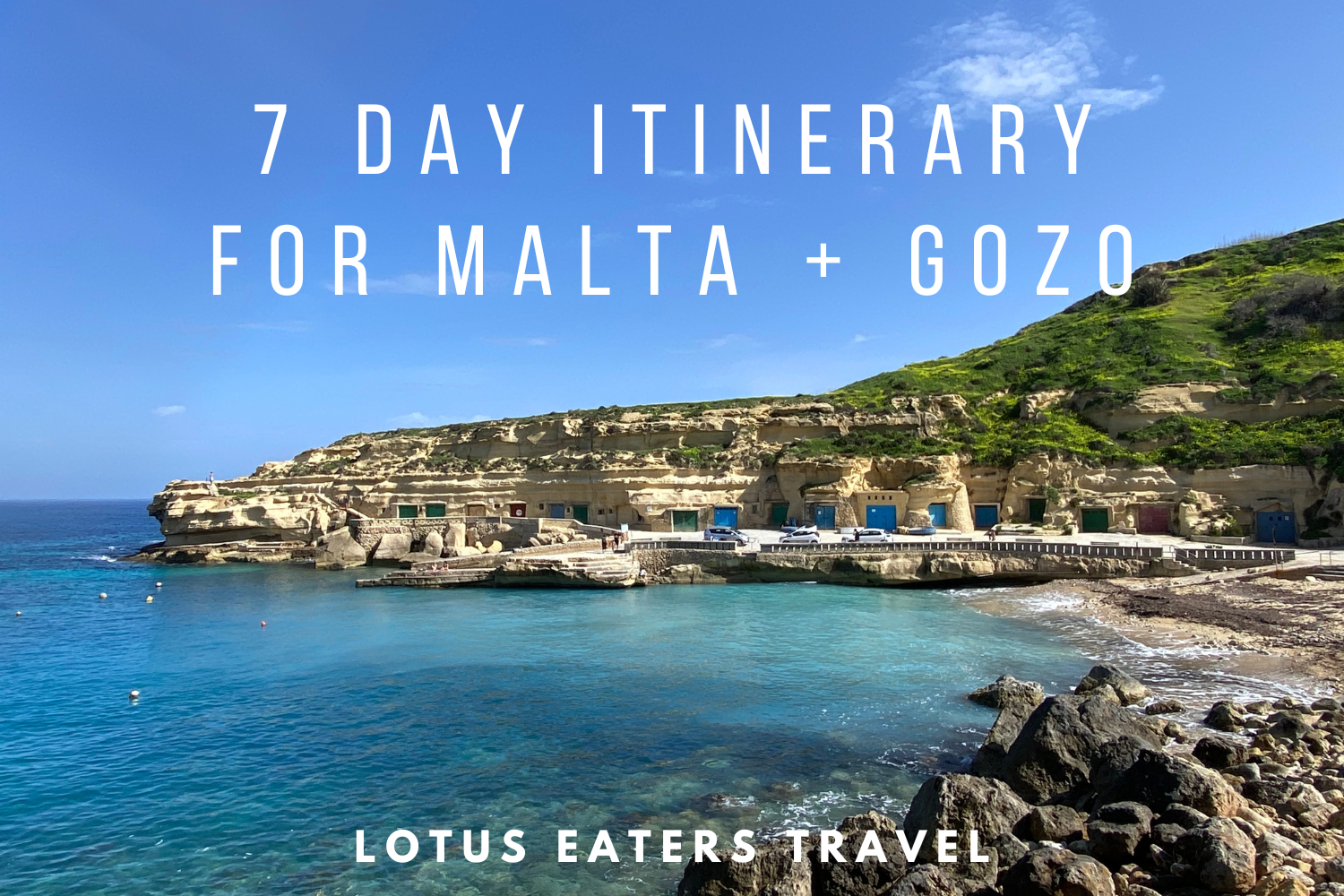
OUR 7 DAY ITINERARY FOR MALTA & GOZO WITHOUT A CAR.
We spent 18 wonderful days exploring Malta on foot, we walked the perimeter of both Malta and Gozo on coastal trails. As well as spending time inland in Rabat and Mdina.
After our trip, a friend of mine asked me what I thought would be the perfect 7 day itinerary for Malta. Honestly, I had to scratch my head about this a little bit because there is so much to see and do. From hiking trails, crazy-old historic landmarks, buzzing cities and towns, and that’s not even mentioning the swimming spots. And that’s just on Malta – then there’s Gozo to consider, the smaller island to the North of Malta.
This itinerary is the seven day itinerary that I would give to a friend who wanted to see the island slowly, but surely. Anyone who wants a mix of culture, activity and relaxation. And crucially, anyone who doesn’t want to hire a car.


In this blog post, I’ll cover our ideal one week itinerary for Malta and Gozo. Including, the best things to do and where to stay. You’ll also find links to more detailed blog posts about each place.
About our itinerary
A week in Malta and Gozo offers the perfect balance of history, nature, and coastline. This itinerary breaks the trip into two parts: four days exploring Malta from Valletta, the Three Cities, or St Paul’s Bay, followed by three days on Gozo, where you can slow down the pace.
I totally fell in love with Gozo and to me, a trip to Malta without spending significant time on Gozo is a total waste. That’s why this itinerary includes half of the trip on Malta and half on Gozo.
I’ve allowed for seven full days, including time to travel back from Gozo to Malta. But depending on flight times, you might want to play around with the plan. It may also suit you to head to Gozo first, then enjoy the second half of your trip on Malta.
You don’t need to hire a car in Malta
This itinerary is also tailored to anyone looking to use public transport on Malta and Gozo and not hire a car.
With reliable public transport and the option for scenic hikes, it’s an itinerary that works whether you prefer adventure or a more relaxed approach. And, you don’t need a car.
Honestly, I think having a car is totally unnecessary and would just make the trip more stressful. Traffic in Malta can be quite bad, personally I’d rather be on a bus able to zen out when there’s traffic than being stuck behind the wheel of a car.
Buses can be slow and sometimes late, but they do tend to be reliable. Use Google Maps to plan your trips. And, you can also pay by card on the bus – it’s normally €2.
Malta is small, so there are no “long journeys” and no requirements for advance booking of coaches.
Our 7 day itinerary for Malta & Gozo: summary

All locations mentioned can be found on the map below.
- Day 1: Valletta
- Day 2: The Three Cities & Marsaxlokk
- Day 3: Rabat & Mdina then Dingli Cliffs and surrounding area
- Day 4: Travel to Gozo – Victoria & Citadel
- Day 5: Visit Xlendi and the coast
- Day 6: Marsalforn/ Ramla Bay
- Day 7: Back to Malta
Days 1 – 4: Staying in Malta
For the first part of your trip, choose between:
Valletta or the Three Cities for an atmospheric stay surrounded by history. Well-connected for public transport, ideal for culture lovers and those wanting easy access to cafes and bars.
St Paul’s Bay for budget travellers prioritising beach time. A quieter base with a more laid-back feel, though slightly less convenient for day trips.
Public transport in Malta is efficient, with buses running frequently to most sites. Alternatively, taxis and ride-sharing apps are available but can be expensive.
Find our full guide for accommodation and where to stay on Malta without a car here.
Day 1: Valletta


Start in Valletta, the capital. Walk through the narrow streets lined with colourful balconies, visit St John’s Co-Cathedral, and stop for coffee when you see somewhere you fancy.
Valletta is a city that doesn’t really require a plan, simply spend time wandering and seeing what you find. Be sure to see the upper and lower Barrakka Gardens – popular but worth the hype. Visit in the morning to avoid crowds.
We also loved walking the Valletta Ditch – it doesn’t sound great, but it’s a lovely space away from crowds.
For lowkey supper – we loved happy hour at Sally Ports Pizzeria, 2 for 1 Aperol Spritz and excellent pizza.
Day 2: The Three Cities & Marsaxklokk


Spend the morning exploring the Three Cities across the Grand Harbour – Birgu, Senglea, and Cospicua -best reached by the small ferry from Valletta Waterfront. I’d recommend visiting the main fort on Birgu, as well as allowing time just to wander freely. There are lovely spots for coffee along the Senglea waterfront, it’s idyllic.
Find our guide to the best things to do in the Three Cities here.


For the afternoon, head to the fishing harbour of Marsaxlokk. An ideal spot for a late afternoon lunch or early supper by the water. Enjoy fresh fish and Maltese wine with a view. Near to Marsaxlokk is St Peter’s Pool – a famous swimming spot within walking distance of the town.
Now, we really liked Marsaxlokk but I had a sense that it might be becoming too popular for it’s own good. Restaurants can be quite busy and prices a little higher than the rest of the island.
A quieter alternative is nearby Marsaskala, a similar fishing village, but smaller and less popular. There are also places to swim just outside the harbour. And it’s easier to get there from the Three Cities (one bus instead of two.)
Find our guides to Marsaxklokk (here) and Marsaskala (here). These include the best things to do and where to eat.
If you do take the bus to Marsaxlokk from the Three Cities, you’ll pass Ħal Saflieni Hypogeum – one of Malta’s most significant historic landmarks dating back to 4000 BCE. If you want to visit, book in advance.
Day 3: Mdina & Rabat then Dingli Cliffs


Take the bus to Mdina, Malta’s Silent City. Wander through the fortified streets and visit St Paul’s Cathedral before stopping for coffee and Pastizzi at Crystal Palace. Afterwards, explore Rabat’s catacombs or walk around the quiet streets.
After Rabat and Mdina, take a bus to Dingli Cliffs. This is the highest point of Malta and you can take in the awesome views.


A few more options:
For history lovers, there’s also an option to tag on a visit to Għajn Tuffieħa. A neolithic structure which is open to visitors. It costs around €10 and you’ll probably spend around one hour there.
For hikers – you can actually walk from Ghakn Tuffieha to Dingli Cliffs – an invigorating hiking trail with awesome views. You ideally need at least 3 hours, it might be best to do this early in the morning, then if you still have the energy head to Rabat/ Mdina afterwards. You can find our guide to hiking this coastal route here.
Days 4 – 7: Staying in Gozo
Ferries from Malta to Gozo depart from Ċirkewwa and take around 25 minutes. You could also consider taking the fast ferry direct from Valletta, it only costs a couple of Euros more and involves less faff than heading to Cirkewwa in the north of the island.
In Gozo you could stay in:
- Victoria for a central base with access to bus routes, shops, and restaurants.
- Mgarr if you prefer a harbour-side setting and easy access to the ferry.
- Marsalforn for a more relaxed, coastal atmosphere with swimming spots nearby.
Find our list of recommended accommodation in Gozo here.
Public buses in Gozo are less frequent than in Malta, but still manageable – just keep in mind that you might have to change buses in Victoria or Mgarr. Renting a bike or using taxis can be useful for remote locations.
And, if you want complete ease, there’s also a red hop on hop off tourist bus that goes around the entire island – I normally wouldn’t advocate for this kind of bus, but in Gozo I think it’s quite handy.
Day 4: Victoria & the Citadel


Explore Victoria, Gozo’s capital. The Citadel offers panoramic views over the island and a mix of small museums. Afterwards, take a walk through the old town streets and visit the market and second hand stores. Spend the evening at a wine bar or relaxed restaurant in Victoria – Neolitik is a quiet spot on a backstreet of the city.
History lovers may also want to tie in a visit to Ġgantija Archaeological Park, a megalithic temple. Buses drop off directly outside the park and you can expect to spend between 60 and 90 minutes there.
Day 5: Xlendi & the Coast


Catch a bus to Xlendi Bay, a small seaside village with a scenic coastal path leading to the Xlendi Tower.
You can also hike to Xlendi Bay from Mgarr (the port) in around 18km. If you’d rather a shorter walk, you can visit the Sanap Cliffs from Xlendi in under an hour by foot.
If hiking isn’t for you, spend the afternoon relaxing by the bay, swimming or trying fresh seafood at one of the local restaurants.
Day 6: Ramla Bay & Marsalforn


Visit Ramla Bay, Gozo’s largest sandy beach with its distinctive red sand. For those who enjoy hiking, take the path up to Tal-Mixta Cave for stunning views over the bay.


In the afternoon, head to Marsalforn, where you can visit the nearby salt pans or relax at the waterfront with drinks and supper.
For serious hikers, the trail from Marsalforn to Ramla Bay is around 60-90 minutes. A rugged sort of hike but with incredible views. Find out more here.
Day 7: Slow Morning & Return to Malta
Enjoy a final slow morning in Gozo, perhaps visiting one more swimming spot, before taking the ferry back to Malta. If you have time before your flight, stop in Valletta or somewhere on the Northern Coast, like Silema or St Julian’s Bay for a long lunch.

Written by Emma
Wine Lover. Yogi. Hiker. Writer.


Where to next?
Valletta Cruise Port: All you need to know
VALLETTA CRUISE PORT: ALL YOU NEED TO KNOW. Valletta is one of the easiest cruise ports in Europe to arrive to. And it has potential to offer a very rewarding visit to the city. Everything is close, the city is compact, and you can see a lot in just a few hours without needing to…

18 best things to do in Malta from a cruise ship
18 BEST THINGS TO DO IN MALTA FROM A CRUISE SHIP. We have travelled extensively around Malta, so when someone recently asked me for advice on what to do in Valletta from a cruise ship, it made me realise something. I was so focused on the capital that I almost forgot to mention how easy…
Cyprus or Malta: a deep dive into the two islands
CYPRUS OR MALTA: A DEEP DIVE INTO THE TWO ISLANDS. Golden stone cities, azure seas, and a long, tangled web of Mediterranean culture and history – both Malta and Cyprus tick so many boxes when it comes to sunshine escapes. They’re warm, safe, culturally rich, and surprisingly affordable. But if you only have time for…
USEFUL LINKS FOR FLIGHTS, ACCOMMODATION AND TRANSPORT


FOLLOW US ON SOCIAL MEDIA
Please note that some links on our website are partnered with affiliates. Using an affiliate links does not make it more expensive for you to purchase. We receive a small commission whenever you buy something which in turn allows us to keep writing independent travel guides and your support is greatly appreciated.