
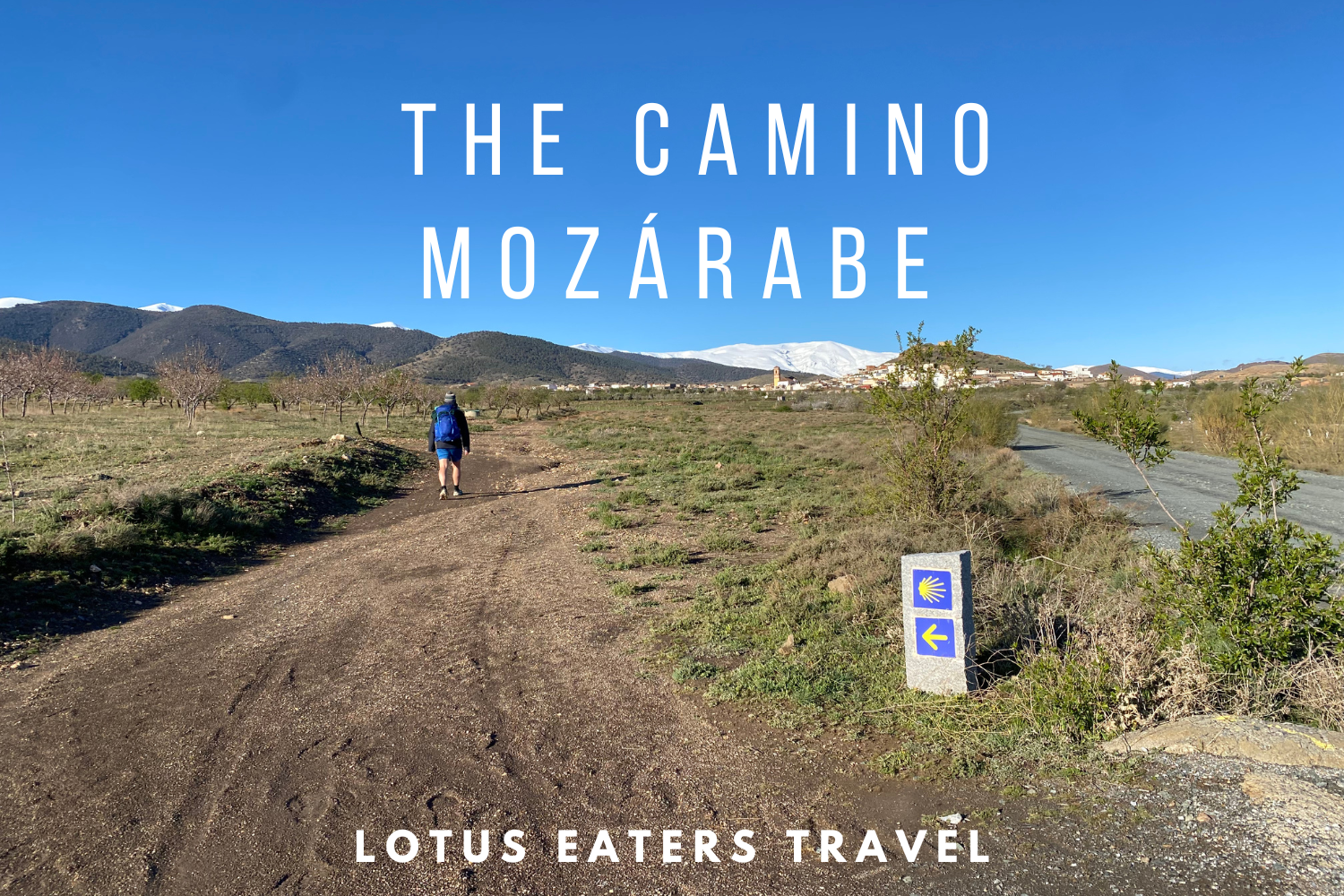
OUR GUIDE TO THE CAMINO MOZARABE ALMERIA TO MERIDA: ALL YOU NEED TO KNOW.
Having been lucky enough to walk the main Camino de Santiago routes in Northern Spain, we were keen to shake things up a little this year and head south. Way south. Specifically, to the Camino Mozarabe route starting in Almeria.
One of the reasons for this, was that we were walking in March and April – and after walking a rather rainy Camino Portuguese route last spring – we thought that Andalusia might bring us better weather. Various unprecedented storms had other ideas – but that story is for another time!
Our main reason for choosing the Camino Mozarabe is that we wanted to discover a new area of Spain. We have both visited Andalusia before and knew that we loved the cities, but it was time to get out and see the more authentic rural side of southern Spain.

We chose to walk from Almeria to Merida – a distance of 618km. Crossing from the palm treed coast of Andalusia, around the mountains of the Sierra Nevada, past Cordoba and all the way to Extremadura.
In this blog post, you can find out everything we learnt about the Camino Mozarabe from Almeria to Merida.


1/ The Camino Mozarabe is in Andalusia and Extremadura

The Camino Mozárabe stretches across two distinct regions of Spain: Andalusia in the south and Extremadura, which lies to the north. This gives pilgrims a diverse experience, from coastal plains to mountain landscapes, historical cities, and rural villages.
Each region offers its own flavour of Spanish culture and history, making it a unique pilgrimage.
2/ There are a few different starting points for the Camino Mozarabe
The Camino Mozarabe can be a little tricky to understand because there are multiple start points.
One route runs from Almeria all the way to Merida – this is the route that we chose. Along this route, pilgrims choose to start and finish at different points. For example, many join in Granada and finish in Cordoba.

A second version of the route begins in Malaga – this route joins the Almeria to Merida stretch at a town called Baena, where it then continues on to Merida. So, when we walked from Almeria to Merida we met pilgrims in Cordoba who had started walking in Malaga and recently joined the same route as us!
Finally, a third version of the route begins int he city of Jaen. This merges with the “main” Mozarabe route in the town of Alcaduete.
3/ From Almeria to Merida is 618km


The route we walked, from Almeria to Merida, is a 618km journey, which took us just over three weeks to complete. While it’s not as long as some other Camino routes, the distance still provides a significant challenge, especially given the varied terrain and climates along the way.
Most walkers will opt for 27 or 28 daily stages, but it is possible to linger longer, or to cover more distance each day. For example, we walked the route in 21 days.
You can find all of our daily stages guides here.
4/ You can continue on the Via del Plata to Santiago de Compostela

The Via de la Plata, which translates to “silver route” runs from Seville in the south of Spain all the way to Santiago de Compostela. The route stretches for 1000km.
Merida is the meeting point for pilgrims walking from Seville towards Santiago on the Plata and for pilgrims completing the Camino Mozarabe. In this sense, Merida feels a little like Santiago, as you see pilgrims arriving into the city from multiple directions.
If you wanted to continue to Santiago, you could join the Via de la Plata seamlessly in Merida.
5/ The Camino Mozarabe is a bit “under the radar”

Compared to the more famous Camino routes in Northern Spain, the Camino Mozárabe is relatively under the radar. This means that the route is quieter, and you’ll often find yourself walking along peaceful stretches with fewer pilgrims. If you’re looking for a more serene and contemplative pilgrimage, this could be the perfect choice.
To give you an idea, in March 2025 178 pilgrims walked the Camino Mozarabe from Almeria. In contrast, the number walking the Camino Frances is probably in the region of 20 to 30,000!!!!
6/ The Camino route is well organized


The Jacobean associations of the Camino Mozarabe have gone to great efforts to ensure that the route is well organized. You can expect good sign posting and a clear path. We were even getting weather warnings direct from the association when we started (and we could not have been more grateful!)
The albergues are well taken care of and the association can provide you with all the information you need to access them. There’s so much love and attention put into caring from the albergues, it really is quite special.
You can find details for the association here. I’d strongly recommend getting in touch with them before you walk. Local volunteers can also arrange pilgrim blessings for your in Almeria before you leave. This was a truly memorable experience for us.
7/ And well sign posted


The Camino Mozarabe uses the same system of signposting as the Camino routes in the north of Spain. Expect to see yellow arrows, stone way markers and even some unique Mozarabe sign posting.
We felt that the sign posting was clear and always useful. Only once did we head the wrong way, but I don’t think the arrows were to blame!
You can also follow along the route on the Buen Camino app. Just remember, you’ll need to download both the routes from Almeria to Granada and the section from Cordoba to Merida if you’re doing the entire 618km.
8/ There are some incredible sections


Throughout the route there were so many moments where to just had to stop and say “wow”. I’m not exaggerating to say there were genuine feelings of awe.
Particular highlights for me were walking into some of the villages in the foothills of the Sierra Nevada – churches and whitewashed buildings with the epic backdrop of snowy mountains. Trails winding through immense olive groves that seemed to go on for miles. Castles set atop hills that conjured up images of a time gone by. And that’s not even to mention visiting The Mezquita in Cordoba.
9/ And some less satisfying stretches
Let’s just be honest about it – on any Camino route, there are going to be less “appealing” sections of the route. Often, it is required to walk on road and you cannot expect 600km of beautiful trail!
That said, we found the last 2 to 3 days into Merida to be a little bleak. There’s a significant amount of road walking, including some stretches that we weren’t totally comfortable with. Whilst it is very special to arrive on foot to Merida, if I were to walk this route again I might consider ending in Medeillin.
You can see our daily stages on YouTube here for a bit more of an insight.
10/ There are many municipal albergues on the way


Whilst it may not be possible to stay in municipal albergues for the entire route, I would estimate that you could manage to do so for around 80% of the daily stages.
Of our 21 daily stages, we chose to stay in albergues for 50% of the time. And on only one occasion we were unable to get beds in the albergues we wanted to stay in.
It’s important to be aware that the albergues don’t tend to be “manned”, bar one or two which have voluntary “hospitalario” (i.e. a friendly host.) Instead, you will normally request keys from a local government office (like the town hall), or be provided with a code to let yourself in.
11/ As well as hotels


We had no issues finding private rooms in hotels along the way. In fact, we stayed entirely in private rooms between Granada and Cordoba!
Generally speaking hotels are basic, often 1 or 2 * set ups. And we tended to pay around €45 for room for two people. We were able to book everything we needed via booking.com too.
12/ The Camino Mozarabe can be less expensive than Caminos in Northern Spain
In general, Southern Spain is less expensive than Northern Spain. Although the margins are small, you’ll find a few price cuts for things like a glass of wine or a meal. For example, we could regularly get a main meal for under €10. And often a glass of wine came in at around €2.
When it comes to food and drink – the big game changer in Southern Spain is that you’ll often get a free tapas with your drink. This takes some getting used to! We were often found asking for menus, only to be told they’d bring us a surprise tapas. Honestly, this was so much fun for us! And we often would be sated by a few tapas and not need to order anything more.
Many of the albergues on the Camino Mozarabe are Donativo – meaning you can donate what you can afford. The recommended rate is €10 per person, or more if food is included.
When it comes to hotels, we found them to be very reasonable priced for the most part – our average spend was €45 for a double room. We paid €99 for one night, but this was in a lovely 3* hotel – so no complaints from us!
13/ You’ll meet pilgrims from around the world
Before we walked the route, we expected that we would meet many Spanish pilgrims (noting that the all routes are of course popular with Spanish walkers!) But, hadn’t quite realised that we would meet such an international crowd.
Along our way we met Norwegian, Dutch, Polish, German, Belgian, French and American walkers. And, in the month that we walked there were also some Korean and Australian pilgrims.
So, I think it’s safe to say that the Camino Mozarabe is attracting an international crowd!
14/ Many are Camino “veterans”

Anecdotally, most of the pilgrims we met were all Camino veterans who had walked at least one route before. Many, like us, had walked multiple Camino routes as well as taken pilgrimages in different European countries.
We did meet one Dutch pilgrim flying the flag for Camino newbies, so it is possible to do this as your first Camino if you wanted to!
15/ The route is accessible to different fitness levels

The route is typically broken down into 28 daily stages of between 20-30km. But there is one day that requires a 35km walk. In this sense, completing the entire route might require a high fitness level, or at least experience of walking long distances.
That said, we met a few walkers who chose to take taxis to cut down distance on longer days. This is always an option if you are faced with a long day that is beyond your fitness reach.
The section from Almeria to Granada offers perhaps the most challenging aspects when it comes to hill climbs and terrain. Whereas the section from Granada to Cordoba has fewer hills.
As always, it’s important to train for your Camino de Santiago route. You can find our advice on training here. And some freebie yoga for hiking videos here on YouTube.
16/ You will walk through some fantastic cities


Along the Camino Mozárabe, you’ll pass through historic cities like Granada, Cordoba, and Merida, each offering its own unique attractions. Granada’s Alhambra, Cordoba’s Mezquita, and Merida’s Roman ruins are just a few of the incredible landmarks you’ll encounter on your journey.
17/ See incredible landscapes and historical sites


Aside from the cities, the route takes you through beautiful rural landscapes, olive groves, rolling hills, and ancient villages. You’ll walk past ancient churches, castles, and other historical sites that offer a glimpse into Spain’s rich history. The combination of natural beauty and historical landmarks makes the Camino Mozárabe a deeply rewarding pilgrimage.
More info on the Camino Mozarabe
For more information on the Camino Mozarabe, you can find the following blog posts:

Camino Mozarabe Guide Book
We also have a comprehensive 160 page guide book for sale in our shop. The book is available in an e-book format, ideal for reading on your phone as you walk.

Written by Emma
Wine Lover. Yogi. Hiker. Writer.


Do you need to book accommodation on the Camino Primitivo?
DO YOU NEED TO BOOK ACCOMMODATION ON THE CAMINO PRIMITIVO? PROS AND CONS. We walked the Camino Primitivo recently and—after much debate—decided to book all of our accommodation ahead of time. While the Primitivo is often described as one of the quieter Camino routes, that reputation is becoming outdated. Throughout the summer we saw frequent…

Taking the ferry from Laredo to Santoña: a short guide
TAKING THE FERRY FROM LAREDO TO SANTONA ON THE CAMINO DEL NORTE: A SHORT GUIDE. Walking the Camino del Norte along Spain’s northern coast brings many unique experiences. For me, one that stands out is the crossing the estuary from Laredo to Santoña by ferry. Despite being a quick journey, it’s a rare chance to…
How to Take the Pilgrim Ferry from Caminha to A Guarda (Camino Portuguese)
HOW TO TAKE THE PILGRIM FERRY FROM CAMINHA TO A GUARDA: A SHORT GUIDE. If you’re walking the Camino Portuguese Coastal Route, sooner or later you’ll reach the Minho River at Caminha and face a simple question: how do I get across to Spain? The answer, for most pilgrims, is the small tidal ferry that…
Most of our planning is done using other blogs, but you can’t beat a guide book at the bottom of your case.
Find them here on Amazon.

USEFUL LINKS FOR FLIGHTS, ACCOMMODATION AND TRANSPORT


CHECK LATEST FLIGHTS
ACTIVITIES TO CONSIDER
FOLLOW US ON SOCIAL MEDIA
Please note that some links on our website are partnered with affiliates. Using an affiliate links does not make it more expensive for you to purchase. We receive a small commission whenever you buy something which in turn allows us to keep writing independent travel guides and your support is greatly appreciated.
3 responses to “The Camino Mozárabe Uncovered: 17 Key Things Every Walker Needs to Know”
[…] you can find and lodging options for the evening. Alongside this, you can find our guide to 17 things you need to know about the Camino Mozarabe and our daily stages playlist on […]
[…] repair, my backpack developed a few more minor issues. Then just as I set out to walk 600km on the Camino Mozarabe this year, the front pouch of my backpack broke. Given that this is where I normally store my water […]
[…] Camino Mozarabe allows you to walk through through some of southern Spain’s most beautiful and lesser-known […]