
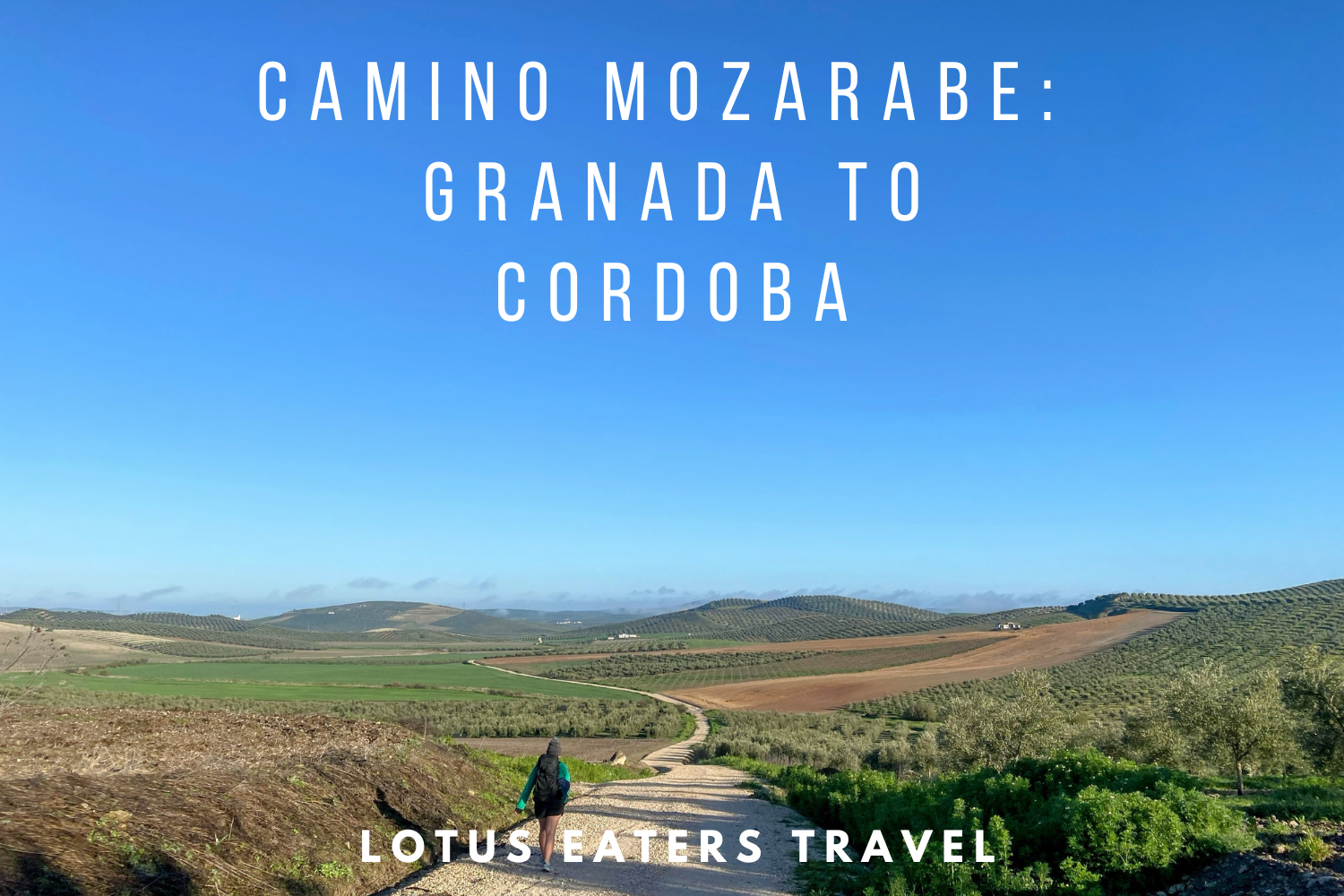
CAMINO MOZARABE: GRANADA TO CORDOBA DAILY STAGES.
I’m not sure that there’s anything that could excite me more than walking between two fantastic Spanish cities, like Granada and Cordoba. When we found out that the Camino Mozarabe allowed us to do just that, we had booked flights within minutes. Indeed, I was mentally packing my trusty backpack before we got our booking confirmation.


The Camino Mozarabe is a 620km long route which forms part of the Camino de Santiago. Starting in Almeria and ending in Merida, where it merges with the Via de la Plata (which leads all the way to SdC). The Mozarabe also offers sections from Malaga and Jaen.
We recently walked the full distance from Almeria to Merida, taking in the highlights of Andalucía and Extremadura.
Whether you’re planning to walk the entire Camino Mozarabe, or stick to the section between Granada and Cordoba, we hope that this blog post enables you to plan your trip. Here you can find details of the daily stages, both the typical ones and the stages walked by the Lotus Eaters Travel team.
What’s the distance between Granada and Cordoba?
The total distance on the Camino Mozarabe between Granada and Cordoba is 173km. That’s roughly 107miles.
How many days does it take to walk the Camino Mozarabe from Granada to Cordoba?
Typically, most walkers will reach Cordoba seven days after leaving Granada. We chose to walk in six days, purely because we wanted to carve out a rest day in Cordoba. And the best way to do this was to walk two stages in one day on our last day into the city.
It is also possible to walk in eight days, splitting the long stage between Granada and Moclin into two.
Typical daily stages for the Camino Mozarabe from Granada to Cordoba
The following are the “typical” stages from Granda to Cordoba. This allows for seven days of walking and takes into account accommodation options:
- Day 1: Granda to Moclin – 33km (it’s also possible to stay in Pinos Puente at 19km)
- Day 2: Moclin to Alacla La Real 22.5km
- Day 3: Alcala La Real to Alcaduete 23km
- Day 4: Alcaduete to Baena 25km
- Day 5: Baena to Castro del Rio 20.5km
- Day 6: Castro del Rio to Santa Cruz 22km
- Day 7: Santa Cruz to Cordoba 25.5km
Our daily stages from Granada to Cordoba
We chose to walk some of the “typical” stages as well as changing things up a little to suit us.
Firstly, we wanted to walk in six days so that we could have a spare day to rest and explore in Cordoba. This meant that we needed to walk a couple of longer days to cover the distance.
Secondly, we really wanted to stay in Espejo and not in Santa Cruz or Castro del Rio. In all honestly, Santa Cruz didn’t appeal – accommodation is private only and the town sits alongside a busy road. Espejo was much more attractive to us and offers a choice between an albergue and private rooms.
With that in mind, we were able to create an itinerary to suit us and our fitness levels, to reach Cordoba in six days. This plan was almost scuppered when we encountered a flooded riverbed on our last day – more on that in our daily stages below.
Day 1: Granada to Moclin
Key Details: Distance 33km, ascent 700m, descent 350m.
ROUTE


Many walkers will choose to split this section into two, opting to stay in Pinos Puente. We tend to prefer to cover distances of more than 20km, so opted to continue to Moclin.
British readers may have seen Moclin in the recent BBC TV show – Alan and Amanda’s Spanish job, in which Alan Carr and Amanda Holden “do up” a house in the centre of town. We were particularly excited to visit having watched the show!
The route out of Granada is easy, urban and flat. It takes you out of the city towards the town of Maracena, into some park land and then onto a fairly straight and uninteresting road which eventually crosses over the motorway. A highlight of the morning is the views to the Sierra Nevada from Granada. The town of Atarfe is also a welcome break. But the road after this is more mundane with a straight industrial road, leading all the way to Pinos Puente.
After this, there are sections on a quiet road, as well as some footpaths running parallel to the road. The few kms of trail leading to Olivares is very pleasant, taking in olive groves and lovely scenery. Olivares is a pleasant village with a friendly bar, we wanted to stay for hours soaking in the atmosphere.
The tough bit of the day is right at the end – 3km of near constant climbing into Moclin. Probably one of the most challenging sections, but rewarding for the vistas. Moclin Castle towers over the pretty village, when you do eventually reach it.
AMENITIES
- The route leads of the city of Granada, presenting lots of options for coffee and breakfast on the way out of town so you don’t need to worry too much about finding somewhere in particular.
- Maracena – a town outside Granada has shops/ cafes – 5.5km in
- Atarfe – large town with lots of options for refreshment – 11km in
- Pinos Puente – cafes and restaurants, bakery (morning only), this town has a pilgrims hotel too, so you can split this day into two sections – 19km in
- Olivares – a lovely bar just before Moclin – just keep in mind that the last stretch into Moclin is tough, so don’t get too relaxed here! 29km in.
- Moclin – the town has a bar and a tiny shop, but look out for opening hours, the bar shuts at 16:00 outside of summer. We took takeout food from the bar in Olivares.
ACCOMMODATION
Moclin has one albergue (Albergue-Casa rural La Fundación) and a handful of private room options. It is best to book in advance as Moclin is popular with walkers, not just those on the Camino.
We stayed at Casa Maria, a private room in a local house. The room was and Maria very friendly. A good value double room in the heart of the town.
Day 2: Moclin to Alcalá la Real
Key Details: Distance 22.5km, ascent 500m, descent 600m.
ROUTE


If you found the previous day of walking tough, this day will be much easier by comparison. A short day, with lots of downhill out of Moclin to be enjoyed. That said, there are a few steep sections – including one to Ermita Nueva. For me, this went by in a blur because I was so excited to reach the village cafe and grab a coffee!
For us, this was the first time on our Camino Mozarabe that we really saw other walkers. The stage from Granada to Cordoba is perhaps one of the most popular legs, especially with Spanish pilgrims.
The route today also leaves Granada and enters the province of Jaen. Marked by an increase in more sightings of olive trees. Jaen, of course, being famous for olive oil.
The route involves some trail and some road walking, one stretch of which (just before crossing into Jaen) is not particularly pleasant, but only lasts a km or so. The scenery is generally pretty and paths quick under foot. A highlight for us was seeing asparagus growing and later seeing the imposing fortress of the town as we arrived.
AMENITIES
- The bar in Moclin opens early for breakfast
- Ermita Nueva – one bar/ cafe, which serves lovely breakfast (second breakfast!) – 12.5km in
- Alcala la Real – there are lots of bars, restaurants and shops in town, everything you need.
ACCOMMODATION
Alcalá la Real does not have a municipal albergue, but you can find a pension designed for pilgrims (Casa Marisa Pilgrims Hostel) as well as two hotels that are available to book on booking.com.
We stayed at Hostel Rio de Oro, which is a 1 star hotel. The rooms are basic, but clean and comfortable. A second option is Hotel Torrepalma, which at time of writing doesn’t have the best reviews.
Day 3: Alcalá la Real to Alcaduete
Key Details: Distance 23km, ascent 400m, descent 650m.
ROUTE


A steady and straightforward day of walking, that for us seemed to go very quickly. Lots of lovely trail running through olive groves. There are a few ups and downs – ascent of 400ms in total – but nothing feels too steep throughout the day.
The entrance to Alcaduete takes you through a lovely park and into the city. A highlight for us was finding the Kiosk Bar at the edge of the park, where locals gather in early evening.
It is possible to visit the imposing castle of Alcaduete if you arrive before 17:00.
AMENITIES
- Alcala la Real – plenty of cafes in town as you leave in the morning, as well as shops.
- Ventas del Carrizal – there is a cafe, which could be pleasant, but we found it expensive and a little grubby when we visited – 12km in
ACCOMMODATION
Alcaduete does not have a municipal albergue. Instead, there are two hotel rooms offering private rooms.
We stayed at Hidalgo, a restaurant and hotel. When we visited the restaurant didn’t appear to open. But rooms were fine, albeit a little expensive for what they are (in our opinion).
A second option is Pension Spa Rueda – I’m not too sure why it is called “spa” as it doesn’t have one. But nonetheless, it’s an option.
Day 4: Alcaduete to Baena
Key Details: Distance 25km, ascent 400m, descent 650m.
ROUTE


The route today is pretty and mostly easy-going. A highlight is the trail leading away from the town, with the castle behind you. Quite mystical first thing in the morning as the sun comes up.
We were pleasantly surprised to find more of the route on trail than we had anticipated. The route we followed (sign posted by arrows) differed somewhat to the Buen Camino App map. But this meant that we enjoyed more trail through olive groves than road.
Baena is a great town, lots of fun with a buzz of bars and restaurants. It is quite noticeable that the town’s main economy is olive oil – you can actually smell olives as you enter the town and around the area. It is very alluring!
AMENITIES
There are no amenities on route between Alcaduete and Baena. It’s best to take some refreshments with you, and grab breakfast in Alcaduete.
ACCOMMODATION
As with the previous towns, Baena does not have a municipal albergue.
The most popular choice with pilgrims tends to be Guesthouse Jaszmines Mozrabes. This is a private house turned into an albergue – we booked the private room via booking.com. But if you contact the albergue directly, you can book a bed in the shared rooms (€30). Rates include breakfast, but honestly it was a bit basic. That said, the building and host are lovely.
Baena also has a few good value apartments, it may be worth considering these if you have someone to share with. Getting a two bed apartment between four of you may be cheaper than the albergue.
Day 5: Baena to Espejo
Key Details: Distance 30km, ascent 450m, descent 450m.
ROUTE


You will exit Baena via a quiet road, before finding a trail. Once again, you’ll pass through olive groves. Much of which were water-logged when we walked, due to recent rain.
Castro del Rio is the first town that you will reach after 20km. A long road leads into the town, with not much room for walkers. Luckily it is a slow and quiet road. I remember being almost serenaded by dogs, barking from behind fences as I walked for a few kms on this road.
After this point, we were unable to follow the normal route which leads through olive groves. The low lying land near to the Guadajoz river had become flooded. So we were forced to follow the N-342 road. Not a particularly charming route, especially in the rain!
Espejo itself is a wonderful town, well worth a look around if you have time and energy. It would be remiss of us not to take the time to recommend Bar Mario, which offers excellent food and warm service in the town.
AMENITIES
- Baena offers supermarkets and cafes for breakfast and refreshments before you leave town.
- Castro del Rio – cafes and shops as well as albergue (many choose to stay here) – 20km in
ACCOMMODATION
In Espejo, there are two accommodation choicse.
There is a municipal albergue with four beds. Whilst this doesn’t sound like many, keep in mind that most pilgrims will stay in the town before Espejo (Castro del Rio).
Secondly, there is a lovely hotel in town, Casa Almara. The hotel is simply gorgeous and oh so comfortable. I think we had one of our best ever Camino sleeps here.
Day 6: Espejo to Cordoba
Key Details: Distance 39km, ascent 600m, descent 900m.
Arriving in Cordoba today? You might want to read our guide on the best things to do in one day in Cordoba.
ROUTE


Seeing that the route was mostly downhill today, we decided to gives ourselves a long day into Cordoba. The hope was that we could take a rest day the next day and explore the city. A always on the Camino, sometimes the best laid plans can go array.
The first section of the route is very lovely, a downhill trail leads out of Espejo, passing an old Roman bridge. On a dry day, with no previous rain, this route would be easy – but on the day we walked, the ground was waterlogged making farm tracks barely passable.
The real challenge for us, was meeting a river crossing a few kms prior to Santa Cruz. The river bed tends to be dry for most of the year, or offer a shallow crossing.
Due to rain, we found a gushing river that we didn’t think would be safe to cross. If it were just a little flooded, we would have done a “shoes off” crossing, but it was flowing very quickly and seemed unsafe. Hence, we were forced to backtrack and take a track to meet the N-342 once again. Other pilgrims chose to take this road all the way from Espejo. And this could be an option if it has rained heavily.
If you would rather avoid too much road, take the normal Camino route out of Espejo until you meet this track (google map coords) then cut towards the N road where there is a bridge to cross the river. This way avoids the floodable ford.
At Santa Cruz, there are options for refreshment before continuing to Cordoba. Here, once again, we were forced by rain to take the N road. I would not recommend doing this – if you find the normal route to be an issue, then take a bus to Cordoba! The ordinary route should pass pleasant, if not a little unsatisfying trail.
The real reward is of course arriving to Cordoba via the Roman Bridge. It had a feeling a lot like arriving to Santiago de Compostela.


AMENITIES
- Espejo has bars and cafes to dine at before leaving in the morning
- Santa Cruz – café and bakery as well as private accommodation for anyone splitting this day into two – 13.5km in
ACCOMMODATION
We were pleasantly surprised by how much accommodation is available in Cordoba old town for a good price. If you are after an inexpensive double room – consider Hotel Maestre or Hotel de Los Faroles. There are quite a number of hotels in this area that will work well for walkers.
If your Camino ends in Cordoba, or you want a little luxury to break up the journey – consider staying somewhere like boutique hotel Eurostars Conquistador.
More info on the Camino Mozarabe
For more information on the Camino Mozarabe, you can find the following blog posts:

Camino Mozarabe Guide Book
We also have a comprehensive 160 page guide book for sale in our shop. The book is available in an e-book format, ideal for reading on your phone as you walk.


Would you like us to plan your walk for you?
Embark on a journey of a lifetime with Lotus Eaters Travel Planning, where we turn your dream of long-distance walking into a meticulously planned reality.
Our passion for exploration, love for diverse cultures, and commitment to providing an unparalleled experience drive us to offer personalized consultation services for some of the world’s most iconic walking trails
Written by Emma
Wine Lover. Yogi. Hiker. Writer.


18 best long distance hikes in Europe for June
18 BEST LONG DISTANCE HIKES IN EUROPE FOR JUNE. June is one of the very best months for hiking in Europe. Summer has arrived, the days are long, and most trails are finally free of winter snow. But, if you head out for a long distance hike in Europe, you’ll be beating the crowds of…

Do you need to book accommodation on the Camino Primitivo?
DO YOU NEED TO BOOK ACCOMMODATION ON THE CAMINO PRIMITIVO? PROS AND CONS. We walked the Camino Primitivo recently and after much debate, decided to book all of our accommodation ahead of time. While the Primitivo is often described as one of the quieter Camino routes, that reputation is becoming outdated. Throughout the summer we…
Taking the ferry from Laredo to Santoña: a short guide
TAKING THE FERRY FROM LAREDO TO SANTONA ON THE CAMINO DEL NORTE: A SHORT GUIDE. Walking the Camino del Norte along Spain’s northern coast brings many unique experiences. For me, one that stands out is the crossing the estuary from Laredo to Santoña by ferry. Despite being a quick journey, it’s a rare chance to…
Most of our planning is done using other blogs, but you can’t beat a guide book at the bottom of your case.
Find them here on Amazon.

USEFUL LINKS FOR FLIGHTS, ACCOMMODATION AND TRANSPORT


CHECK LATEST FLIGHTS
ACTIVITIES TO CONSIDER
FOLLOW US ON SOCIAL MEDIA
Please note that some links on our website are partnered with affiliates. Using an affiliate links does not make it more expensive for you to purchase. We receive a small commission whenever you buy something which in turn allows us to keep writing independent travel guides and your support is greatly appreciated.