
LAUGAVEGUR TRAIL SELF GUIDED: FAQs.
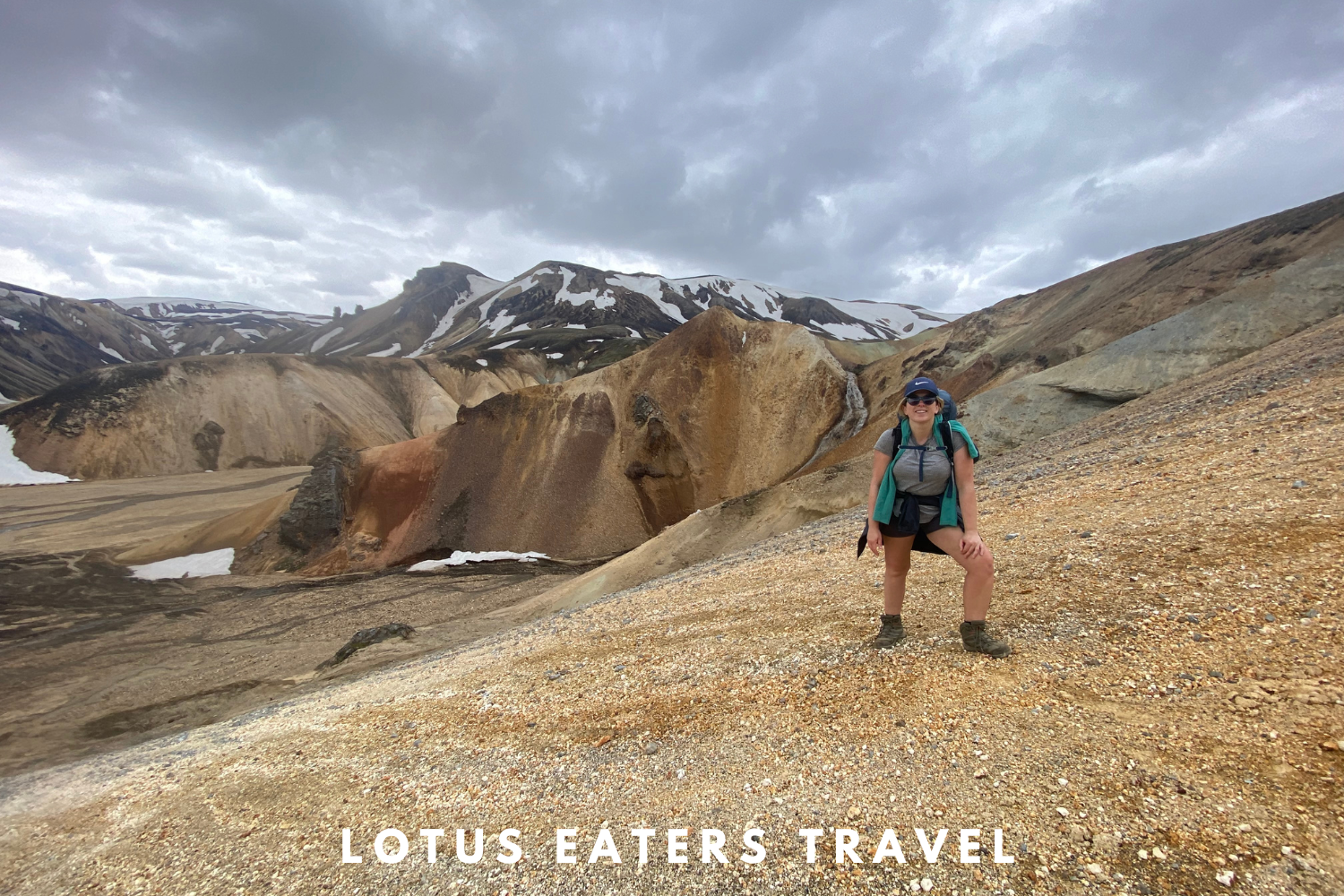
Planning to hike Iceland’s most iconic long-distance trail on your own? Fear not. Every summer, thousands of hikers set off to tackle the 55km Laugavegur Trail, weaving through rainbow-coloured mountains, black sand deserts, and verdant valleys, without a guide. And yes, it’s absolutely possible to do it self-guided.
But should you?
This blog post is packed with practical FAQs to help you decide if a self-guided Laugavegur trek is right for you.
Can you walk the Laugavegur without a guide?

In short, yes you can walk the Laugavegur trail without a guide. The logistics of the trail are actually very straightforward, and as long as you are willing to carry your own equipment and supplies, you really don’t need a guide.
It’s entirely possible to navigate the trail with the help of trail markings and a GPS app. If you put the time and effort into planning your accommodation, packing well and training, the route is accessible for experienced hikers.
Should you consider taking a tour?

That said, there are a few reasons why you might want to consider a tour.
Firstly, for anyone experiencing their first long-distance hiking trail, a tour with a guide may be a better option. The reason for this is that the Laugavegur is a challenging hike – it requires a good level of fitness, surefootedness and tenacity.
The extra challenge is that you need to carry food for the entire route. Plus, the route takes you up to high levels of altitude, where the weather can be challenging. This is not to say that a first-time trail hiker couldn’t do it solo- but it requires careful preparation to make sure you have a safe and enjoyable experience.
The second reason someone might want to consider a tour rather than walking self-guided, is for the social experience. A tour group gives you a ready made group of friends to chat to on the trails and in the evening.
Finally, a tour may be the best experience for you if you want a little luxury. Booking a tour means you get luggage transfer included, which I have no doubt would make the hike an easier pill to swallow. You’ll stay in huts along the way and enjoy far better food that anyone self-guided could. Whilst we were surviving on trek meals and protein shakes, hikers on tours were enjoying nightly BBQs and beers!
It really depends on what kind of experience you hope to get from walking the Laugavegur. Challenge v Comfort. Independent v Social.
Safety on the trek

Despite its remote setting, the Laugavegur Trail is well-marked and fairly well-travelled during the summer months. That said, you are walking through the Icelandic Highlands, an unpredictable and often harsh environment. Weather can shift dramatically in a matter of minutes, and even in July, you might be caught in snow, sleet, or strong winds.
The biggest safety risk on the trail is the weather. Always check the Vedur.is forecast before setting off and be prepared to delay your plans if conditions are dangerous. The huts along the route are safe refuges if needed, and the rangers are incredibly helpful. You can ask them for advice on weather too.
The trail itself doesn’t involve any technical climbing, but there are steep sections, river crossings, and long stretches with no shelter. I’d recommend bringing a GPS map (I used AllTrails) and downloading everything offline. Mobile signal is patchy, so don’t rely on it.
For more safety advice specific to Iceland, Safetravel.is is an excellent resource.
Safety as a solo traveller
We walked as a duo so I can’t fully comment on walking the trail as a solo person. That said, we did meet many trekkers walking solo – male and female. A few were carrying GPS devices for extra safety. The less confident solo trekkers were able to tag onto groups or buddy up as required.
How difficult is the Laugavegur trail?

In short, yes, it’s “quite tricky”. But the long answer is a bit more nuanced.
If walking in summer, you don’t need mountaineering experience, or technical equipment like crampons (although I did meet one hiker who packed them.) There’s no climbing or serious scrambling. And, at 55km, the trail is manageable in four days for those with good fitness levels.
That said, there are challenging aspects. As follows:
- The weather – wind, rain, sun, snow. It can all happen in one day. At the highest point of the route in Hrafntinnusker, fog is common and this can make visibility an issue. It’s not unusual to lose the trail markings in this area.
- Some tricky terrain – expect steep ascents and descents, loose ground and ridge walking. Surefootedness and hiking confidence is required. As well as good footwear.
- River crossings – there are six river crossings on the Laugavegur trail. If you’re not experienced with crossings, it can feel little daunting. The water is seriously cold, but that aside, we did find the crossings manageable. Water shoes and trousers you can roll up above your knees are recommended.
- Bridges – I don’t know why, but nobody talks about the two bridge crossings on the last day into Þórsmörk. Anyone with vertigo is not going to be a fan!
- Snow on the ground – even into summer, there can still be snow on the ground at the higher altitudes of the Laugavavegur trail.
- Hill climbing – the total elevation gain on the Laugavegur is around 2,000m (6,600ft) over the course of 55km. And, a large chunk of that elevation gain is on day one, when you will climb almost all day to an altitude of 1,100m.
- Carrying your supplies – you can buy some limited supplies at ranger stations on the way (not modestly priced.) But, in general, hikers will carry their own supplies for the route. Planning food for four days is a logistical obstacle, plus the weight of carrying supplies is a challenge. Luckily – the bag gets lighter every day!
Tip – pack a few small treats, like hot chocolate sachets or some sweets you can share with others. Even over four days, you will want something to perk you up.
How long is the trail?

The Laugavegur trail is 55km or 34 miles.
How many days does it take to walk the Laugavegur trail?

The Laugavegur trail can be walked in three to five days. Most walkers choose three or four, but there is an option to walk in five if you stayed at every hut/ campsite along the way.
It’s worth adding that walking in three days is challenging and only recommended for experienced hikers.
We chose to walk in four days, because we honestly didn’t see the point in rushing the experience.

The trail is marked by a series of sticks/ stakes in the ground painted with blue and red markings. Honestly, these are really great and you can more or less follow them the entire time.
That said, I would always want an offline GPS app with a clear map when walking the Laugavegur. This is particularly important at high altitude on the first and second day because the area is prone to fog. Having a GPS map helps to keep you on track at all times. I met hikers who had got lost in this area because they didn’t have a map.
We recommend All Trails – the offline version is ideal for remote treks.
Best time of year to walk the Laugavegur trail

The Laugavegur trail can be walked between June and September. That’s the short answer!
But, there’s some important nuance to consider.
Firstly, the season is different every year. Access to the Laugavegur trail is dependent on the Highland Roads opening and buses operating. Huts won’t open until roads open, for obvious reasons! In general, it’s safe to assume that the entire thing will be accessible and open from the 25th June each year. But sometimes it’s possible to start earlier (we started on the 17th June this year.)
Secondly, if you do plan to walk in early to mid June, keep in mind that some facilities will not yet be open. For example, the Mountain Mall opened on the 22nd of June this year, so when we were in Landmannalaugar, it was not yet open. Ditto the restaurant in Álftavatn.
We’ve written a detailed guide about what to expect if you walk in June – here.
Finally, if you walk mid-late July and through August, expect the trail to be much busier than in June or September. Whilst this is the best time for weather, you have to compromise a little with regards to peace and tranquillity on route.
Don’t forget – the “good weather” is never guaranteed in Iceland. You can have snow in summer. And you should always expect and plan for high winds and some rain.
How busy is the Laugavegur trail

The Laugavegur is Iceland’s most popular long-distance hiking trail. And, it’s fair to say that it is known to be one of the best hikes in the world. People travel from the US, Australia, China and all corners of Europe to walk the Laugavegur.
What to pack for the Laugavegur?
Packing is a really key part of the Laugavegur trail preparation. It’s crucial to have the right gear for trekking in Iceland, where the weather and conditions can be demanding.
We’ve written a full guide to packing for the Laugavegur based on our experience here.
Huts on the Laugavegur


In total, there are eight huts on the Laugavegur, including one in Landmannalaugar (the start for most trekkers) and three in Þórsmörk (the end.) The majority are operated by Ferðafélag Íslands, the Iceland Touring Association, (FÍ). Most cost In total, there are eight huts on the Laugavegur, including one in Landmannalaugar (the start for most trekkers) and three in Þórsmörk (the end.) The majority are operated by Ferðafélag Íslands, the Iceland Touring Association, (FÍ).
A bed in the huts will cost 15,800 kr per person (£95 at time of writing.) And, for peak season, it’s best to book ahead.
Huts vary when it comes to facilities and comfort levels. We stayed at one hut, Hrafntinnusker, and were quickly informed by other trekkers that this was the “worst hut” of the lot. Personally, I thought it was quite luxy!
All huts have running water (except Hrafntinnusker when we visited because the pipes had frozen), some form of heating and toilets. There are also showers available at all the huts (except Hrafntinnusker), for the price of 1000 ISK (£6 at time of writing.)
Huts have small kitchens, with kitchenware, which is quite handy. All beds are bunk beds, the bottom bed is a double and the top a single. In theory, you could have to share the double with a stranger. John and I shared the bottom double bunk, and I must say it was quite a squeeze.
You can find the full details about the huts and booking options on the FI website.
Tip – huts DO NOT have WiFi or charging points. And some don’t have phone signal. We had Airalo Iceland e-SIMs and found we had signal at points on the trail but not at huts (with the exception of Landmannalaugar and Þórsmörk.)
Camping on the Laugavegur


It’s completely possible to camp along the Laugavegur, many trekkers choose to do this rather than stay in the expensive huts.
You can find our full guide to camping on the Laugavegur here.
North or South or South to North
Walkers can choose to walk in either direction, either from North to South (Landmannalaugar to Thórsmörk), or South to North.
The vast majority of walkers that we met chose to walk North to South. In fact, this is the direction that Ferðafélag Íslands, the Iceland Touring Association, (FÍ) encourages, in order to manage walking traffic.
Having walked North to South, this is the direction that we would recommend. GPS maps are set up to walk this way, plus it’s easier to socialise on route if you walk the same was as most of the trekkers on route.
Toilets and hygiene
Iceland’s wilderness is pristine, and the authorities are understandably serious about keeping it that way. Each official hut and campsite along the Laugavegur has toilet facilities, some more basic than others. These are your best bet.
There are long stretches without facilities, so if you need to go en route, be discreet, stay well off the trail, and follow Leave No Trace principles.
For hygiene purposes, we carried wet wipes and hand sanitizer. Beyond that, toilets all have soap or sanitizer. And you can pay to use a shower at most huts (1000 kr).
Drinking water
Iceland’s water is some of the cleanest in the world. On the Laugavegur, you can safely drink from most natural streams and rivers, especially those near snowmelt or glacial sources (if you’re unsure, use water purification).
That said, we would set out for the day with 2 litres of water each, which meant that we didn’t have to top up before arriving at the huts.
Money & payments
The huts and campsites accept card payments for everything – overnight stays, snacks, showers, and even beer if they have it.
That said, don’t rely on signal or phone banking on the trail – if you use a money card, make sure your card is topped up before arriving to the hut! We very nearly came a cropper from this.
Getting to Landmannalaugar


Landmannalaugar is in the Highlands of Iceland and it requires a bit of planning to get there.
The easiest way to get there is to take one of the Highland Bus routes, operated throughout summer months once the F-Roads have opened for the season. The two most commonly used operators are Reykjavik Excursions and Trex.
Buses leave from Reykjavik and take around 5 hours. This time normally includes a convenient stop at Hella services, where you can buy camping gas and snacks.
We used Reykjavik Excursions and paid £75 (12,000kr) one way per person. The service is great, especially as it can include a transfer from Reykjavik Eco Campsite, where many trekkers stay.
Tip – if you travel at the start of the season, your ticket will be contingent on the Highland Roads opening. In our experience, Reykjavik Excursions offered buses earlier in the season (14 June this year) compared to Trex (22 June.)
Leaving from
Thórsmörk/ Þórsmörk
Getting out of Thórsmörk is a bit of an adventure as it requires multiple river crossings. Luckily, the Highland Buses are equipped to do this.
You can book buses with Reykjavik Excursions, Trex and South Coast Adventures. Expect to pay around 12,000kr (around £75) with Reykjavik Excursions or more with Trex (13,900kr).
Buses can take you all the way back to Reykjavik or you can stop at Selfoss. A few services can also take you to Skogar.
Trex also offer a hikers bus pass for 25,900 kr. If i’m totally honest, I’m not sure this offers the best value as it’s actually cheaper to book two tickets with Reykjavik Excursions.
Extending the Laugavegur trail


Any loyal readers will know that we love a long-distance trail, so we were really keen to explore how we could extend our Laugavegur experience beyond four days.
Luckily, it’s entirely possible to create your very own long distance trail in Iceland, centred around the Laugavegur. The trail can be extended in two directions to create a nine day walking trail.
We’ve written a full blog post here, setting out how to extend the Laugavegur trail.
Laugavegur Guide Book
Looking for a little more information? You can find our ebook in our shop. It includes 60+ pages of useful information about planning and preparing for the trail. As well as daily stages and route guides. The book also sets out how you can extend the Laugavegur to create a 9 day trek in Iceland’s Highlands.

Written by Emma
Wine Lover. Yogi. Hiker. Writer.


Laugavegur Trail in June: what to expect
LAUGAVEGUR TRAIL IN JUNE: WHAT TO EXPECT. When we were planning our trip to Iceland, we knew two things: we wanted to go in summer, and we wanted to spend about a month exploring the country. The plan was to complete a few long-distance hikes back-to-back – a full immersion in Iceland’s wild landscapes. When…

Food on the Laugavegur Trail: What to Expect (and What to Pack)
FOOD ON THE LAUGAVEGUR TRAIL: WHAT TO EXPECT & WHAT TO PACK. Hiking through Iceland’s highlands is unforgettable -steaming valleys, colourful rhyolite mountains, and snow-capped peaks everywhere you look. But it doesn’t take long before one thing starts to dominate your thoughts: food. Before tackling the Laugavegur Trail, we spent ages figuring out what to…
Our 5 Day Itinerary for Iceland’s Westfjords (2WD Friendly)
OUR 5 DAY ITINERARY FOR ICELAND’S WESTFJORDS (2WD FRIENDLY.) When we decided to travel to Iceland, we knew that we wouldn’t want to do the typical ring road. With ten days to spare, we decided to do something a little different instead – and headed to the far flung region of the Westfjords. And when…
USEFUL LINKS FOR FLIGHTS, ACCOMMODATION AND TRANSPORT


CHECK LATEST FLIGHTS
ACTIVITIES TO CONSIDER
FOLLOW US ON SOCIAL MEDIA
Please note that some links on our website are partnered with affiliates. Using an affiliate links does not make it more expensive for you to purchase. We receive a small commission whenever you buy something which in turn allows us to keep writing independent travel guides and your support is greatly appreciated.