
11 THINGS NOT TO MISS IN LUGO, GALICIA.
When I first entered the city walls of Lugo, I must have looked so excited, as a busy-looking local stopped to ask if I wanted a picture. I’ve never been able to hide my feelings from my face, and at that moment I must have been glowing with delight.
I hadn’t expected to love Lugo as much as I did. Galicia has plenty of well-known cities, Santiago de Compostela, A Coruña, and Ourense, each with its own character. But Lugo felt different. It doesn’t try too hard to impress, and yet it completely wins you over. It’s compact, charming, and quietly confident in its identity.
In this blog post, we will cover whether Lugo is worth visiting and why and the best things to do when you get there.
Is Lugo worth visiting?


Lugo might not appear on every Spanish itinerary, but that’s precisely what makes it so special. It’s one of those rare cities that still feels truly local.
The city’s biggest claim to fame is its incredible Roman wall, which completely encircles the historic centre and is still fully walkable today.
It’s also wonderfully compact. Everything worth seeing sits neatly within the walls: the cathedral, museums, bustling squares, and plenty of bars serving generous plates of tapas (often free with your drink).
There’s enough to fill a day or two, yet not so much that you’ll feel rushed or overwhelmed.
11 things to not to miss in Lugo
When visiting Lugo, here are 11 things I recommend not missing.
1/ Tour the cathedral


Lugo’s Cathedral of Santa María occupies a large centra location, making it a bit of a star of the city. Much like when visiting Santiago, you can use the cathedral to navigate your way around.
For pilgrims on the Camino, the cathedral is a special place where you can visit to get a sello for your credential. But, it’s still very much worth visiting. Entrance costs €7, but you could easily spend an hour or so there. Tickets include access to the museum upstairs.
Tip – pilgrims can get entry tickets for €5.
2/ Visit the Lugo museum


The Lugo museum is free to visit and honestly, I spent at least two hours there. I hadn’t expected it to be so big, or quite so interesting. Downstairs is the archaeological section, including a huge area of mosaic. A lovely spot to sit and enjoy the peace and quiet.
Upstairs you’ll find art and ceramics. I loved seeing art depicting Galician places that I’d visited on the Camino – as well as a few paintings of Santiago de Compostela.
3/ Lunch at the market

There are two great indoor markets in the heart of Lugo and they are found opposite one another (how handy.) The Mercardo Municipal Quiroga Ballesteros has a number of food stalls where you can purchase all sorts of delights – like hot grilled meats or churros. Small tables offer the chance to sit down and enjoy whatever you buy.
The market opposite Praza de Abastos is great if you want to grab some fresh fruit or cooking ingredients. But there’s also a section downstairs to eat in.
4/ Coffee culture

Any visit to a Galician city is not complete without savouring at least one cup of coffee.
For a local experience, try La Oficina Café – ideal for early morning buzz. And coffee comes with a free tostada (I know!) Breoghan is another traditional spot. Or, La Cosechera GALLERY is a little more modern.
5/ Walk the city walls

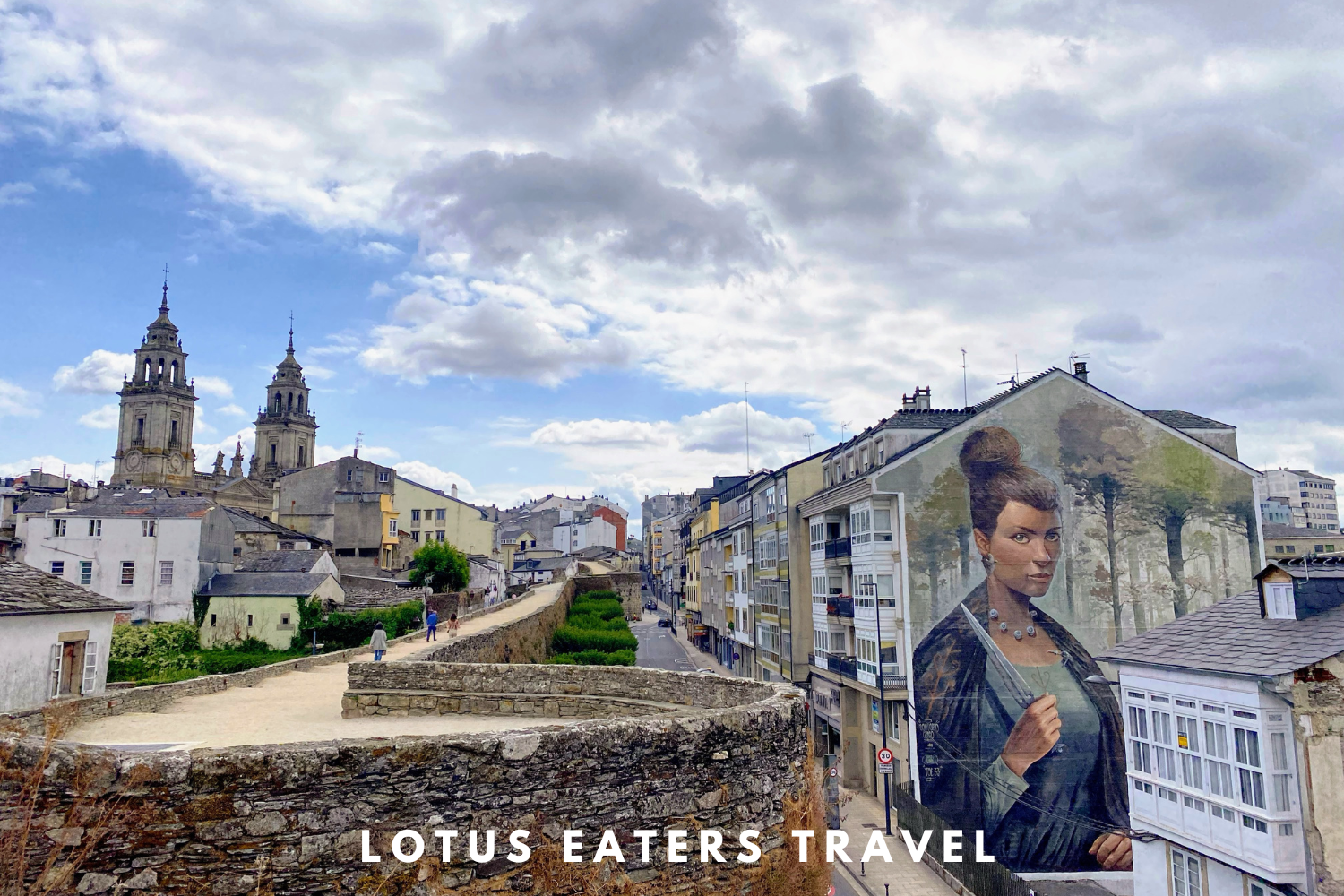
Walking Lugo’s Roman walls is one of my favourite things to do in the city. The 2-kilometre loop gives views over terracotta rooftops, glimpses of street art and the modern city beyond.
Navigating the city wall is a great way to see the city – you can come down at frequent points, explore a little, then head back up.
6/ Pause in a plaza


The main square is Praza Maior, and this is great if you want a buzzy and lively atmosphere with some good people watching. The centre of the square contains a small square and one side is lined with restaurants and bars (a bit hit and miss for quality.)
My preferred plaza (or praza) in Lugo is Praza Soldade (meaning loneliness or a variation of) is a much quieter place (as the name would suggest) away from tourist crowds. It’s a shady terrace with one or two cafes spilling onto it.
7/ See street art


I found bursts of colour tucked between old stone buildings. Lugo’s street art celebrates Galician culture, music, and myths, and I enjoyed wandering the streets trying to spot as many murals as I could.
8/ Embrace tapas culture


As with any city in Spain, evenings in Lugo are all about tapas culture. But, what sets a night out in Lugo apart? Free tapas!
From about 8pm, you can crawl slowly through the tightly packed streets around Praza do Campo. At each bar, grab a drink and you’ll get a bite to eat with it, completely free.
We loved Beira Taperia and Bodegas do San Vicente, but there are no real bad choices in this area.
9/ Browse artisan stores

One of the things that first struck me about the old city of Lugo, is how pretty each shop front looks. I’ve noticed this in Galician cities before – somehow even a hat shop can look beautifully curated.
Whether you’re looking for jewellery, clothing or some sassy stationery, I guarantee there is a to satisfy your cravings in Lugo.
10/ Notice the Galician architecture

As Lugo is so walkable, it’s really enjoyable just to stroll and take in the noticeable Galician architecture. Remember to always look up to notice facades and wooden balconies around you.
11/ Take a day trip to the coast
If you’re visiting Lugo for more than a few days, you may wish to take a day trip out to the coast. The coastal city of A Coruña is less than a 90 minute train ride away.
Alternatively, you can reach the quieter beach town of Ribadeo, or the quaint beaches of Tapia de Casariego with an organised tour (or of course a hire car.)
How to get to Lugo

Getting to Lugo is easier than I expected. The city doesn’t have its own airport, but it’s well connected by road and rail to the rest of Galicia.
The nearest airports are Santiago de Compostela (SCQ) and A Coruña (LCG) – both around two hours away by train or bus.
There are direct trains to Lugo from Ourense, Monforte de Lemos, and Madrid, although the journey from Madrid is long (around seven hours).
And, of course, if you’re walking the Camino Primitivo, you’ll arrive in the best way possible: through the ancient Roman gates, straight into the heart of the old town. It’s an entrance you won’t forget.
Where to stay in Lugo


Aim to stay within the city walls where possible. Here are a few suggestions.
BUDGET: We stayed at Hostel Porton, a hostel which offers shared or private rooms. It’s a great space with a huge bar.
MID-RANGE: Sercotel EsteOeste is a pretty hotel in the heart of the old city walls. Guests love the value for money and quality of rooms.
Written by Emma
Wine Lover. Yogi. Hiker. Writer.


13 of the best places to visit in Galicia
13 OF THE BEST PLACES TO VISIT IN GALICIA. After walking the Camino through Galicia several times, we’ve spent a fair amount of time getting to know this quiet, green corner of Spain. Each visit, we’ve found somewhere new to love. If you’re planning a trip to Galicia, or maybe you’re finishing your Camino and…

Do you need to book accommodation on the Camino Primitivo?
DO YOU NEED TO BOOK ACCOMMODATION ON THE CAMINO PRIMITIVO? PROS AND CONS. We walked the Camino Primitivo recently and after much debate, decided to book all of our accommodation ahead of time. While the Primitivo is often described as one of the quieter Camino routes, that reputation is becoming outdated. Throughout the summer we…
Taking the ferry from Laredo to Santoña: a short guide
TAKING THE FERRY FROM LAREDO TO SANTONA ON THE CAMINO DEL NORTE: A SHORT GUIDE. Walking the Camino del Norte along Spain’s northern coast brings many unique experiences. For me, one that stands out is the crossing the estuary from Laredo to Santoña by ferry. Despite being a quick journey, it’s a rare chance to…
Most of our planning is done using other blogs, but you can’t beat a guide book at the bottom of your case.
Find them here on Amazon.

USEFUL LINKS FOR FLIGHTS, ACCOMMODATION AND TRANSPORT


CHECK LATEST FLIGHTS
ACTIVITIES TO CONSIDER
FOLLOW US ON SOCIAL MEDIA
Please note that some links on our website are partnered with affiliates. Using an affiliate links does not make it more expensive for you to purchase. We receive a small commission whenever you buy something which in turn allows us to keep writing independent travel guides and your support is greatly appreciated.