
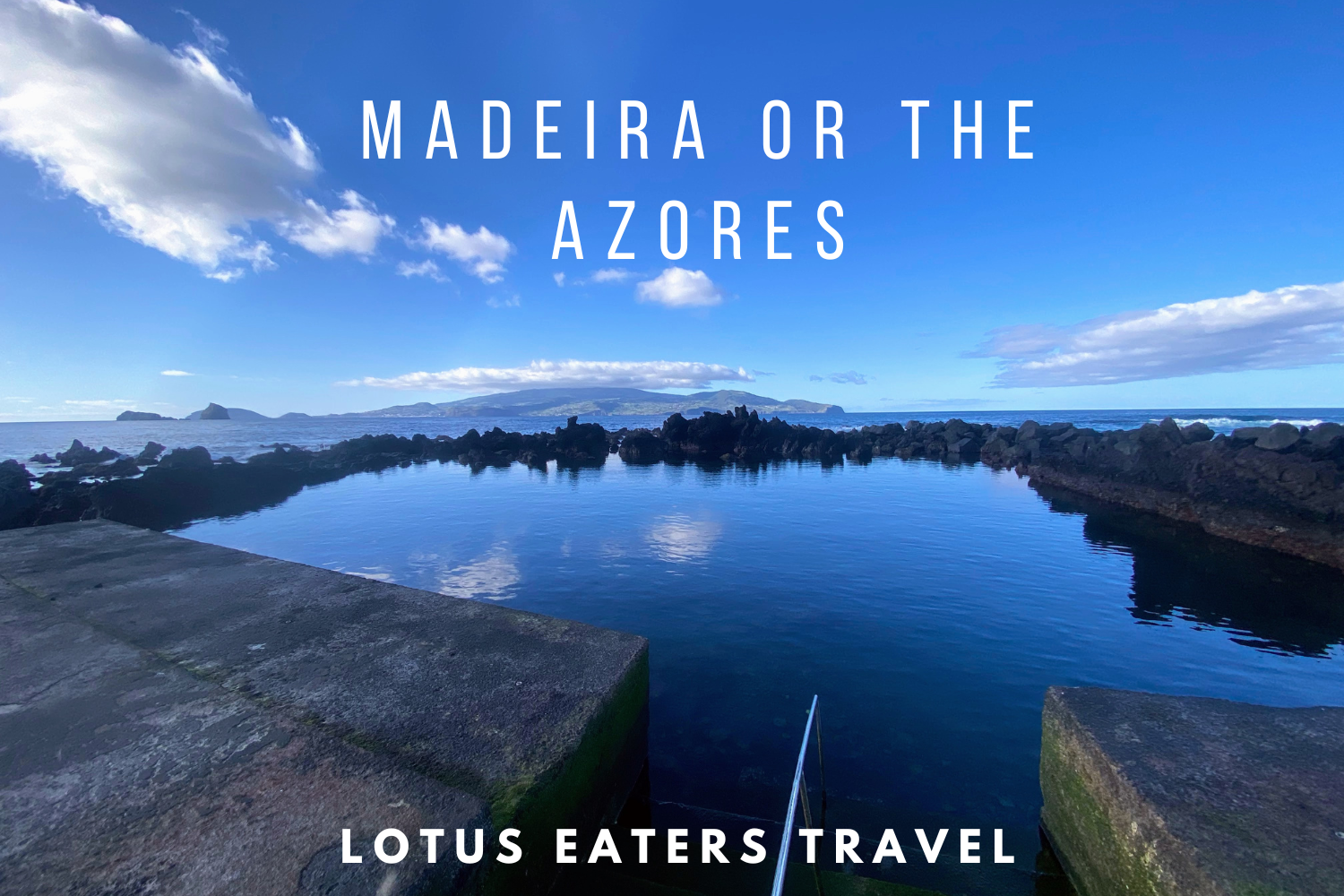
MADEIRA VS THE AZORES: WHICH PORTUGUESE ISLANDS SHOULD YOU VISIT AND WHY?
Portugal’s Atlantic islands have long played on my mind. I am, and suspect I will always be, an island girl at heart. Rugged volcanic coastlines, dramatic hiking trails, tropical plants galore, and that irresistible blend of European ease but island soul.
But between Madeira and the Azores – two very different island groups – which should you choose?
I’ve been lucky enough to spend time exploring both, and I’d happily go back to either in a heartbeat. But if you’re trying to choose one for your next trip, I hope this article can help.
I’ve compared them across all the things I care most about as a traveller – from hiking and wild swimming to food, cost, and ease of travel.
Where Are They – And What’s the Difference?


Both Madeira and the Azores are autonomous regions of Portugal, sitting out in the Atlantic Ocean – but they’re nowhere near each other.
Madeira is the easier one to spot on a map: it’s much closer to mainland Portugal and North Africa, just over an hour and a half by plane from Lisbon. The archipelago includes the main island of Madeira (where most people go), a smaller island called Porto Santo, and a couple of uninhabited islets.
The Azores, on the other hand, are a remote cluster of nine volcanic islands scattered about 1,400km west of Lisbon – almost halfway to North America.
For the sake of this comparison, I’m focusing on the islands I visited: São Miguel (the largest and easiest to reach), Terceira, and the three “Triangle Islands” – Pico, Faial, and São Jorge. These are the most accessible for a first-time Azores trip and give a brilliant overview of what the archipelago has to offer.
Did you know, that both groups of islands are part of “Macaronesia” – a term meaning “islands of the blessed” (so they must be good.) This includes The Azores, Madeira, The Canary Islands and Cape Verde. Something for you to geek over!
Getting There and Getting Around


Let’s start with logistics – as we are talking “far flung” islands, there’s bound to be a little bit of complication to it.
Madeira: Easy Flights, Steep Roads
Getting to Madeira is actually more simple than you’d expect, depending on where you’re coming from. There are regular direct flights from the UK and much of Europe, and once you land, you’re just a short transfer from Funchal, the capital.
That said, once you arrive, you may want to consider hiring a car. There is some public transport, but in all honesty, a car is the best way to get around the island properly, especially if you plan to hike.
Be warned – driving is not for the faint hearted. Yes, there are some fast and easily navigable roads through the island. The tunnel roading system is sleek and really quite useful for getting across the island. But away from this, you’ll find steep (and I mean, first gear with the accelerator floored steep) roads.
I’ve written a detailed guide about driving in Madeira here.
The Azores: A Bit More Effort, But Worth It
Flying into the Azores requires a bit more planning. I flew to São Miguel via Lisbon, and then used internal SATA flights to hop to Terceira, with ferries between the Triangle Islands. It’s definitely doable – just not the kind of place you rock up to on a whim.
Each island requires its own car hire, and whilst ferries do allow hire cars, it is generally best to hire a new car on each island. This can make things feel a bit disjointed at times, but it’s also what gives the trip its exploratory magic – each island felt like a new chapter.
That said, driving in the Azores once you are there, is a total breeze. Roads are quiet and many roads are in good condition. There are a few little things to watch out for (cows on the road, rogue pot holes etc). More on that in my Azores driving guide.
Verdict: Madeira wins for ease. The Azores are more of an expedition – but a rewarding one if you have time.
Cost: Where Your Euros Go Further

I would not regard either destination as “expensive” – we are certainly not talking London prices. But, there are some subtle cost differences.
Madeira: Sometimes pricey
In general, travelling in mainland Portugal is still quite inexpensive (as compared to travelling in Norther Europe say.) But, the price of travelling in Madeira does not quite match the mainland.
In Madeira, supermarkets are inexpensive (perhaps slightly more than the mainland.) Eating out is a bit more, you might pay €3-4 more for a main course, versus on the mainland. For drinks, you’re looking at closer to €4-5 for a glass of wine, versus €2-3 on the mainland.
Where things do get a little more noticeable in Madeira is accommodation. Expect to pay a minimum of €70-100 per night for accommodation in Funchal, for a basic apartment or hotel room.
The Azores: A surprising bargain
We were genuinely surprised by the prices in The Azores. We frequently ate out for €20 for two of us, including a glass of wine. Lets just say it was quite difficult to say no to one more glass too, especially as you can get a round in for €5.
Even ferry tickets and internal flights were reasonable if booked ahead.
Accommodation can be a little bit more costly. That said, visiting in the off season (winter) can mean that prices are three times less than the summer. We visited in December and got comfortable rooms for between €30-50 per night.
Verdict: Budget travellers should lean toward the Azores (in off season). Madeira is lovely, but your euros won’t stretch quite as far.
Weather: Sunshine or Stormclouds?


The weather can make or break your trip – especially if you’re planning to hike.
Madeira: Mild and Predictable
Madeira has a stable, subtropical climate year-round. Temperatures rarely dip below 16°C in winter or rise above 26°C in summer. It does rain, particularly in the mountains, but it tends to pass quickly. Even in March, I hiked in shorts.
The best time to go? March to June or September to November – warm, lush, and fewer crowds.
The Azores: Four Seasons in a Day
The Azores are wetter, wilder, and far less predictable. We had blue skies, fog, torrential rain, and sunburn – all in the same day. Summer (June to September) is the best time to go if you want drier trails and less weather roulette. Outside of that, bring layers – and a good waterproof.
Verdict: If weather matters to you, Madeira is the safer bet. The Azores are moodier, but beautiful in their chaos.
Hiking and Outdoor Adventures


This is a big one for me! Both island groups offer unforgettable walking experiences, but they differ in style.
Madeira: Levada Walks and Mountain Ridges
Madeira is a dream for hikers. Basically unbeatable when it comes to the sheer number of fantastic hikes on one small island. We covered it in depth in our guide to the best hikes in Madeira, but highlights include:
- Pico do Arieiro to Pico Ruivo: An iconic ridge trail that takes you above the clouds
- Levada do Caldeirão Verde: Lush forest paths alongside ancient irrigation channels
- Ponta de São Lourenço: A wild, windswept peninsula walk with coastal views
Trails are well-marked, sometimes accessible by public transport, and cater to all levels. If you want to walk every day on totally different and unique trails – pick Madeira.
The Azores: Volcanoes, Crater Lakes and Clifftops


The Azores feel more raw and adventurous – there are plenty of trail marked paths, it’s just all a little more spread out than on Madeira. The Triangle Islands are particularly special:
- Mount Pico: A tough but spectacular climb, with views across the archipelago
- São Jorge’s Fajãs: Hikes down to seaside hamlets nestled beneath cliffs
- Faial’s Caldeira: A high-altitude rim walk with sweeping views
Verdict: Madeira is more organised and varied; the Azores are wilder and more challenging. Hikers will love both – but if you’re short on time or want stress-free trails, go with Madeira.
Beaches and Swimming
Madeira: Natural Pools and Black Sand

Madeira doesn’t have classic sandy beaches – it’s mostly cliffs and coves – but it makes up for it with unique swimming spots.
- Porto Moniz Pools: Volcanic rock pools filled with seawater. Safe, fun, and scenic.
- Seixal Beach: A rare black-sand beach backed by rainforest cliffs.
- Funchal Lidos: Great for easy dips and sunbathing.
If you want a proper beach day, hop on the ferry to Porto Santo – nine kilometres of golden sand and some of the warmest sea in Portugal.
The Azores: Wild Swimming and Geothermal Dips

The Azores have beaches – mostly black sand – and a few real gems:
- Praia do Fogo (São Miguel): A hot-spring beach where warm water seeps into the sea.
- Ponta da Ferraria (São Miguel): A surreal geothermal ocean pool warmed by volcanic vents.
- Terra Nostra Gardens: Swim in a rust-coloured thermal lake in a botanical garden.
- Poça da Dona Beija: A series of steaming jungle pools you’ll never want to leave.
Verdict: Azores for thermal, wild, and wonderfully weird swimming. Madeira for lidos, pools, and that Porto Santo escape.
Food and Drink


Madeira: Seafood, Stews, and Fortified Wine
Madeira has a refined food scene, particularly in Funchal. Elsewhere, you’ll get quite used to the local specialities:
- Espada com banana (black scabbard fish with banana)
- Espetadas (beef skewers grilled over open flames)
- Local garlic bread (bolo do caco)
- A glass (or three) of sweet, aged Madeira wine
- And of course, poncha – the local firewater (do not take this stuff lightly!) Let’s just say that after one too many of these, we ended up at a dodgy nightclub in Funchal until the wee hours.
The stand out for me is the produce grown in Madeira. If you love avocado, fresh fruit and earthy foods like sweet potato – you’ll be quite content here.
The Azores: Simpler, Heartier, More Local


Food in the Azores is hearty yet still fresh. We ate a lot of soup, fresh fish and stews, having visited in winter. There’s a big connection between food and tradition in the Azores – for example, in São Miguel, you can try cozido das Furnas (a stew cooked underground in volcanic heat – as you do!)
Food is also different depending on the island. Some of our favourite memories from our trip were trying the local specialities on each island – for example, São Jorge is known for cheese. São Miguel for pineapples. And Terceira has coffee plantations.
And, one thing that a lot of people don’t realise is that wine grows in the Azores. You can visit vineyards and a wine museum on the island of Pico.
Verdict: Madeira is better for foodies and wine lovers. The Azores are ideal for rustic, satisfying, farm-to-table fare.
Things To Do (Besides Hiking)
Both destinations offer a full itinerary beyond the trails.


Madeira Highlights:
- Take the cable car to Monte and toboggan back down
- Explore the botanical gardens in Funchal
- Drive to Cabo Girão skywalk, one of Europe’s highest sea cliffs
- Visit vineyards and taste Madeira wine
Find our full guide to things to on Madeira here.
Azores Highlights:
- Climb Mount Pico at sunrise
- Go whale watching from Faial or Pico
- Relax in hot springs and jungle pools
- Visit the tea plantation at Gorreana – the only one in Europe
Find a full guide to spending two weeks in the Azores here.
Verdict: Madeira is better for organised experiences and day trips. The Azores win for nature-based relaxation and offbeat adventures though.
So, Which Island Should You Visit?
If you want a short, active, stress-free island trip – Madeira is perfect. Especially for hiking, food, and ease.
If you have a bit more time and want to explore wilder landscapes at a slower pace – the Azores will steal your heart.
As for me? I’d choose Madeira for a spring hiking break… and the Azores for a slow summer of thermal pools, forest walks, and starry skies.
Here’s my quick cheat sheet:
| Prefer… | Choose… |
|---|---|
| Easy travel & road trips | Madeira |
| Wild nature & adventure | The Azores |
| Elegant meals & boutique hotels | Madeira |
| Solitude & off-grid charm | The Azores |
| Dramatic but accessible hiking | Madeira |
| Volcanoes, cows & crater lakes | The Azores |
| Sun-seeking & reliable weather | Madeira |
| Thermal pools & quirky beaches | The Azores |
Madeira or The Azores – detailed guides
You can find our detailed travel guides for Madeira and The Azores below.


Written by Emma
Wine Lover. Yogi. Hiker. Writer.


Join our subscriber list for new posts with awesome travel tips. Don’t miss them!
Subscribe below to our newsletter for tips, thru hiking, adventures and insights to places unseen.
10 Best Hikes in Madeira: Explore + Hike Madeira
10 BEST HIKES IN MADEIRA: BEAUTY BEYOND THE PICO TO PICO. We recently visited the tropical island of Madeira. A beautiful island offering incredible opportunities for hikers and nature lovers, close to Portugal. There is an abundance of trails in Madeira, from mountain hikes, to coastal and the famous Levada hikes. You’ve probably heard of…

27 of the best things to do in Madeira
27 OF THE BEST THINGS TO DO IN MADEIRA. On our recent visit to Madeira we explored the island from top to bottom. It’s fair to say that it is now one of our favourite places to be. From lush gardens, to mountain hikes and beach walks. Madeira is simply beautiful. But there’s also buzz…
Madeira in March: what to expect
MADEIRA IN MARCH: WHAT TO EXPECT. We love travelling off-season. It’s a great way to save money, avoid the crowds, and experience a destination at a different time of year, which is exactly why we chose Madeira in March. While the UK was still rainy and grey, Madeira felt like an early spring escape. Flowers…
Most of our planning is done using other blogs, but you can’t beat a guide book at the bottom of your case. Find yours on here and get the travelling started!


USEFUL LINKS FOR FLIGHTS, ACCOMMODATION AND TRANSPORT


CHECK LATEST FLIGHTS
ACTIVITIES TO CONSIDER
FOLLOW US ON SOCIAL MEDIA
Please note that some links on our website are partnered with affiliates. Using an affiliate links does not make it more expensive for you to purchase. We receive a small commission whenever you buy something which in turn allows us to keep writing independent travel guides and your support is greatly appreciated.
One response to “Madeira vs The Azores: Which Portuguese islands should you visit?”
[…] of how nature and humanity can thrive together. If you ever find yourself on the islands of the Azores or Madeira, make time to visit a fája—you won’t just see a landscape, you’ll step into a […]