
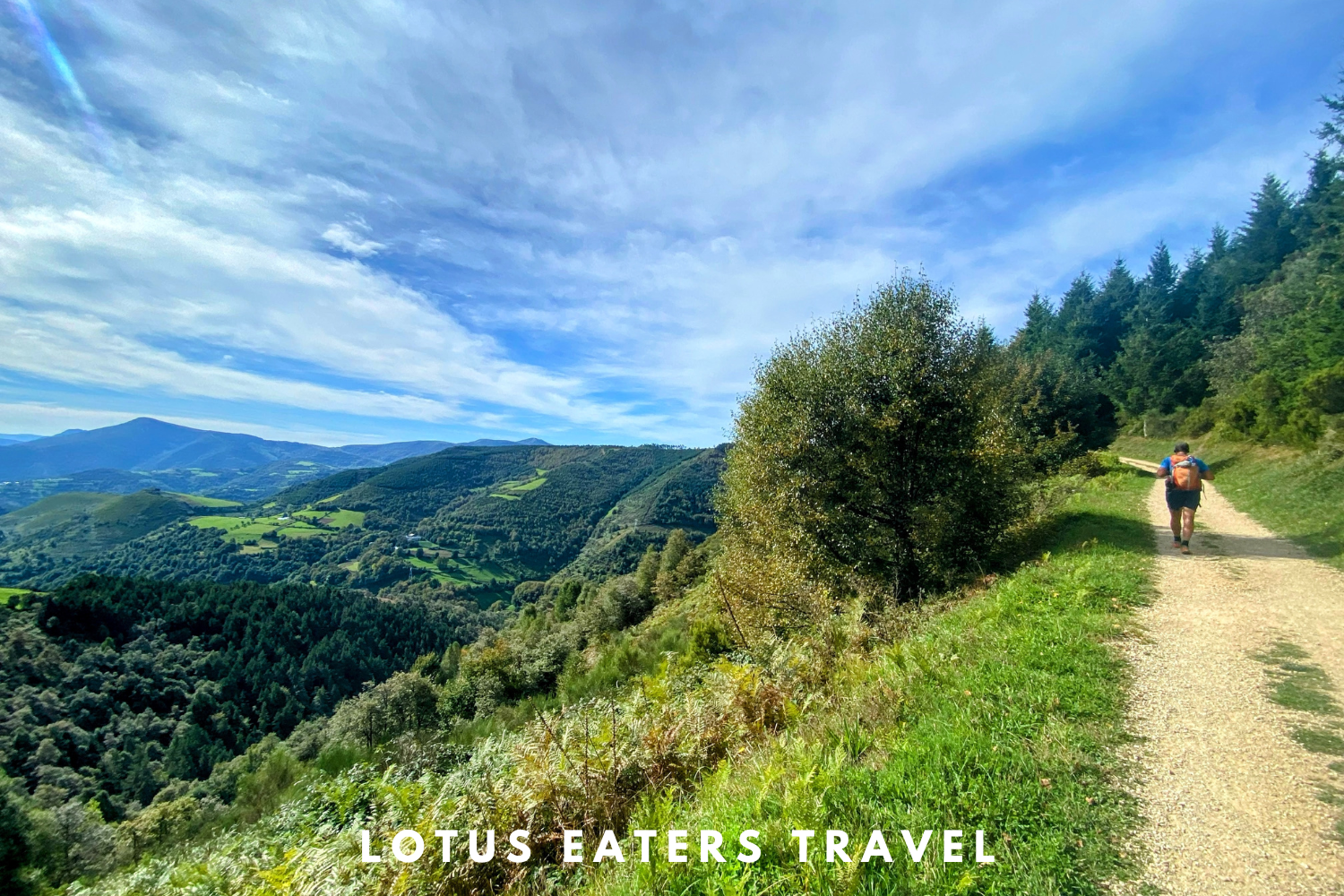
CAMINO DE SANTIAGO ONE WEEK ITINERARIES (THAT AREN’T THE LAST 100KM).
The Camino de Santiago is so often associated with the famous “final 100km” into Santiago de Compostela, yet this is the most crowded and perhaps overrated section of the route.
Historically, the last 100km was popular because this stretch qualified you for a Compostela certificate. But that all changed recently, as you can now walk 100km of any route and qualify for a Compostela, so long as you walk the last stage into Santiago.
Whether you’ve only got a week to spare or you’re slotting a Camino stage into a longer trip, there are plenty of brilliant one-week itineraries that skip the last 100km altogether.

Some pass through vibrant cities, others snake across mountain passes or follow the coast. What they all share is that elusive Camino magic, the simplicity of the path, the rhythm of walking, the sense of discovery.
Here are some of our favourite one-week Camino de Santiago routes that steer clear of the final stretch, but still offer that rich, soul-satisfying Camino experience.
1. Porto to Vigo (Portuguese Coastal Route)


- Distance: Approx. 170km
- Days: 6–7 walking days
- Difficulty: Moderate
- Route: Porto – Vila do Conde – Esposende – Viana do Castelo – Caminha – A Guarda – Oia – Baiona – Vigo
Starting in Porto, this is one of the most scenic and laid-back sections of any Camino route. The Portuguese Coastal Way is a dream if you love sea breezes, wide sandy beaches, and fresh seafood.
You’ll walk north from Porto along boardwalks and coastal trails, with the Atlantic Ocean often in sight. The towns en route are charming rather than grand, with pastel buildings and harbours dotted with colourful boats. The crossing into Spain from Caminha to A Guarda is done by ferry – an experience in itself, and the Galician coastline brings a slight shift in vibe: more cliffs, more pulpo, and often, more fog.
This stretch ends in Vigo, a lively city that often gets overlooked but is well worth a night or two. If you want to continue walking, you could carry on to Redondela and beyond, but Vigo is a natural pause point for a one-week itinerary. And an easy place from which to take onwards transport connections.
Why choose it? For a relaxed pace, beachy stops, and a Camino with a holiday feel.
Find our full guide to the Portuguese Coastal Camino here.
2. Granada to Córdoba (Camino Mozárabe)


- Distance: Approx. 170km
- Days: 7–8 walking days
- Difficulty: Moderate to Challenging
- Route: Granada – Pinos Puente – Moclín – Alcalá la Real – Alcaudete – Baena – Castro del Río – Córdoba
The Camino Mozárabe is one of the lesser-walked routes, beginning in southern Spain and joining up with the Via de la Plata in Mérida. This section between Granada and Córdoba is one of the most spectacular.
It’s a route of olive groves, white-washed villages, and Moorish echoes. Starting at the foot of the Alhambra and ending at the Mezquita in Córdoba, this itinerary is a cultural feast. The terrain can be demanding, there are rolling hills and some rocky trails, but you won’t see loads of other pilgrims, which makes the solitude all the more special.
This particular stretch is also very manageable when it comes to accommodation. A mix of pilgrim albergues and private B&Bs are found at regular intervals.
Why choose it? For Moorish history, two fantastic cities to visit, olive country charm, and off-the-beaten-track authenticity.
Find our full guide to walking from Granada to Cordoba here.
3. Astorga to O Cebreiro (Camino Francés)


- Distance: Approx. 104km
- Days: 4-5 walking days
- Difficulty: Moderate to Difficult
- Route: Astorga – Rabanal del Camino – Foncebadón – Ponferrada – Villafranca del Bierzo – O Cebreiro
Many pilgrims walk the Camino Francés all the way from St Jean Pied de Port, but this central section between Astorga and O Cebreiro stands out for its drama and beauty.
From Astorga, the path gradually ascends into the Montes de León. You’ll pass through tiny mountain villages, cross the Iron Cross (Cruz de Ferro), and descend into the wine region of El Bierzo. The final ascent to O Cebreiro is a stiff climb, but you’re rewarded with views that are positively Celtic in character. The hilltop village of O Cebreiro itself is a stunning finish point.
This stretch is perfect for those who want a classic Camino feel but can do without the crowded final days into Santiago.
The route will take between 4 and 5 days, so you could also tag on a few days in the city of León before walking.
Why choose it? For mountains, mythology, and the most beautiful section of the Camino Frances (in my opinion.)
Find our full guide to the Camino Frances route here.
4. San Sebastián to Bilbao (Camino del Norte)


- Distance: Approx. 125km
- Days: 6–7 walking days
- Difficulty: Moderate
- Route: San Sebastián – Zarautz – Deba – Markina-Xemein – Gernika – Lezama – Bilbao
If you’re craving coastal views with a side of pintxos, the Camino del Norte offers the perfect blend. This week-long itinerary from San Sebastián to Bilbao is a foodie’s dream with clifftop paths and Basque countryside rolling in between.
The trail is undulating but not overwhelming, and it delivers everything from quiet forest sections to dramatic ocean panoramas. You’ll walk into towns famed for cider, anchovies, and avant-garde architecture.
The arrival into Bilbao – with the Guggenheim gleaming by the river – feels like the ideal conclusion to a Basque-flavoured Camino.
Why choose it? For food, two fabulous cities, sea air, and a modern Camino twist.
Find our full guide to the Camino del Norte here.
5. Ponferrada to Sarria (Camino Francés, pre-final 100km)


- Distance: Approx. 100km
- Days: 4–5 walking days
- Difficulty: Moderate
- Route: Ponferrada – Villafranca del Bierzo – Vega de Valcarce – O Cebreiro – Triacastela – Sarria
Yes, Sarria is the start of the final 100km for many, but this route ends there, making it a quieter, more varied journey. This stage includes the glorious climb to O Cebreiro and some of the most atmospheric villages on the Camino Francés.
It’s a great option if you’re looking for a relatively short but hilly walk. Ponferrada’s castle, the vineyards of El Bierzo, and the arrival into misty Galicia all offer a strong Camino flavour.
Why choose it? For a condensed Camino with varied scenery and a little mountain magic.
Find our full guide to the Camino Frances route here.
6. Seville to Zafra (Via de la Plata)

- Distance: Approx. 147km
- Days: 6–7 walking days
- Difficulty: Moderate
- Route: Seville – Guillena – Castilblanco de los Arroyos – Almadén de la Plata – El Real de la Jara – Monesterio – Fuente de Cantos – Zafra (+ onward bus to Mérida)
The Via de la Plata is the longest of all the Camino routes in Spain, and in many ways, one of the most underappreciated. This southern stretch from Seville to Zafra makes for a rewarding one-week walk, especially if you crave open space, quiet trails, and sunshine.
Starting in Seville, you’ll walk straight out of the city- no taxi needed and into the Andalusian countryside. The early stages take you through olive groves and farmland, with cork trees lining the dusty tracks. It’s rural, yes, but not desolate.
The walking is varied, with some long stretches between villages and a few gentle ascents, most notably around Almadén de la Plata and into the Sierra Norte.
Pilgrim infrastructure is improving on this route, but expect simpler accommodation and fewer crowds than the Camino Francés.
Zafra is a lively town with a Moorish fortress and an atmospheric old centre. An ideal place to end your walking week. From here, it’s an easy one-hour bus ride to Mérida, home to one of Spain’s most impressive Roman archaeological sites.
Why choose it? For Andalusian flavour, solitude on the trail, and a finish line steeped in Roman history.

Would you like us to plan your walk for you?
Embark on a journey of a lifetime with Lotus Eaters Travel Planning, where we turn your dream of long-distance walking into a meticulously planned reality.
Our passion for exploration, love for diverse cultures, and commitment to providing an unparalleled experience drive us to offer personalized consultation services for some of the world’s most iconic walking trails
Written by Emma
Wine Lover. Yogi. Hiker. Writer.


18 best long distance hikes in Europe for June
18 BEST LONG DISTANCE HIKES IN EUROPE FOR JUNE. June is one of the very best months for hiking in Europe. Summer has arrived, the days are long, and most trails are finally free of winter snow. But, if you head out for a long distance hike in Europe, you’ll be beating the crowds of…

Do you need to book accommodation on the Camino Primitivo?
DO YOU NEED TO BOOK ACCOMMODATION ON THE CAMINO PRIMITIVO? PROS AND CONS. We walked the Camino Primitivo recently and after much debate, decided to book all of our accommodation ahead of time. While the Primitivo is often described as one of the quieter Camino routes, that reputation is becoming outdated. Throughout the summer we…
Taking the ferry from Laredo to Santoña: a short guide
TAKING THE FERRY FROM LAREDO TO SANTONA ON THE CAMINO DEL NORTE: A SHORT GUIDE. Walking the Camino del Norte along Spain’s northern coast brings many unique experiences. For me, one that stands out is the crossing the estuary from Laredo to Santoña by ferry. Despite being a quick journey, it’s a rare chance to…
Most of our planning is done using other blogs, but you can’t beat a guide book at the bottom of your case.
Find them here on Amazon.

USEFUL LINKS FOR FLIGHTS, ACCOMMODATION AND TRANSPORT


CHECK LATEST FLIGHTS
ACTIVITIES TO CONSIDER
FOLLOW US ON SOCIAL MEDIA
Please note that some links on our website are partnered with affiliates. Using an affiliate links does not make it more expensive for you to purchase. We receive a small commission whenever you buy something which in turn allows us to keep writing independent travel guides and your support is greatly appreciated.