
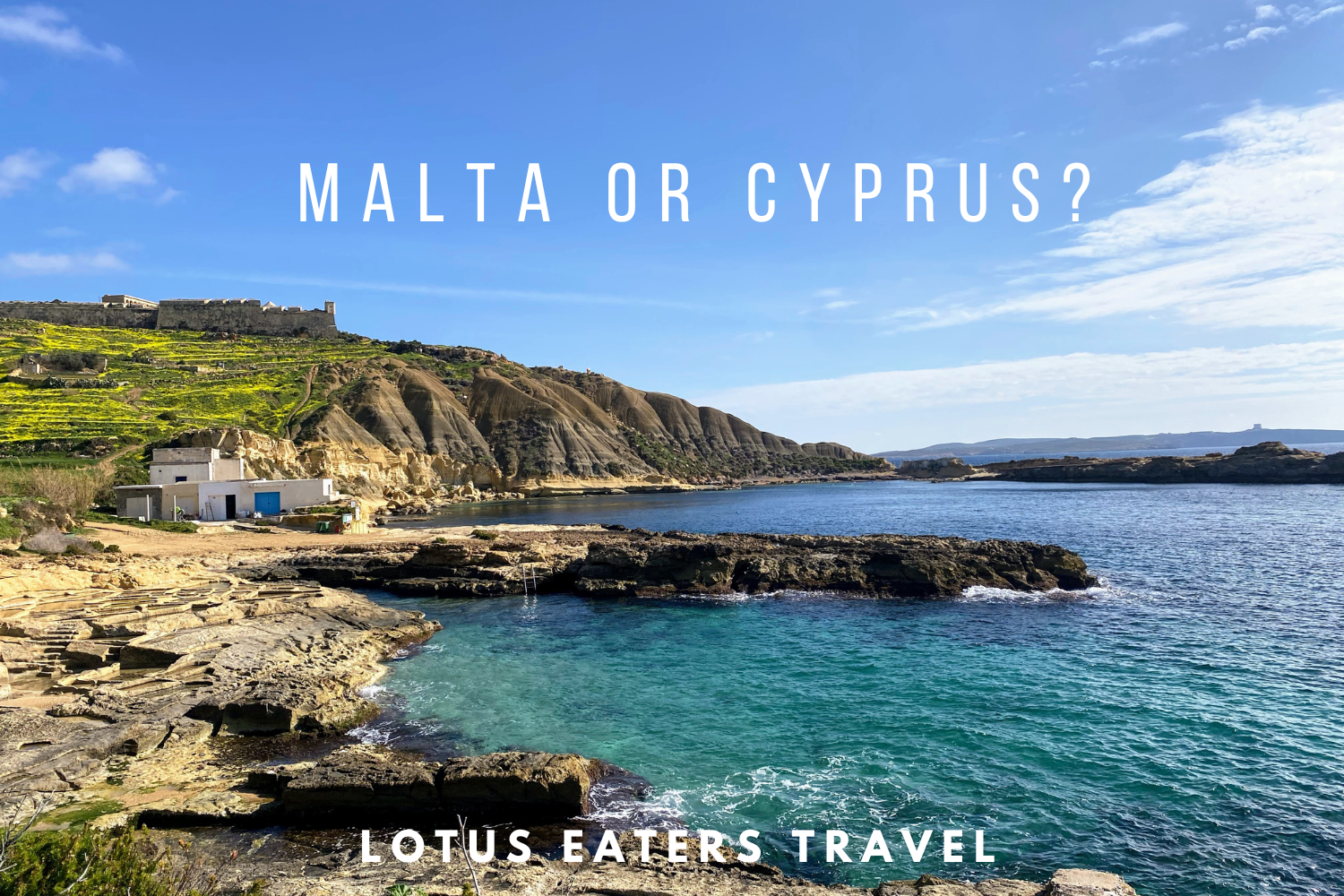
CYPRUS OR MALTA: A DEEP DIVE INTO THE TWO ISLANDS.
Golden stone cities, azure seas, and a long, tangled web of Mediterranean culture and history – both Malta and Cyprus tick so many boxes when it comes to sunshine escapes. They’re warm, safe, culturally rich, and surprisingly affordable. But if you only have time for one, which should you choose?
I’ve spent time exploring both islands – swimming in hidden bays, hiking hidden trails, wandering through history, eating great food and drinking far too much wine.
This guide unpacks everything I cared about most on my travels, from beaches and archaeology to public transport, hiking, and food.
Where Are They – And What’s the Difference?


Malta
Malta is a tiny archipelago just south of Sicily, wedged between the south of Europe and North Africa. The main island, Malta, is where most people stay, but nearby Gozo offers a more laid back feel. Comino, the smallest of the islands is a popular day trip destination.
It’s one of the smallest countries in the world by land area, but don’t let that fool you – there’s so much to see and do.


Cyprus
Cyprus sits further east – closer to Turkey and Lebanon than to mainland Europe. It’s the third-largest island in the Mediterranean, and politically split between the Republic of Cyprus in the south (EU member state) and Northern Cyprus.
This guide focuses on southern Cyprus, the part most travellers explore, particularly the cities of Paphos, Larnaca, Limassol and Nicosia, as well as the wild Troodos Mountains and beachy Ayia Napa.
Getting There and Getting Around


Malta: Direct flights from the UK run year-round. From Valletta’s little airport, buses or taxis deliver you to St Julian’s – or Mdina – in under 30 minutes. Ferries to Gozo, run regularly from either Cirkewwa or Valletta. Many people think that it’s difficult or complicated to get to Gozo, but honestly it couldn’t be easier. We would always recommend visiting Gozo during a trip to Malta –find our guide to Gozo here.
We actually chose to walk around Malta (find our guide to that here), but we took a few buses. And family travelling alongside us relied fully on public transport. Because Malta is so small, you really don’t need a car to get around. Buses are frequent and easy to navigate, there can be short delays due to traffic, but generally transport is reliable.


Cyprus: You can choose to fly to either Larnaca or Paphos airports, at different ends of the island. From Larnaca, the city is a 15-minute taxi ride; from Paphos airport, you’re in town in 10 minutes.
Cyprus is bigger than Malta, subsequently it can be better to hire a car if you plan to explore widely. That said, we visited Cyprus for one month, without a car, and relied solely on local buses (good and efficient) and inter-city services (cheap and comfortable.)
You can find our guide to exploring Cyprus without a hire car here.
Cost: Cyprus vs Malta

Malta: Mid-Range with Budget Options
Malta sits somewhere in the middle of the European cost spectrum. You can grab a decent meal for €15–20, or a pizza for under €10. Wine, especially if you drink Italian wine, is cheap and cheerful. Entry to museums and historic sites is usually under €10.
Accommodation varies widely – especially depending on the season when you travel. You can find budget rooms for €25-30 a night off season, and decent private rooms or apartments from €50–80. That said, Valletta is pricier, expect to pay a minimum of €100 a night, even off season.
You can find our guide to the best places to stay in Malta for every budget here.

Cyprus: Slightly Cheaper Overall
Cyprus surprised me – it felt slightly cheaper than Malta. Meals out, even in beachy resorts like Larnaca, were great value: €10–15 for a big plate of souvlaki, salad and wine.
Supermarket prices are low, and even in touristy towns, I never felt gouged. And one thing we loved is that sun loungers and umbrellas are really reasonable – we consistently paid €8 for two beds.
Accommodation is especially affordable outside summer. In spring or autumn, €40–60 gets you a very comfortable studio or hotel room. Even in summer, we felt that Airbnbs and hotels were very affordable – we often paid around €40-60 for basic rooms.
Weather and Seasonality

Malta enjoys a stable Mediterranean climate. Winters are mild (12–16 °C); summers reliably hit 28–32 °C. Rain is rare May–October. Tourism is spread out over quite a long season, although there are peaks in the summer.

Cyprus is hotter in summer – often above 35 °C in July/August along the south coast. Winters can dip to 5 °C in the Troodos peaks (where you can even ski). Shoulder seasons (April–May, September–October) offer warm sea temperatures (22–26 °C) without the midsummer crowds. But, it’s sometimes possible to sunbathe even into November.
Hiking and Outdoor Adventures
Malta

Whilst Malta might not seem the most obvious hiking destination, we actually came to Malta just to hike. We walked the coastal trail around the main island, then the shorter (better marked) trail around Gozo. I would particularly recommend the latter, a three day trek, to any keen hikers.
There are also adequate day hikes, Dingli Cliffs to Ghar Lapsi for example. As we as more inland trails taking in historic sights.

Cyprus
Cyprus is more established as a hiking destation. There’s a long distance path crossing the island, as well as numerous trails in the Troodos Mountains. We visited in summer, but sampled a section of the Aphrodite Trail in the Akamas Peninsula and a shorter hike to Caledonia Waterfall.
City and Town Profiles
Malta
St Julian’s & St Paul’s Bay


These are the island’s “holiday resort” zones. You’ll find high-rise hotels, Irish pubs spilling out with expat chatter, arcade parlours and nightclubs thumping until dawn. It feels less “authentic Malta” and more “European seaside package holiday.”
You can find a comparison of the two resorts here.
Valletta, Mdina & The Three Cities

These historic cities are the standout memories for me in Malta. In Valletta, wander the bastions at dawn, then sip espresso in a dimly lit café. Mdina and Rabat, feel a little like stepping into movie sets. Across the Grand Harbour, The Three Cities offer waterfront promenades, ancient churches and local osterias.
Gozo

Gozo is gentler, greener, quieter. We walked the perimeter of the island in three days and would do it again in a heart beat. We visited quiet beaches, scenic bays, like Xlendi and quirky harbour towns like Marsalforn.
Find our guide to the best beaches and swimming spots in Gozo here.
Hidden Gems


- Dingli Cliffs: The highest point in Malta, dramatic scenery. Close to Rabat/ Mdina, so you can combine both.
- Marsaxlokk: Sunday fish market with traditional luzzu boats bobbing in the harbour. Or the quieter alternative, Marsakala.
Cyprus
Paphos


Whilst we didn’t immediately “gel” with Paphos, although there are lots of selling points. Parts of the town feel a little naff, with chain restaurants and a “Brit abroad” vibe.
But where Paphos really excels, is as a base to explore nearby areas. Visit the Blue Lagoon on a boat tour, nearby beaches like Coral Bay and of course, the Tomb of Kings. For a bit more atmosphere and more traditional tavernas, head to Paphos Old Town.
Limassol


Conversely, we were totally charmed by Limassol. There’s a trendy marina with yachts and chic cafes. But head to the old town and you’ll find narrow alleys with quirky wine bars and breweries. Of all the cities we visited, we enjoyed the nightlife in Limassol the most.
It is also a great base from which to explore nearby – we visited wineries and waterfalls in Platres and the spectacular Kourion Ruins and beach of the same name. Limassol has a great city beach too, and we loved the ease of life here.
Find our guide to the best things to do in Limassol here.
Larnaca & Protaras


Larnaca is a quieter town, with some pretty areas. We loved the area around the church of Saint Lazarus and spent a great few hours at the archaeological museum. And there are two beaches – Finikoudes and Kastella Beach, both within walking distance of the centre of town. Find our full guide to Larnaca here.
Nearby, Protaras is more of a holiday resort. The beaches are some of the prettiest in the area and it makes a practical place to stay.
You can find our guide to the best places to stay in Cyprus here.
Ayia Napa


Once known for foam parties, Ayia Napa surprised us with the absolutely stunning beaches. There are also some more laid back restaurants and bars, albeit the evening is dominated by the infamous “strip.” I will admit that we sampled a night out and it was at least a little fun!
Find our guide to Ayia Napa for the over 30s here.
Troodos Mountains


This is Cyprus’s wild side and less explored side. Here we visited vineyards, hiked to Caledonia Falls. and visited quaint villages. A must-visit if you prefer to get away from the coast and into cooler air.
Find our guide to the Troodos area here.
Food & Drink
Malta
Maltese food is hearty and unique – a mix of Italian, Arabic and British influences.
Dishes to try:
- Rabbit stew (Malta’s national dish)
- Pastizzi (flaky pastries stuffed with ricotta or mushy peas – addictive)
- Lampuki pie (fish pie)
- Kinnie, the local bitter orange soda
- Maltese wines are improving rapidly – but they can be tricky to find on menus. Most restaurants serve Italian wine.
Cyprus
Cypriot cuisine is divine – think Greek food, with its own twists. Most meals are generous and communal. I don’t think it’s a coincidence that I gained a little weight during our month long stint in Cyprus. Order a meze and you’ll be served 10+ small plates: dips, grilled meats, fresh veg, local cheese.
Other highlights:
- Sheftalia (sausage parcels)
- Kleftiko (slow-cooked lamb)
- Fresh halloumi
- Excellent local wine from the Limassol and Troodos regions – full-bodied reds and crisp whites.
Beaches and Swimming


Malta
Malta’s beaches tend to be rocky or small sandy coves. But there are some large sandy beaches like Ramla Bay on Gozo. What it lacks in long stretches of sand, it makes up for with the brilliant blue of the water. It is just so inviting.
Some of the best spots:
- St Peter’s Pool (rocky, dramatic, popular with cliff jumpers)
- Golden Bay (actual sand!)
- Ramla Bay – red sand beach
- Qarraba Bay – accessible by boat or hiking.
Find our detailed guide to Malta’s best beaches here and Gozo’s best swimming spots here.


Cyprus
Cyprus definitely wins for traditional beach lovers. Long sandy stretches like Nissi Beach in Ayia Napa or Coral Bay in Paphos are postcard-perfect.
The sea stays warm through to November and most beaches are easy to access by car and sometimes public transport.
Culture and History


Malta
Few places in Europe pack in as much visible history as Malta. You’ll find:
- Megalithic temples older than the pyramids
- The fortified city of Mdina
- Valletta, a baroque masterpiece and UNESCO site
- WWII history around every corner


Cyprus
Cyprus has a fascinating history – Greek, Roman, Byzantine, Crusader, Ottoman, British. In the south, don’t miss:
- Paphos Archaeological Park and Tomb of the Kings
- Kourion amphitheatre
- Kykkos Monastery in the mountains
- Nicosia, Europe’s last divided capital
So, which island should you choose?
Pick Malta if you crave history at your doorstep, compact days without long drives, clear blue sea, the chance to do some hiking and loads of variety.
Choose Cyprus if you want diversity on a larger scale, golden sand beaches one day, Greco-Roman ruins the next, then mountain villages offering a glimpse of timeless island life.
Honestly, both are brilliant. But if you can – visit both. They offer completely different slices of the Mediterranean, and both are far more than just beach destinations.
Written by Emma
Wine Lover. Yogi. Hiker. Writer.


Valletta Cruise Port: All you need to know
VALLETTA CRUISE PORT: ALL YOU NEED TO KNOW. Valletta is one of the easiest cruise ports in Europe to arrive to. And it has potential to offer a very rewarding visit to the city. Everything is close, the city is compact, and you can see a lot in just a few hours without needing to…

18 best things to do in Malta from a cruise ship
18 BEST THINGS TO DO IN MALTA FROM A CRUISE SHIP. We have travelled extensively around Malta, so when someone recently asked me for advice on what to do in Valletta from a cruise ship, it made me realise something. I was so focused on the capital that I almost forgot to mention how easy…
St Paul’s Bay vs St Julian’s Bay Malta: which coastal town to choose?
ST PAUL’S BAY VERSUS JULIAN’S BAY: WHICH COASTAL TOWN TO CHOOSE? Malta’s coastline is all cliffs, coves, and flashes of blue. Dotted along it are bays and towns that each have their own pace and rhythm. Two of the most talked-about spots, St Paul’s Bay and St Julian’s Bay, both pull in visitors, but for…
Malta & Gozo Coastal Trails eBook

If you want all the information you need in one place, why not get hold of our eBook. This book gives you 152 pages of information about the route, including daily stages guides and how to prepare.
USEFUL LINKS FOR FLIGHTS, ACCOMMODATION AND TRANSPORT


FOLLOW US ON SOCIAL MEDIA
Please note that some links on our website are partnered with affiliates. Using an affiliate links does not make it more expensive for you to purchase. We receive a small commission whenever you buy something which in turn allows us to keep writing independent travel guides and your support is greatly appreciated.