
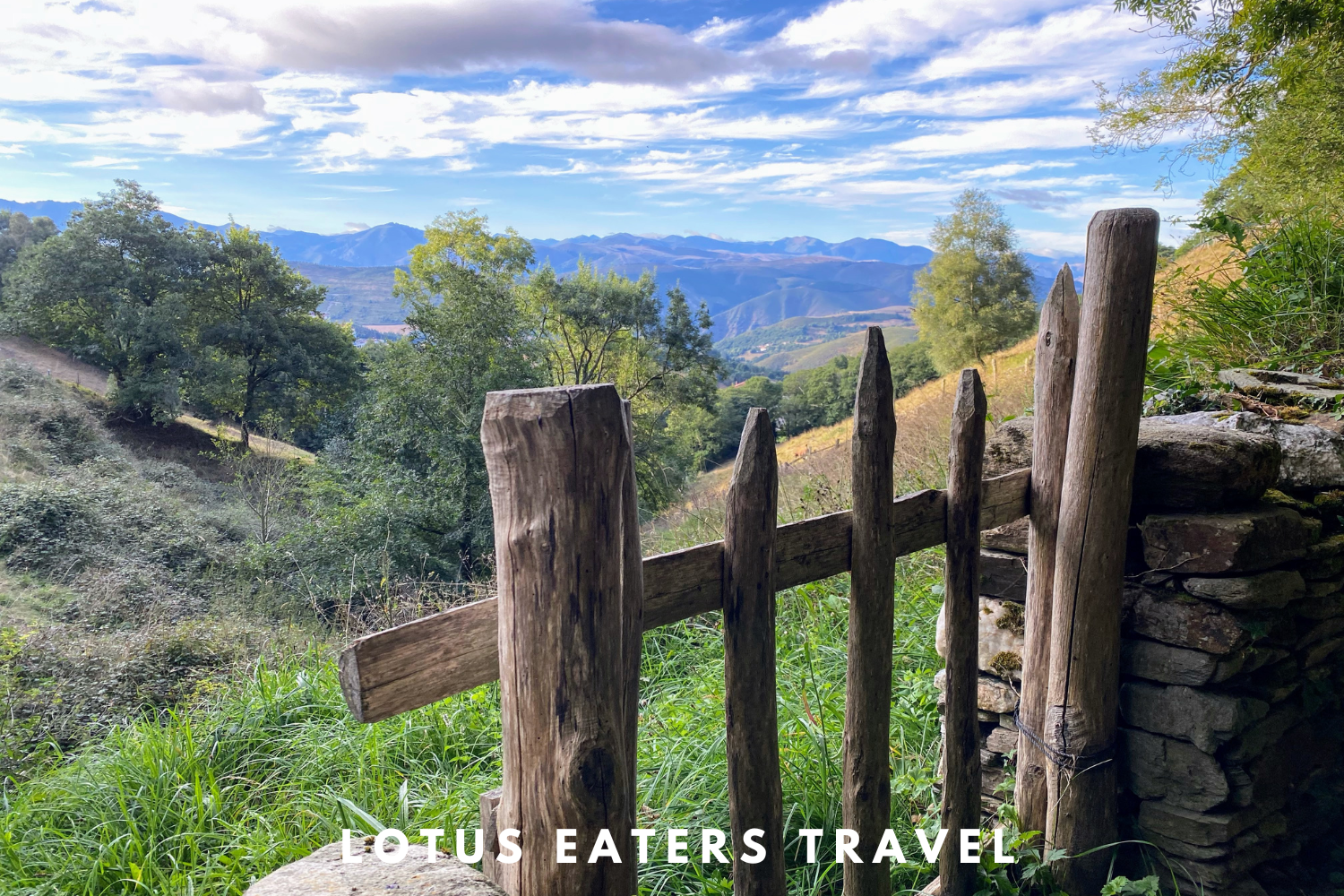
OUR CAMINO PRIMITIVO DAILY STAGES: FROM OVIEDO.
Walking the Camino Primitivo from Oviedo is a journey through Asturias’ rolling hills, shaded paths, and timeless villages, with plenty of highs (literally) and the occasional challenge thrown in.
When we planned our Camino, we set out with a 14–day itinerary, including a rest day in Lugo. As is often the case on the Camino, those plans shifted along the way, but the first nine days unfolded almost exactly as we had mapped them out.


Our route combined some longer days with shorter, more relaxed ones, and we often planned around particular albergues we wanted to stay in or towns we didn’t want to miss. Along the way, we found a good balance between rural quiet and lively evenings in historic towns.
One of the key decisions on the Camino Primitivo is whether to take the dramatic Hospitales route or head via Pola de Allande.

We opted for the latter, and in this guide we’ve set out our daily stages, highlights, challenges, and recommendations, so you can get a feel for what it’s really like to walk this stunning Camino.
Our Camino Primitivo Daily Stages: From Oviedo
We planned to walk the Camino Primitivo in fourteen days, including one rest day in Lugo. As you’ll see, our plans changed a little, but we did stick with the first nine days as we had planned out.
We chose a mix of some shorter days and one or two longer ones. Primarily, we planned our days around albergues we wanted to stay in and towns we wanted to visit too. With a nice mix of rural and urban locations.

One of the big decisions you’ll have when planning your Camino Primitivo is whether to take the Hospitales route, or opt for the route via Pola. We chose to the latter and I’ve set out how we chose this route in a full blog post here.
Day One: Oviedo to Grado
KEY DETAILS: distance 26km, ascent 519m, descent 690m, time 5-6 hours.


A lovely day and great start to the Camino Primitivo. Be careful to follow the signs for the Primitivo and not the Camino Costa as you leave the city!
You can find our guide to getting to Oviedo and the best things to do in the city here (published soon.)

HIGHLIGHTS
- Oviedo Cathedral and seeing the city waking up;
- At about 3km outside of Oviedo you can get a Sello hidden in a little cupboard;
- Our first taste of beautiful trails and shaded paths;
- Hearing the sound of cowbells, which would become the soundtrack to our time in Asturias;
- Grado is a smart little town with lots of options for drinks, dinner and general milling around. There’s also a great Bazar shop to pick up the inevitable forgotten items on day one!
Look out for – references to the Valduna chestnut, an Asturian delicacy that originates in Las Regueras area, which you will walk through today.


CHALLENGES
- A few sections on road, including busy ones;
- These were generally short, but we were surprised to encounter this;
- We missed a few arrows and somehow lost our way twice – I’ll put this down to first day excitement, but it’s possible that there are a few sneaky hidden sign posts. If in doubt, check your map;
- Lots of smaller climbs make the route quite undulating – the climb up to Escamplero is around 150m. But in the context of the Primitivo this is one of the easier days.

AMENITIES
As you leave Oviedo, there are plenty of places to grab groceries or breakfast. In Escamplero (14km in) is a small deli and a restaurant. If you have sandwiches or a picnic, the Chapel of Fatima (1km or so past Escamplero) has picnic tables and is a great spot for lunch.
6km before Grado is Villa Palatina – a scenic albergue. A good option for a drink before the end of the day.
ACCOMMODATION


Most pilgrims will walk from Oviedo to Grado, so it’s a good idea to book accommodation in advance. That said, there is a Donative Albergue (Villa de Grado Pilgrims Hostel), which does not take bookings). It has only 16 beds, so is best for walkers who will arrive earlier.
We opted for La Quintana Hostel, a grand looking building with 42 beds spread over two dorm rooms and a few private spaces. They offer dinner and breakfast, although we opted to head out, we heard good things about supper. There’s a pleasant garden out front and a bar where you can purchase drinks. The only thing we didn’t like so much, were the communal showers – although this meant there was never a queue!
If you’d rather a hotel, try Hotel Areces, which is central to town.
Day Two: Grado to Casazorrina
KEY DETAILS: distance 19.5km, ascent 700m, descent 610m, time 4-hours.

Most will walk from Grado to Salas today, 22km. We chose to take a shorter day to Casazorrina to stay at the boutique albergue there.


HIGHLIGHTS
- We took the chance to enjoy a slow breakfast in Grado at Cafe Expres – honestly, the tortilla here was an absolute treat;
- The Monastery of San Salvador de Cornellana dates back to the 11th century. It’s not possible to go in to visit, but you can get a Sello. There’s also a pilgrim’s hostel, so you can stay the night if you fancy a shorter day;
- We really enjoyed the rural section around Villazon – pumpkin patches, corn and apple trees.


CHALLENGES
- From Grado, a 300m ascent awaits over 5km. It’s not steep but requires steady climb. What comes up, must come down, and the next 5km into Casa del Puente are largely downhill.
AMENITIES
Cornellana (around 10km in) is a small town with a few options to eat and drink. There’s also a small grocery store. After this, there’s nothing until reaching Casazorrina.
ACCOMMODATION


We chose to walk a short day specifically to stay at La Figal de Xugabolos, a rural albergue with rave reviews. It turned out to be a stunning place, gorgeous gardens with lots of lounging space. We were a little disappointed with a few elements – dinner was on the pricey side (€18 for small portions and one glass of wine), the dorm room felt a little cramped and you can’t check in until 16:00 (although you can arrive and hang out in the garden.)
That said, we had a great experience overall and we heard from others that the food had been great on previous nights, so it may be that the chef had an off day.
Other pilgrims we met chose to stay in Salas – 3km away. And when we next walk this route, we would do the same. Both Casa Sueño and Albergue el Tulipán de Salas are recommended.
Day Three: Casazorrina to Tineo

KEY DETAILS: distance 23km, ascent 900m, descent 400m, time 5-6 hours.
An easy stroll into the charming town of Salas, followed by a climb and then a meandering path into Tineo.


HIGHLIGHTS
- Salas is a charming little town, in retrospect we wished we had stayed there. But, it’s the perfect place to stop for coffee and breakfast if you didn’t stay overnight;
- The vast majority of the route is on trail – 16km or so;
- Tineo is an absolute delight – the ideal size town for a Camino evening. There are a few different options for drinks and dinner – we enjoyed traditional Asturian cider (sidra) at Sidrería El refugio (great views) and supper at Restaurante la Vinoteca (great prices.)
Look out for – there are a couple of chapels on route, ideal for a bit of solitude and reflection. You can get a Sello at both. Iglesia de los Santos Xustu y Pastor and Iglesia de Santa Marina.


CHALLENGES
- From Salas, there’s a 500m climb over the course of 6km or so, finishing in Porciles. After this, the route has a few undulations but nothing so significant;
- A few sections of road have quite fast traffic, but fortunately these are brief stretches.

AMENITIES
A few kms from the start, we reached the town of Salas, there are lots of cafes to enjoy coffee. Around 13km in is the town of La Espina, which has a few cafes. Around Bedures are a couple of vending machines and rest areas.
ACCOMMODATION


When we found out about the albergue hidden under a 4* hotel in Tineo, we knew that we had to stay there. Palacio de Meras Hotel is in the centre of town and is quite plush, downstairs is the secret albergue.
There are a huge number of beds, fancy bathrooms and all the mod cons. Breakfast is also included in the €20 bed rate. As luck would have it, we ended up with a bed each in a little cubby, which felt almost private.
If you’d rather a bit more luxury, you can of course stay upstairs in the hotel. We heard from others that the rooms are particularly plush.
You can find our full guide to visiting Tineo here.
Day Four: Tineo to Pola de Allande

KEY DETAILS: distance 27km, ascent 850m, descent 950m, time 6-7 hours.
For us, this was a total 10 out of 10 walking day. We arrived to Tineo with legs like jelly, but felt it had been the best day of the Primitivo so far.
The route splits just after Borres – around 16km from Tineo. At this point, you have to decide whether to walk the Hospitales route or take the route to Pola de Allande. Many pilgrims will stay in Borres or just before, so that they can tackle the Hospitales route the next day.

We decided to stick to the main route via Pola – you can find out more about the two different routes here (published soon.)


HIGHLIGHTS
- The whole day was just wonderful – stunning trail dotted with trees and flowers and expansive views;
- We paused for lunch in Campiello and there was a great vibe on the terrace at Casa Hermenia, with most pilgrims also taking a break here;
- Pola de Allande is a quirky and pretty town that is quite literally nestled into the mountains. It has a really distinctive vibe. We enjoyed drinks at Cervecería Queipo and supper at Restaurant The Casino. As it happened, the night we visited, there was a massive fiesta going on – music still pumping at 04:00 (we were of course tucked up by then!)

CHALLENGES
- The ascent starts straight from Tineo and continues for 5km – I always find it harder to tackle a climb first thing in the morning.
- After Borres, there are three short climbs.
- The final descent into Pola is stunning, but very steep. My legs were shaking with fatigue by the time we arrived to town.
AMENITIES
If you stay overnight at the Palacio albergue, breakfast is included – an absolute bonus.
Campiello (13km in) has two albergues with cafes and shops.
ACCOMMODATION


Our accommodation in Pola was a highlight of this day for sure. We stayed at La Casita de Aba and from the moment we were welcomed by the wonderful hosts with a glass of cold lemonade, I knew we were in for a great albergue. Everything was spotlessly clean and the bedrooms are spacious with comfortable beds (and slinky linen!)
For private rooms, consider Casa Gayon or the more central Hotel Nueva Allande.
Day Five: Pola de Allande to La Mesa

KEY DETAILS: distance 22km, ascent 1100m, descent 750m, time 4-5 hours.
People who walk the Hospitales Route, think that it’s the most difficult. In actual fact, walking via Pola means you have to climb more on this day! With 1100m, this is a difficult day of walking but very rewarding.


HIGHLIGHTS
- The trails from Pola are absolutely stunning – it’s like being in a magical rain forest with streams and plant life;
- At Puertu de Palu at 1146m, the peak of the day, the views are spectacular.

CHALLENGES
- What can I say about the climb out of Pola, other than, it is long! It’s not particularly steep at any point, but you’ll climb about 700m over 9km, finally reaching a peak at 1146m;
- Expect windy conditions at the top and as you walk down towards Montefurado.


AMENITIES
In Pola, there is one cafe which opens early. There’s also a supermarket, but check opening times. We packed a lunch with us and enjoyed it with the views just past the peak. In Berducedo, 4km before La Mesa, there are a couple of bars.
ACCOMMODATION


Many pilgrims will stay in Berducedo, when I was planning our daily stages, I couldn’t see any interesting albergues there, so decided to push to walk further to La Mesa.
In La Mesa, we stayed at the Miguelin Hostel. A remote albergue which has a bar offering a decent fixed price menu and breakfast the next day. It is a lovely place to stay, with friendly staff and we enjoyed the outdoor space and bar.
That said, you can tell that it needs a bit of updating – and the swimming pool was a rather lurid colour of green when we stayed. Dorm rooms or private rooms are available.
Day Six: La Mesa to Grandas de Salime

KEY DETAILS: distance 16km, ascent 970m, descent 1300m, time 4-5 hours.
A short day for us, I planned this because I wanted to eek out one last night in Asturias. Despite the distance, we found this route quite tricky with lots of ascents and descents.


HIGHLIGHTS
- The views down the Arroyo de Grandas are spectacular;
- The town of Grandas is small but enjoyable. There is a well reviewed Museum – Ethnographic Museum of Grandas de Salime, which was closed when we visited. We passed the time at Bar La Esquina.

CHALLENGES
- The big challenge of the day is the descent, which lasts around 8km. You will go from 1000m down to 200m. The route has lots of switch backs and is gently meandering, but after some time can be tiring on the legs;
- From the river, there’s a long section of road – 4km or so before Grandas.

AMENITIES
After La Mesa, the only amenities are in Vistalegre at Hotel Las Grandas. A good stop for coffee or food, 5km before Grandas de Salime.


ACCOMMODATION
There are couple of different hotels and albergues in this town – we chose Albergue Porta de Grandas. A friendly and comfortable albergue close to town. They offer dorm space or private rooms.


Note – if you want a view of the Grandas river, consider staying at Las Grandas Hotel, a few kms before the town and right on the river.
Day Seven: Grandas de Salime to O Piñeiral

KEY DETAILS: distance 29km, ascent 950m, descent 600m, time 6-7 hours.
A challenging day of walking with a long climb throughout the first part of the day.

HIGHLIGHTS
- Lots of trail – around 17km of it throughout the day;
- Without a doubt, the albergue and excellent supper was a highlight of the day.
Look out for – crossing from Asturias to Galicia, there are markers on the ground. When we walked, it felt like the rain got heavier as we crossed into Galicia, just to mark the occasion.

CHALLENGES
- Almost non-stop climbing from Grandas to O Acebo at 15km in;
- A little road walking, normally on a path alongside the road;
- The climb into A Fonsagrada is quite steep.
AMENITIES
The first cafe we came across was in O Acebo, around 16km into the day. After this, Fonsegrada ( a small town 4km from the end) has grocery stores and cafes/ bars.
ACCOMMODATION


We stayed at a rural albergue, O Piñeiral and would very much recommend it. There are private rooms as well as dorm space, and we ended up with two bunk beds and a cubby space to ourselves. If you have a swim suit, you can enjoy the hot tub to soothe aching legs.
There’s also an excellent on sight restaurant for dinner – just be warned that it doesn’t open until 20:30. I was ready to chew my arm off by this point.
Day Eight: O Piñeiral to Vilar de Cas

KEY DETAILS: distance 35km, ascent 1100m, descent 1500m, time 7-8 hours.
We planned in a longer walking day as we wanted to stay at the top rated albergue A Pociña de Muñiz. Whilst it was a tough day of walking, it was well worth it to enjoy this albergue and to give ourselves a shorter route into Lugo for the next day.

HIGHLIGHTS
- A spectacular sunrise on the hills a few kms into the walk – we sat and watched the sun and the cows waking up with it. It was a little like the Lion King, but with cattle.
- The town of Castroverde (around 28km in) is lovely – lots of nice bars and a central square near the church. Had we not stayed at Vilar de Cas, we would have been very happy to spend the night in this town.
- Our stay in Vilar de Cas was a standout of the whole trip – such an excellent albergue and one we would definitely return to.
CHALLENGES
- In O Cadavo, we had to go off the Camino route a little bit to find a lunch stop and there are some longer stretches without facilities;
- A long day, with three longer sections of climbing and a few short, sharp hills.


AMENITIES
The albergue does offer breakfast, but it’s a full buffet situation for €8. We declined and had coffee instead.
Casa mesón (Taberna) is the first café we came across at 8km, it’s got an excellent reputation particularly for the tortilla. Which I will say, was delicious. On a sunny day, you can sit outside and the owner plays music – it’s a great stop.


After this, O Cadavo (21km in) is a small town with a few places to eat and a grocery store.
Finally, Castroverde is a larger and prettier town with a handful of amenities.
ACCOMMODATION


A Pociña de Muñiz is a boutique albergue with dorm space and private rooms. It has gorgeous gardens with hammocks and impeccable facilities. There’s an excellent communal dinner too – oodles of food and wine. We would really recommend this albergue if you can get a space.
Day Nine: Vilar de Cas to Lugo


KEY DETAILS: distance 16km, ascent 300m, descent 300m, time 3-4 hours.
A nice easy short day through Galician villages. Lugo is a rare treat on the Camino, a perfectly sized city without any industrial areas to walk through to get there.
Tip – We really loved exploring Lugo and would recommend adjusting your itinerary to ensure that you have time and energy to see the city. You can find our guide to visiting Lugo here.


HIGHLIGHTS
- The walk into Lugo is really special, we loved seeing the “100km” marker, showing the distance remaining to Santiago de Compostela. Entering the city walls is very atmospheric.
CHALLENGES
- No particular challenges, an easy and pleasant day of walking.


AMENITIES
Amenities a-plenty in Lugo, but we didn’t see anything until this point.

ACCOMMODATION
Lugo has a selection of private accommodation and albergues. There’s a municipal albergue with 44 beds too.
We chose to stay at Hostel Porton, which offers an inexpensive private room. The location is super handy for the main tapas streets.
Find our detailed guide to the best things to do in Lugo here.
From Lugo to Santiago – a change of plans
The Camino Primitivo merges with the Camino Frances in the town of Melide. From Melide onwards into Santiago de Compostela, the trail can become quite crowded. Although we enjoy this route into Santiago, we have walked it a number of times before and we were craving something a little quieter.
For this reason, over drinks in Lugo, we made a snap decision to re-route our entry into Santiago. We boarded a train to Ourense – two hours and €5 later, we were ready to walk the final 105km of the Camino Sanabres into Santiago de Compostela. You can find out more about this route and our journey here.
Had we continued on this route, our daily stages plan would have been as follows:
- Day Ten: Lugo to Ferreira (26km) or a little further to get to Albergue A Toqueira
- Day Eleven: Ferreira to Boente (26km)
- Day Twelve: Boente to Santa Irene (24km)
- Day Thirteen: Santa Irene to Santiago de Compostela (23km)
You can find out more about walking into Santiago de Compostela via the Camino Frances on our Camino Frances daily stages guide – here. Or on our Camino Frances FAQs guide.
Written by Emma
Wine Lover. Yogi. Hiker. Writer.


Everything you need to know about walking the Via de la Plata
EVERYTHING YOU NEED TO KNOW ABOUT WALKING THE VIA DE LA PLATA. The Via de la Plata is one of the longest and quietest Camino routes in Spain. It offers a very different experience to the more popular northern paths, with wide open landscapes, long stretches of solitude, and a slower, more traditional rhythm of…

Via de la Plata stages: Merida to Salamanca
VIA DE LA PLATA STAGES: MERIDA TO SALAMANCA. Walking the Via de la Plata from Mérida to Salamanca is one of the most memorable sections of this historic Camino route. Over nearly 300 kilometres, pilgrims pass through the quiet landscapes of Extremadura before gradually entering the hillier terrain of Castilla y León. Roman ruins, wide…
Where to get your Camino credential in Sevilla + FAQ’s about starting there
WHERE TO GET YOUR CAMINO CREDENTIAL IN SEVILLA + FAQ’s ABOUT STARTING THE VIA DE LA PLATA THERE. If you are starting the Via de la Plata in Sevilla, one of the first things you will need is a Camino credential (pilgrim passport). This small booklet records your journey as you walk to Santiago de…
Most of our planning is done using other blogs, but you can’t beat a guide book at the bottom of your case.
Find them here on Amazon.

USEFUL LINKS FOR FLIGHTS, ACCOMMODATION AND TRANSPORT


FOLLOW US ON SOCIAL MEDIA
Please note that some links on our website are partnered with affiliates. Using an affiliate links does not make it more expensive for you to purchase. We receive a small commission whenever you buy something which in turn allows us to keep writing independent travel guides and your support is greatly appreciated.
One response to “Our Camino Primitivo Daily Stages from Oviedo”
[…] first walked the Camino de Santiago a few years ago and we have walked it most recently in September 2025. Over that time, we have noticed some small changes to the average costs of walking the Camino de […]