
HOW DIFFICULT IS THE CAMINO PRIMITIVO: WHAT TO EXPECT.
The Camino Primitivo has a reputation: shorter than most routes to Santiago, but also the toughest.
Even when we walked our first Camino de Santiago, we heard about the Primitivo. People talked about it in hushed tones, like you couldn’t speak it’s name out loud. Those who walked it, would mention their experiences like a humble brag.
Steep climbs, remote stretches, and unpredictable weather all play their part. But how difficult is it, really?
Having walked from Oviedo, here’s our honest take – with some stories from the trail that show what “difficult” looks and feels like on the ground.


The Terrain
The Primitivo is rarely flat. Every day brings climbs and descents, sometimes gentle, often long.
In Asturias, the daily ascents and descents of 500–1,100m set the tone. None of them are technically hard, but the sheer relentlessness can sap your legs.
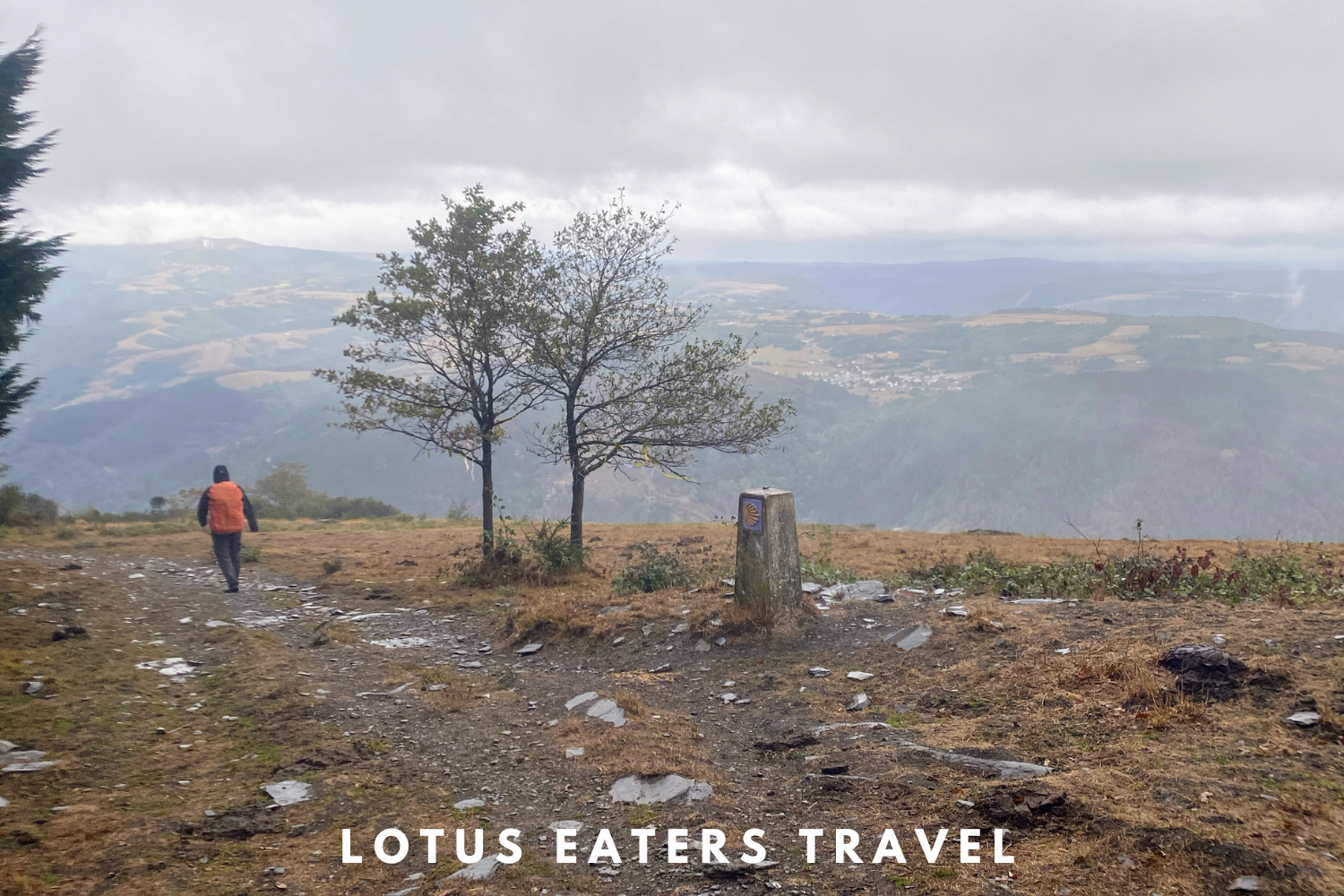
The Hospitales route is the most infamous stretch, taking you across exposed mountains with no facilities. We chose the main route viaPola de Allande, which avoids Hospitales, but still meant tackling the long climb to Puerto de Palo – 700m over 9km, followed by a steep descent that left our legs shaking with fatigue by the time we reached Pola.

Our experience: While the paths themselves are well maintained, the undulating terrain never lets up. Even the “easy” first day into Grado had sneaky climbs.
One aspect that does make things easier, in our view, is that the Primitivo route spends a lot of time on trail. In contrast to the Camino del Norte, for example, which requires significant road walking. I found that my feet were in much better shape on the Primitivo – no blisters and relatively no pain.
The fact that the climbs aren’t technical and are generally quite steady, means it is accessible to most walkers with a reasonable level of fitness.
The Distance
At around 323km, the Camino Primitivo is shorter than the Camino Francés or Portugués, and most people complete it in two weeks. But short doesn’t mean easy.


Typical stages: 20–30km. But it’s possible to include some shorter stages, even 12 or 13km on some days. If you wanted to keep all of your daily stages under 30km, it’s very feasible to do this. But I would not recommend the Camino Primitivo unless you’re comfortable walking 20km as a minimum on some days.
Longest day for us: 35km, from O Piñeiral to Vilar de Cas. It was a push, but we wanted to stay at a particular albergue, and collapsing into a hammock in the garden with a glass of wine made it worthwhile.
Our experience: Shorter days helped balance the tough ones – for example, we deliberately stopped early in Casazorrina just to enjoy a boutique albergue. But there’s no denying that longer stages, especially those with multiple climbs, felt like endurance tests.
Weather
Asturias and Galicia are both famously green, which means rain is almost guaranteed at some point during your journey.
High points like Puerto de Palo can be windy and exposed, with mist rolling in suddenly.
In high summer, heat adds another layer of difficulty on the climbs. And in Galicia? It almost felt like the rain got heavier the moment we crossed the border.

Our experience: We had everything from glorious sunshine to drenching downpours. On one memorable day, we sat in a bar with 30 other Camino walkers, all of us sopping wet and not wanting to go back outside. The weather got so bad (in late August) that a few walkers actually got taxis.
Realistically, the Camino Primitivo is a summer route and best walked from June to September.
Accommodation and Amenities
One challenge of the Primitivo is the spacing of albergues and cafés.
Some days have long stretches (15–20km) with no facilities, so carrying snacks and water is essential. But this is quite rare and we generally found the infrastructure good.


Certain villages have only one albergue, which means planning ahead or risking turning up to find it full. Realistically, booking albergues on the Camino Primitivo is recommended. We did meet a few people who were winging it, but then one of them had to walk 45km one day when he couldn’t get accommodation. On this route, booking ahead is better.
Our experience: The rewards were worth it. Quirky albergues in little mountain towns, a grand hostel hidden under a 4-star hotel in Tineo, and rustic rural stays with home-cooked dinners (some better than others). But yes, sometimes that meant walking a little further than we wanted, or eating crisps and apples for lunch when there was no café in sight.
Physical Demands
If you’re used to flatter routes like the Portuguese, the Primitivo is a step up. But it doesn’t mean it’s unattainable with a little bit of training.


Daily climbs: 700–1,100m, especially in Asturias.
Steep descents: The 8km downhill into Grandas de Salime drops from 1,000m to 200m. It looks beautiful, but your knees will disagree.
Constant undulation: Even on “easy” days, the rolling terrain keeps you working.
Our experience: We’ve walked some tough trails – the GR131 in Gran Canaria for example. So we are well versed with hilly hikes, and even then, by the time we rolled into Pola de Allande my legs felt like jelly. Without a doubt, this is the hilliest Camino we’ve ever walked.
The Mental Side
The Primitivo is quieter and can feel wilder than other Caminos, particularly the Frances. But this doesn’t mean you’ll walk alone – we had met 3 or 4 pilgrims within 8km on our first day.
We would normally see 40-50 people over the course of a day. Indeed, over the last few years the number of people on the Primitivo has increased by 15% each year.

Our experience: We loved the sound of cowbells echoing through the hills, which became the soundtrack to our time in Asturias. But there were moments – usually halfway up a never-ending climb – when I wondered why we hadn’t chosen an “easier” Camino. These thoughts were certainly feeling and outweighed but the beauty of our surroundings.
So, Is the Camino Primitivo Difficult?
Yes, the Camino Primitivo is more physically demanding than most other Camino routes. The climbs, the descents, and the weather all add up.
But “difficult” doesn’t mean impossible. With some training, good planning, and the right mindset, it’s absolutely achievable. And what you get in return – relatively empty trails (compared to theFrances and Portuguese routes), mountain views, quiet villages, and the pride of finishing one of the oldest and most authentic Camino routes, makes every tough moment worthwhile.


Our verdict: The Camino Primitivo is challenging, yes, but it’s a challenge that rewards you tenfold. If you want a Camino that feels wild, rugged, and deeply satisfying, this is the one.
You might also like: Our Camino Primitivo Daily Stages: From Oviedo.
Written by Emma
Wine Lover. Yogi. Hiker. Writer.


18 best long distance hikes in Europe for June
18 BEST LONG DISTANCE HIKES IN EUROPE FOR JUNE. June is one of the very best months for hiking in Europe. Summer has arrived, the days are long, and most trails are finally free of winter snow. But, if you head out for a long distance hike in Europe, you’ll be beating the crowds of…

Do you need to book accommodation on the Camino Primitivo?
DO YOU NEED TO BOOK ACCOMMODATION ON THE CAMINO PRIMITIVO? PROS AND CONS. We walked the Camino Primitivo recently and after much debate, decided to book all of our accommodation ahead of time. While the Primitivo is often described as one of the quieter Camino routes, that reputation is becoming outdated. Throughout the summer we…
Taking the ferry from Laredo to Santoña: a short guide
TAKING THE FERRY FROM LAREDO TO SANTONA ON THE CAMINO DEL NORTE: A SHORT GUIDE. Walking the Camino del Norte along Spain’s northern coast brings many unique experiences. For me, one that stands out is the crossing the estuary from Laredo to Santoña by ferry. Despite being a quick journey, it’s a rare chance to…
Most of our planning is done using other blogs, but you can’t beat a guide book at the bottom of your case.
Find them here on Amazon.

USEFUL LINKS FOR FLIGHTS, ACCOMMODATION AND TRANSPORT


CHECK LATEST FLIGHTS
ACTIVITIES TO CONSIDER
FOLLOW US ON SOCIAL MEDIA
Please note that some links on our website are partnered with affiliates. Using an affiliate links does not make it more expensive for you to purchase. We receive a small commission whenever you buy something which in turn allows us to keep writing independent travel guides and your support is greatly appreciated.