

HOW MUCH DOES IT COST TO WALK FROM OSLO TO TRONDHEIM ON ST OLAV’S WAY?
Walking Pilegrimsleden is very different from walking the Camino in Spain or the Via Francigena in Italy.
There are fewer cafés, no €10 pilgrim hostels, and long stretches with nowhere to buy anything at all. We spent evenings eating pasta and tinned fish by lakes. On other days, we were surprised by small indulgences— a cold beer on a supermarket bench, or a cinnamon roll that momentarily felt like an out of body experience.
This guide sets out the real costs of walking St Olav’s Way, based on what we spent and what you can sensibly expect today.
It is not intended to scare you away. If anything, it should help you understand why this pilgrimage feels so different: fewer people, more trust, and long stretches where every choice—where you sleep, what you eat, whether you carry your own pack—has a financial implication.

The costs below are practical and grounded in experience. They do not account for sunsets over Lake Mjøsa, the wind rustling in the pine forest, or the quiet arrival into Trondheim when no one else is watching. Those parts are free.
Is it expensive to walk St Olav’s Ways from Oslo to Trondheim
St Olav’s Way is, on balance, more expensive than many other European pilgrimage routes. The main reason is structural rather than touristic: Norway has a high cost of living, a low population density along rural stretches, and fewer low-cost accommodation options.

Whereas the Camino de Santiago is built around inexpensive albergues, St Olav’s Way relies heavily on farm stays, cabins, hostels and campsites. You will not see the same level of €10–15 beds that exist in Spain or Portugal.
That said, costs are manageable if you plan carefully and use Norway’s right-to-roam camping laws.
What’s the currency in Norway
Norway uses the Norwegian Krone (NOK).
For simplicity, many walkers use 10 NOK ≈ $1 USD as a working conversion (this rate has remained fairly steady in the last few years.)
Card payments are widely accepted and cash is rarely necessary.
How much is accommodation on route


Below you can find a guide to accommodation costs on the St Olav’s Way from Oslo to Trondheim.
| Type of accommodation | Approximate Cost |
| Camp Site with own tent | 200-300NOK /$20-30 (per tent) |
| Cabins | 300 NOK to 1000 NOK (depending on location and facilities)/$30 to $100 (per person) |
| Home Stay/ Farm Stay (private room) | 500 NOK to 1000 NOK (depending on location and facilities)/ $50 to $100 |
| Home Stay/ Farm Stay (shared bedroom) | 350 NOK to 900 NOK (depending on location and facilities)/ $35 to $90 (per person) |
| Hostel (shared bedroom) | 300 NOK to 700 NOK (depending on location)/ $30 to $70 (per person) |
| Refuge/ Overnight Shelter | Some are free, but expect to pay 3000NOK/ $30 to stay in the Refuge in Ryphusan (which has great facilities) |
| Wild Camping | Free! |
You can find a more detailed guide to the different types of accommodation on route here.

What to budget for food
Food costs can vary significantly depending on how you approach meals.
Supermarkets such as Rema 1000, Kiwi and Coop Prix offer the best value.
Grocery shopping allows most walkers to remain in the region of 150–250 NOK per day, depending on appetite and the amount of prepared food purchased along the way.
Here are some typical costs of hiking food staples:
- Cheese (500 g): 60 NOK
- Bananas (1 kg): 22 NOK
- Pasta (1 kg): 20 NOK
- Chocolate or cake bar: 30 NOK
- Bread (loaf): 30 NOK
- Tinned fish: 30 NOK

Tip – Unlike on some hiking routes – you can drink the tap water everywhere, so that’s one cost you don’t have in Norway!
What did we eat on route?
Our diet on route relied pretty heavily on a rotation of tinned fish, bread, eggs, cheese (Norwegian brown cheese is insanely good), pasta and snacks (like cake bars, cinnamon rolls and a few sweeties.)


We found a supermarket which offered takeout pizza on one occasion – an absolute treat. And, we would sometimes buy a couple of beers or seltzer from supermarkets for an evening treat (expect to pay between 30 and 60 NOK for a can).
Once or twice we ate in our accommodation – where food was included in the rate. We also had one meal in a restaurant on a campsite, even treating ourselves to a pint!
Dining out


Dining at accommodation increases costs quickly. A typical farm stay dinner will sit around 150–300 NOK, and breakfast 80–150 NOK. For some pilgrims, a cooked meal every few days is a worthwhile expense. Restaurant meals in towns are consistently higher, and can often exceed 300 NOK.
How much does luggage transfer cost

Firstly, it’s worth noting that luggage transfer is not available at every stage. It’s still a little patchy on route – nowhere near as cohesive as on the Camino de Santiago.
They are generally priced per bag, per stage. Fees usually fall in the 200–400 NOK range per transfer. It is a useful option for walkers with injuries or heavy equipment, but it is an ongoing cost that adds up quickly over a long walk.
What else to budget for

There are several smaller categories that can impact your overall budget:
- Transport to and from the route, including the train from Trondheim at the end of the journey.
- Pilgrim passport, generally 50 NOK.
- Maps or guidebooks. Printed guides are commonly 250–400 NOK.
- Laundry, often offered informally at farm stays.
- Replacement gear, such as socks, blister care, or waterproofs. Outdoor equipment in Norway is not cheap.
These expenses are unlikely to dominate your budget individually, but together they should be accounted for.
Total cost of walking from Oslo to Trondheim on St Olav’s Way

The route is approximately 640 km, and most walkers take four to six weeks.
Based on current accommodation and food prices:
Very low-cost approach (primarily camping, supermarket food):
Approximately 150–400 NOK per day.
For four weeks this equates to 4,200–11,200 NOK ($420–$1,120).
Moderate budget (mixed accommodation, self-catering most days):
Approximately 500–900 NOK per day.
For four weeks: 14,000–25,000 NOK ($1,400–$2,500).
Comfort-focused approach (farm stays or private rooms, frequent meals provided):
Approximately 900–1,500 NOK per day.
For four weeks: 25,000–42,000 NOK ($2,500–$4,200).
What did we spend?

We camped for most of the route – a combination of wild camping and staying on campsites. This was punctuated by one farm stay and hotels in Oslo and Trondheim. We predominately ate supermarket food, with one or two meals out throughout the month.

In total – we spent approximately 10000 NOK or $1000 (€800-900) on accommodation for the month (for two people). Our flights cost and train totalled 2000 NOK, or $200 (€170) and our food/ drinks around 13000 NOK or $1300 (€1200).
A total spend of 25,000 NOK or $2500 (€2150) for two people.
Whilst this is marginally more expensive than walking the Camino de Santiago for a month, we were able to keep costs down significantly by staying in our tent.
Top tips for keeping costs down

Accommodation savings have the largest impact. Carrying a tent allows you to camp legally almost anywhere, so long as you respect distance from buildings and leave no trace. We mixed things up with wild camping and overnight stays at campsites (costing around 200NOK.) This really kept costs down for us.
Food costs are managed most effectively through supermarket shopping and simple meals. Stay away from fresh meats, and pick tinned fish and dried foods like pasta.
While local cafés and farmhouse dinners have cultural appeal, they increase daily spending quickly. Carrying a camping stove can mean you can brew up coffee in the morning for much less.
One way to keep costs down is to avoid staying in cities. For example, instead of walking from Oslo, walk from the airport – you can join the route quite easily from there and this avoids the necessity of an overnight in the capital.

Likewise, when you arrive to Trondheim, it is possible to take an overnight train from the city back to Oslo. Thus, you don’t have to stay in Trondheim. Honestly, we really loved both cities – so it’s difficult to recommend skipping them – but if you want to keep costs down, this is one way to do it.
If you do decide to visit both cities – you can find our guides to visiting Oslo on a budget here and the best things to do in Trondheim here.
Finally, buy all your gear beforehand and test it out. Buying hiking equipment in Norway mid-route is far more expensive than purchasing it beforehand. We had a minor sock emergency and had to buy some at a hiking store in Lillehammer – not cheap!
Written by Emma
Wine Lover. Yogi. Hiker. Writer.


A diary of walking our pilegrimsleden in Norway
Views on Pilegrimsleden. We walked St Olav’s Way from Oslo to Trondheim in June 2023. This was one of our favourite European pilgrimages to date. If not, the best one we have walked. Everything about the route was so magical. Based on my journal from the walk, here is a diary of my adventures walking…

How to train for St Olav’s Way in Norway
I have recently completed the St Olav’s Way walk from Oslo to Trondheim. This is the latest in a series of long-distance hikes that I have completed. Despite walking regular long distances, I’ve managed to remain injury free. I credit this to regular and structured training before completing any hike like St Olav’s Way. Here’s…
What to pack to walk St Olav’s Way in Norway
Packing for a long-distance hike is one of the most important preparation activities. This is especially important when walking St Olav’s Way in Norway. We recently walked from Oslo to Trondheim. Here is our ultimate guide to what to pack to walk St Olav’s Way. You can find more of our St Olav’s Way walking…
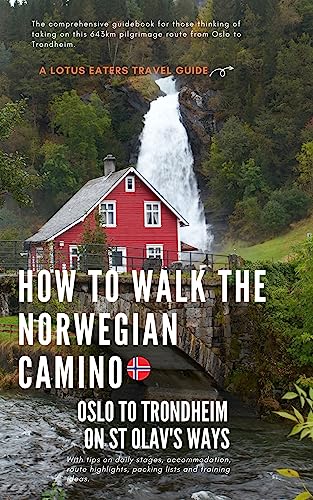
Most of our planning is done using other blogs, but you can’t beat a guide book at the bottom of your case. Find yours on here on Amazon and get the travelling started!


USEFUL LINKS FOR FLIGHTS, ACCOMMODATION AND TRANSPORT


CHECK LATEST FLIGHTS
ACTIVITIES TO CONSIDER
FOLLOW US ON SOCIAL MEDIA
Please note that some links on our website are partnered with affiliates. Using an affiliate links does not make it more expensive for you to purchase. We receive a small commission whenever you buy something which in turn allows us to keep writing independent travel guides and your support is greatly appreciated.