
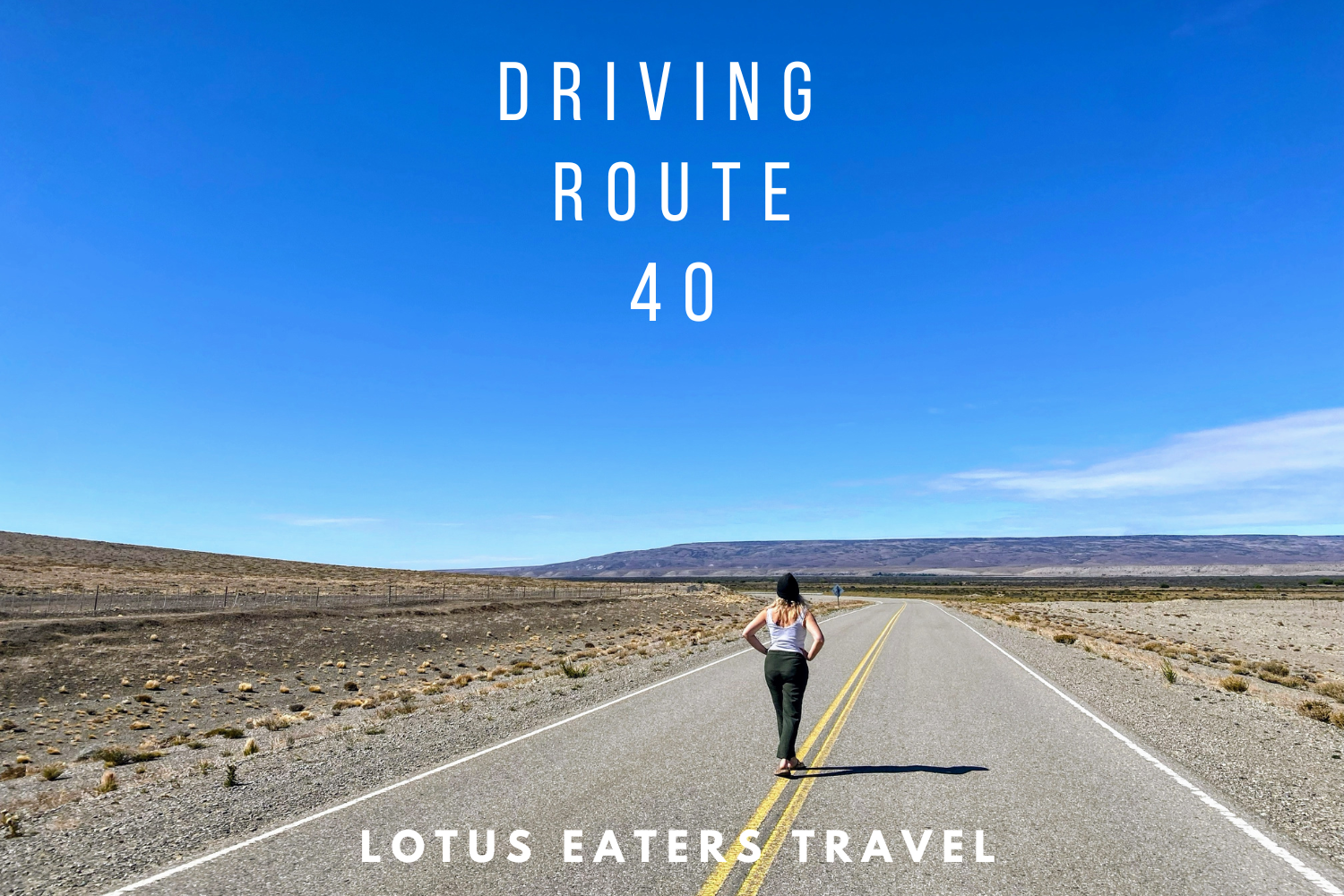
DRIVING ROUTE 40 ARGENTINA: AN EPIC EDUCATION.
We have long held dreams of visiting Argentina. When we started planning our trip, we both knew that we wanted to make it a road trip. Driving down route 40, heading down the length of one of the most epic countries in the world – we had to do it.
Suffice to say, route 40 wasn’t quite the smooth sailing adventure that we had anticipated. Would we do it again? Possibly. But our epic education on the route 40 in Argentina, means that we wouldn’t make some of the same mistakes again.
In this post, we share everything we learnt after driving on the route 40 and route 3 in Argentina. Helping you to, hopefully not, make the same mistakes that we did!

How to hire car in Argentina
It is best to hire a car in advance of arriving in Argentina, especially if you want a good deal. Generally, it is easier to collect your car at the airport, rather than in a city, but it may cost a little more.
We have previously used Discover Cars, although this time did not (more on that below.) We do recommend them, but in Argentina, you could also book directly with a reputable hire car company, such as Hertz – as set out below, this can take a little bit of the risk out of your experience.
Below are a few more tips to keep in mind when hiring a car to explore Argentina.
Avoiding hire car scams
We hired two cars in Argentina and had mixed experiences with the hire car companies. I should say that we chose to use booking.com to book our hire cars on this occasions – we normally use another provider, but due to last minute changes to our itinerary, we were left with booking.com as the only option.
In both cases, booking.com connected us to third party hire car companies to arrange our car collection in airports in Argentina. We were surprised to learn that both of these companies did not actually have offices in the airports – instead, we were greeted in arrivals hall by one person and shown to the car. Whilst this isn’t that unusual, it did make us feel a little uneasy.
Long story short – this seems to be quite a common set up in Argentina. But, we had mixed experiences with this. The car we hired and returned to Bariloche airport was in good condition and the company were very professional (despite not having an office.) However, our experience in Mendoza was less than desirable.
In this instance, we were forced to provide a deposit for the car on a debit card – not something we would usually do – but the hire car refused to accept our Amex. Suffice to say, two months later and we still have not received that deposit back. And, the “company” have now blocked us on Whatsapp. We have asked booking.com to intervene and await an outcome.
All this to say – we recommend booking with a more reputable company if you hire a car in Argentina!
Do you need an international drivers permit to drive in Argentina?
You’ll need a valid drivers license in the latin alphabet – if you have this, then you won’t need an international drivers permit to collect your hire car in Argentina. If your drivers permit is in another script, such as Arabic, then you may need an international drivers permit.
What about insurance?
We would always recommend getting car hire insurance – but it’s also worth noting that third party insurance is required by law in Argentina.
What kind of car to hire in Argentina

When it came to choosing the type of car to hire in Argentina, this is where we went so wrong. And, here we are to share the lessons we learned with you!
Manual v Automatic
Do not get a manual hire car – we both have experience of driving manual and automatic cars. In Argentina, we found that booking an automatic was more expensive – so made our first big mistake.
Yes, you guessed it, we went for the cheap option and booked a manual! Now, in Mendoza and to an extent on route 40, this was fine. But if you plan to drive anywhere around Bariloche, an automatic is a much better idea as it is very hilly! I’m talking extreme hill starts.
Besides this, an automatic will make the very long journeys driving in Argentina much more comfortable.
Do you need a 4×4 in Argentina?
A 4 x 4 is ideal if you plan to drive route 40 – there are large sections of route 40 in Argentina that are unpaved. Instead, you are forced to drive pretty long distances on gravel.
As we drove along in our Renault at 20kmh, every stone that we hit jolting the suspension of the car – it seemed that everyone else was in a 4×4 driving past us with no worries in the world!
If you plan to drive long distances, especially on route 40, and you want to explore off the beaten track in Argentina, we recommend hiring a 4×4.
Mileage limits
Check the mileage limit on your hire car deal – not all hire cars allow “unlimited mileage”. Fortunately, this wasn’t a mistake that we made, but it would have been easy to. When you hire your car, check that you aren’t capped on the number of miles you’re allowed to drive. If you’re planning a road trip, you’re going to need unlimited mileage.
Driving in Argentina: What’s it like?

What is it like driving in Argentina? Is it safe? It wasn’t as bad as we had expected in some aspects, but it was much worse in others. Here are a few things that we learnt:
1 / Frequent police checks
There are so many police checks everywhere. However, we only got pulled over once during our month of driving. If you see a police check, slow down and wait for instructions. Normally, the police will just want to check your paperwork.
2 / Driving isn’t that crazy –
During our month of driving in Argentina, we didn’t really encounter any crazy bad drivers. Even in Mendoza city and other built up areas – we found the roads quite calm. On route 40 and the longer routes, cars overtook us frequently, but we didn’t find the driving style too aggressive.
3 / You have to have your wits about you
That said, sometimes the dangers on the road aren’t other drivers. Our first experience of driving in Argentina was coming out of Mendoza airport. It was here that we experienced some strange behavior from pedestrians.
As we drove down the highway near to the airport, three different people ran in front of our car (yes, on the highway.) This seems to be a bit of a ploy to get tourists to stop, with a view to stealing things from your car. Fortunately, we didn’t stop.
It is also advisable to keep your cars locked at all times when you are driving, including the boot. When parked up, don’t leave valuables in the car.
4 / You must keep your headlights on
This is a weird quirk, but one that is easy to get used to. In Argentina, it is a legal requirement to always have your headlights on at least half beam, even during the day.
Where is route 40 Argentina?

Route 40 in Argentina runs along the west of the country, parallel to the Andes. From the North or Argentina in the region of Salta to the South in Rio Gallegos. Chances are, if you are going on a road trip in Argentina, you will be driving on Route (Ruta) 40.
For example, driving South of Mendoza to the Uco Valley, requires a stint on route 40. As does travelling from Mendoza to Bariloche, or from Bariloche to El Chalten.
Driving route 40: All you need to know

If you’re planning to drive on Route 40, you might be picturing a Thelma and Louise style road trip. Sunglasses on. Good music on the stereo. The wind in your hair. Epic scenery.
To an extent, that is true. We certainly had moments driving on route 40, which were incredible. 360 degree views. And nothing but us and a few Guanacos (a species native to South America and closely linked to the llama.)
But then other sections were frankly awful. There were many kms of driving around serious pot holes, or on gravel sections. Many hours spent behind the wheel where ultimate concentration was required, or we would likely lose a tire to a pot hole.
Here’s what we learnt about Route 40 (Ruta 40) in Argentina.

The distances are very long
This is probably a very obvious point to make – but the distances you’ll cover on route 40 are huge! There are oftentimes hundreds of kms, during which you won’t see anything at all. Allow yourself plenty of time, take breaks and stay overnight on route if you need to.
Forward planning is vital
When setting out on the route 40 in Argentina, we recommend a good amount of forward planning. Think about scheduling your petrol stops and food breaks in advance. Always carry plenty of water too, just in case you breakdown.
There’s no phone signal
Large sections of Route 40 do not have phone signal. This makes it even more important to plan ahead so you know in advance where your next petrol stop is. Also, keep this in mind if you need to contact your next hotel, or you wanted to stream music on your phone!
The road is not in great condition

This is probably the most important thing to note about the route 40. As one of the most epic road trips in the world, we had expected a pretty good tarmac road. This was not what we encountered.
There are long sections of beautiful smooth road, then long sections with bumps, potholes and unfinished surfaces. This is particularly a problem in the Santa Cruz, Patagonia area of the road.
Look out for signs for “Ripio”, meaning gravel. Or signs telling you to slow down due to the deterioration of the road.
One thing to note is that Google Maps directions don’t take into account how slowly you’ll need to drive in these sections. So, expect the trip to take longer than maps might tell you.
Tire pressure is very important

Because of the aforementioned pot holes and unpaved sections of route 40, tire pressure is very important. We got into the habit of inflating and checking our tires at every petrol stop.
In the end, we did burst a tire regardless of checking our tire pressure. This actually happened on a road near to the Perito Moreno Glacier, and not on route 40. But it frequently happens to cards on the 40 every day.
Animals frequently run across the road

Why did the Guanco cross the road? Seeing the guancos alongside the road is amazing, they are absolutely majestic. But, as we also discovered, they are entirely unpredictable. Many times during our journeys on the route 40, one or a group of them, would run across the road.
Sometimes you can see them close to the road and you have a chance to react, other times they might just bolt across suddenly. This is a risk to mindful of when you drive in Argentina.
We also saw armadillos crossing too. Thankfully, none of them were harmed in the process!
Is route 40 Argentina in good condition?

The short answer to this is no. Large sections of the road, especially between Bariloche and El Chalten, are unpaved or have serious problems with pot holes. Other sections are smooth sailing and easy driving. But, the potholes and gravel will slow you down considerably and may cause damage to your car.
What to do if you breakdown on route 40?
You may be wondering what to do if your car breaks down on route 40. With no phone signal, it may be a bit scary.
Thankfully, there are SOS phones along the route. In the event of a breakdown, these can be used. We also saw many other drivers coming to the rescue of stranded motorists.
In our experience, if you bust a tire and you’re not too sure what to do, someone will inevitably come along and help you!
Can you get petrol on route 40?

There are gas stations along route 40. Many are quite big and offer food, toilets etc. You can also normally pay by card at the gas stations on route 40.
You may find stretches of 100 to 200km without a gas station, for this reason, we would recommend planning ahead to make sure you have enough gas. We filled up frequently, just to be on the safe side.
Where can you get refreshments on route 40?
Along route 40 in Argentina, there are many gas stations where you can buy snacks and hot food. Small towns dotted along the route are also a great place to stop. But, do keep in mind that stops aren’t that frequent, so you’ll need to grab a lot of car snacks to keep you going!
Route 40 or route 3?

We drove from Bariloche to El Chalten on Route 40. After our experience of various pot holes and gravel roads, we were not too keen to travel down the same road as we drove from South to North. Subsequently, when driving from El Calafate to Bariloche, we opted to drive along the route 3 instead of the 40.
Route 3 runs along the east coast of Argentina, from the very south to the north. Whereas route 40 runs parallel with the Andes, to the west.
The main reason that you may want to consider route 3 instead of route 40, is that the road is in much better condition. Although the distances are longer, the road is quicker and subsequently the time differential is minimal.
We also really enjoyed driving along the coast or Argentina and the chance to see something different.
Where to next in Argentina?

You can find our guides to travelling in Argentina below:
- Buenos Aires – a three day itinerary
- Best things to do in Palermo, Buenos Aires
- Dining at Don Julio restaurant in Buenos Aires
- Where to stay in Buenos Aires
- Where to stay in Mendoza
- Our experience of staying in a wine hotel in Mendoza
- Wine cycling in Mendoza – a top experience
- Best hikes in Bariloche
- Best hikes & things to do in El Chalten
- Visiting Perito Moreno Glacier – a guide
- Driving in Argentina: A guide
Written by Emma
Wine Lover. Yogi. Hiker. Writer.


Join our subscriber list for new posts with awesome travel tips. Don’t miss them!
Subscribe below to our newsletter for tips, thru hiking, adventures and insights to places unseen.
Three weeks in Argentina: Our itinerary
OUR THREE WEEKS IN ARGENTINA ITINERARY: THE BEST BITS IN 21 DAYS If you’re reading this, I imagine you have have long held dreams of visiting Argentina. I did too! Earlier this year, my dream finally came true when I spent one month exploring the incredible country. Suffice to say, it did not disappoint. From…

El Chalten best hikes & things to do in El Chalten
EL CHALTEN BEST HIKES & THINGS DO IN EL CHALTEN. As soon as I arrived to the tiny outpost of El Chalten, I knew I was going to love it. In fact, I started to love it even before I entered the village. We were driving along in our hire car, Zero 7 blasting on…
3 best hikes in Bariloche: day hikes for your vacation
BEST HIKES IN BARILOCHE: THREE TO TRY DURING YOUR VISIT TO BARILOCHE. Bariloche, often hailed as the most beautiful town in Patagonia, is a paradise for hikers. It provides the ideal starting point for discovering mountains, lakes, and so much more. We recently visited and went in search of the best hiking trails we could…
Most of our planning is done using other blogs, but you can’t beat a guide book at the bottom of your case. Find yours on Amazon here and get the travelling started!


USEFUL LINKS FOR FLIGHTS, ACCOMMODATION AND TRANSPORT


CHECK LATEST FLIGHTS
ACTIVITIES TO CONSIDER
FOLLOW US ON SOCIAL MEDIA
Please note that some links on our website are partnered with affiliates. Using an affiliate links does not make it more expensive for you to purchase. We receive a small commission whenever you buy something which in turn allows us to keep writing independent travel guides and your support is greatly appreciated.