
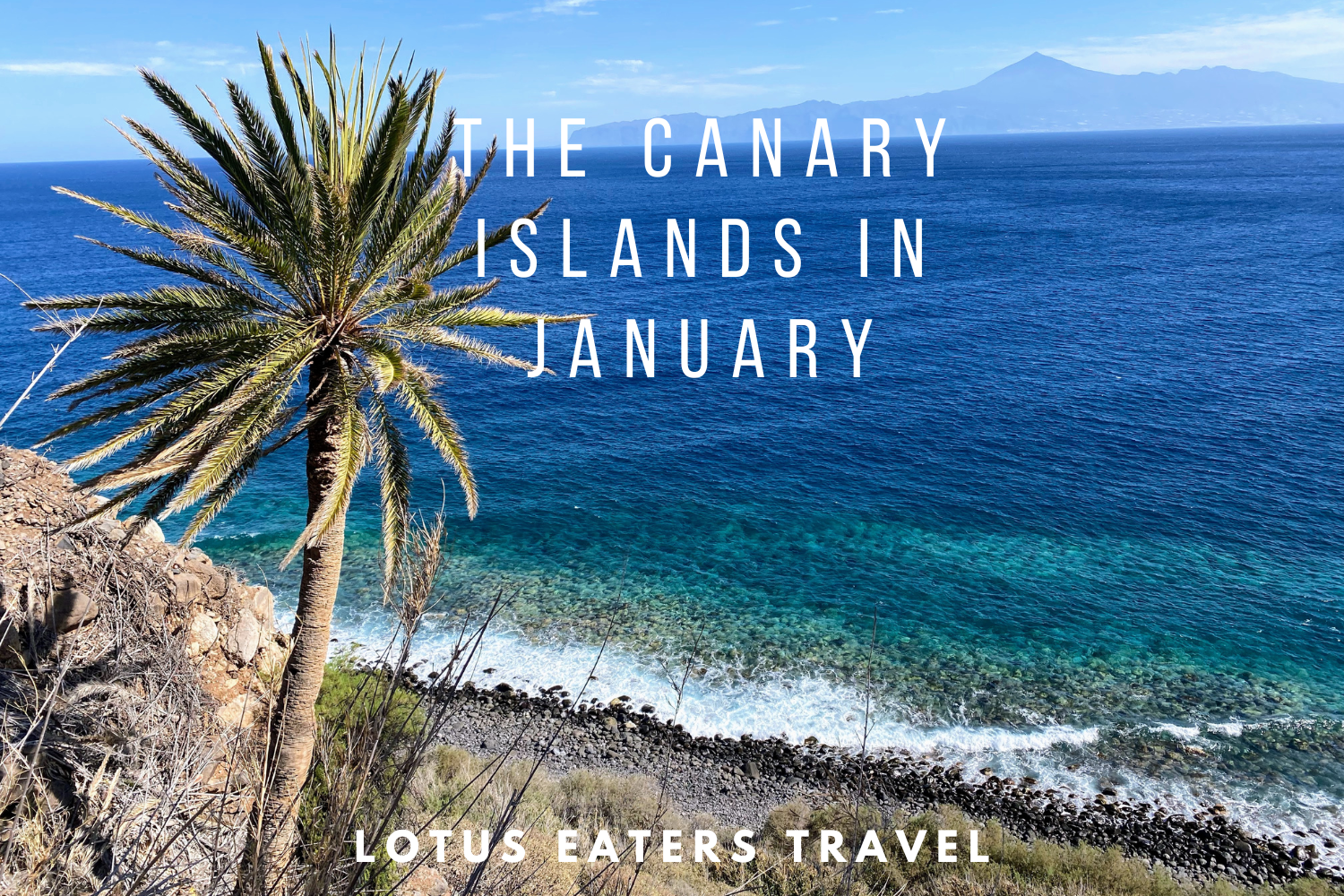
CANARY ISLANDS IN JANUARY: WHAT TO EXPECT.
I make no secret of how much I love a bit of winter sun, or indeed the Canary Islands. Having visited several times in both the shoulder and peak seasons, I was curious to see what they were like in winter, when much of Europe is huddled under grey skies and heavy coats.


What I discovered is that January in the Canaries is quietly glorious. The islands are still bathed in sunlight, the pace of life slows a little, and there’s space to breathe. It’s the kind of winter escape that feels effortlessly easy. No need for snow boots or endless layers, just sunscreen and a jumper for the evening.
Here’s everything you need to know to make the most of the Canary Islands in January.
Weather in the Canary islands in January


When much of Europe is huddled up and getting cosy indoors, in the Canary Islands you can expect daytime highs between 20–23°C (68–73°F) on most islands, with slightly cooler evenings around 15°C (59°F).
Rain is rare, though you might catch an occasional light shower. And of course, if you’re heading up Mount Teide or into the higher mountains of Gran Canaria, pack a fleece – it can get very cold at altitude.

The sea temperature averages around 20°C (68°F), which is just about warm enough for a bracing dip.
Transport in the Canary islands in the off season

Getting around the islands in winter is pleasantly straightforward. Roads are quiet, car hire prices drop, and ferries between the islands run on regular schedules. In fact, I don’t think there’s any change to scheduling.
You can find our detailed guide to using the ferries between the islands here.
If you’re staying on one island, renting a car is a good way to explore. Public transport works well on Tenerife and Gran Canaria, but in smaller islands like La Gomera or Lanzarote, it’s limited.
Accommodation in winter

January sits just after the Christmas rush, so prices begin to ease, particularly in the second half of the month. You’ll find plenty of great-value hotels, villas, and rural fincas available – often at half the price of summer.
When we visited in January, we got an all inclusive hotel in Tenerife for about €80 per night. And, more low key rooms for €40-50.
Tenerife’s south coast (Costa Adeje and Los Cristianos) and Lanzarote’s Playa Blanca stay lively year-round.
Beaches & sunbathing in winter

Yes, you can absolutely sunbathe in January. The southern beaches of Gran Canaria, Tenerife, and Fuerteventura are your best bet for warmth and calm seas.
We snatched a few hours on the beaches during our three week trip – and I did brave the sea a few times. Don’t get me wrong, there were days when it was too chilly or windy to hit the beach, but we also had plenty of days with wall to wall sunshine.

Playa de Maspalomas, with its golden dunes, is a classic choice; Playa del Duque in Tenerife offers a more polished vibe with stylish cafés and loungers.
If you prefer something wild and rugged, Morro Jable is spectacular – a windswept paradise with miles of untouched sand (just bring a jacket; it can get breezy).
Hiking in the Canary Islands in January

January is arguably one of the best months for hiking here. The cooler air makes long walks much more comfortable, and the landscapes are at their greenest after a little winter rain.
We walked the GR131 across five islands when we visited – a long distance trail. But there are so many other choices for the day – like Roque Nublo Trail in Gran Canaria, forest walks in La Gomera or Tiede National Park in Tenerife.
What to wear & pack in January


Packing for the Canaries in January is all about layers.
If you’re staying near the coast and at low altitude, during the day, think light dresses, shorts, lightweight trousers, and T-shirts. But it’s always best to have a sweater and jacket to hand, especially in the evening.
If you’re hiking, like we did, bring sturdy shoes and a waterproof layer, especially if you plan to head into the mountains.

Don’t forget your swimsuit, sunglasses, and sunscreen – even in winter we still got through a bottle of factor 50.
Things to do in the Canary Islands in January
Realistically in January, not every day is going to be a beach or pool day. But luckily, there’s loads to across the different islands.
1/ Go for a hike

From Tenerife’s volcanic trails to the dramatic cliffs of La Gomera, winter hiking here is a dream. You’ll pass cacti, wildflowers, and the occasional goat, all under a bright blue sky.
2/ Walk along the beach

Even if you’re not swimming, long beach walks in January feel blissful. The sand is warm underfoot, the light is soft, and you’ll likely share the space with less people than in high season.
3/ Enjoy a long lunch by the sea


There’s something wonderful about enjoying lunch by the ocean when weather is cooler. Order a bottle of local white wine from Lanzarote, some grilled fish, and papas arrugadas (the famous wrinkled potatoes with mojo sauce). Sit back and watch the world go by.
4/ Head to a vineyard


Yes, the Canaries make wine – and it’s excellent. On Lanzarote, visit La Geria, where vines grow in volcanic craters. Or try Bodegas Monje orFinca Ecológica Alma de Trevejos, both in Tenerife.
You can also book tours which include wine tasting experiences.
5/ Explore a city

Spend a day in Las Palmas (Gran Canaria) or Santa Cruz (Tenerife). Wander the old towns uninhibited by heat and crowds, visit local markets, and enjoy a slow coffee.
6/ Try a new sport
January is perfect for kite surfing, paddleboarding, and diving. Head to El Médano in Tenerife for consistent winds and a laid-back surf town feel. If you prefer calm water, Fuerteventura’s lagoons are ideal for beginners.
7/ Take a scenic drive

The islands are made for road trips. Drive through Tenerife’s Teide National Park, across Lanzarote’s Timanfaya volcanic landscape, or along the winding coastal roads of Gran Canaria.
8/ Visit a market

In winter, local markets are buzzing but not packed. Pick up handmade pottery, island cheese, or palm honey. The Teguise Market in Lanzarote is one of the best.
Detailed Canary Islands Guides
We’ve got more guides for the Canary Islands below:
- Walking the GR131 – a guide for planning
- Best things to do in Fuerteventura
- Best things to do in La Gomera
- The Canary Islands beyond the fly and flop
- Canary Islands or Madeira
Written by Emma
Wine Lover. Yogi. Hiker. Writer.


15 best hikes in Europe for April
15 BEST HIKES IN EUROPE FOR APRIL. April is a wonderful month to enjoy hiking in Europe, whether you’re looking for a long distance trail or a few days of trekking. But, you have to pick wisely to find the best hiking weather. In the north, trails might still be snowbound. But head a little…

10 Hiking Routes in Europe for December: chasing the sun
10 HIKING ROUTES IN EUROPE FOR DECEMBER: CHASING THE SUN. Late last December, we set out to walk the Fisherman’s Trail. A long distance hiking trail that wraps around the very south western point of Portugal and takes in the best of the Algarve. Not a day went by when we didn’t pinch ourselves, feeling…
Canary Islands Ferries: All you need to know
CANARY ISLANDS FERRIES: ALL YOU NEED TO KNOW TO GO ISLAND HOPPING. In early 2024, we traveled extensively around the Canary Islands, island hopping from one to the other. We were so impressed with the ease of moving around the Canary Islands, as well as the islands themselves, that we wanted to share this blog…
USEFUL LINKS FOR FLIGHTS, ACCOMMODATION AND TRANSPORT


CHECK LATEST FLIGHTS
ACTIVITIES TO CONSIDER
FOLLOW US ON SOCIAL MEDIA
Please note that some links on our website are partnered with affiliates. Using an affiliate links does not make it more expensive for you to purchase. We receive a small commission whenever you buy something which in turn allows us to keep writing independent travel guides and your support is greatly appreciated.