
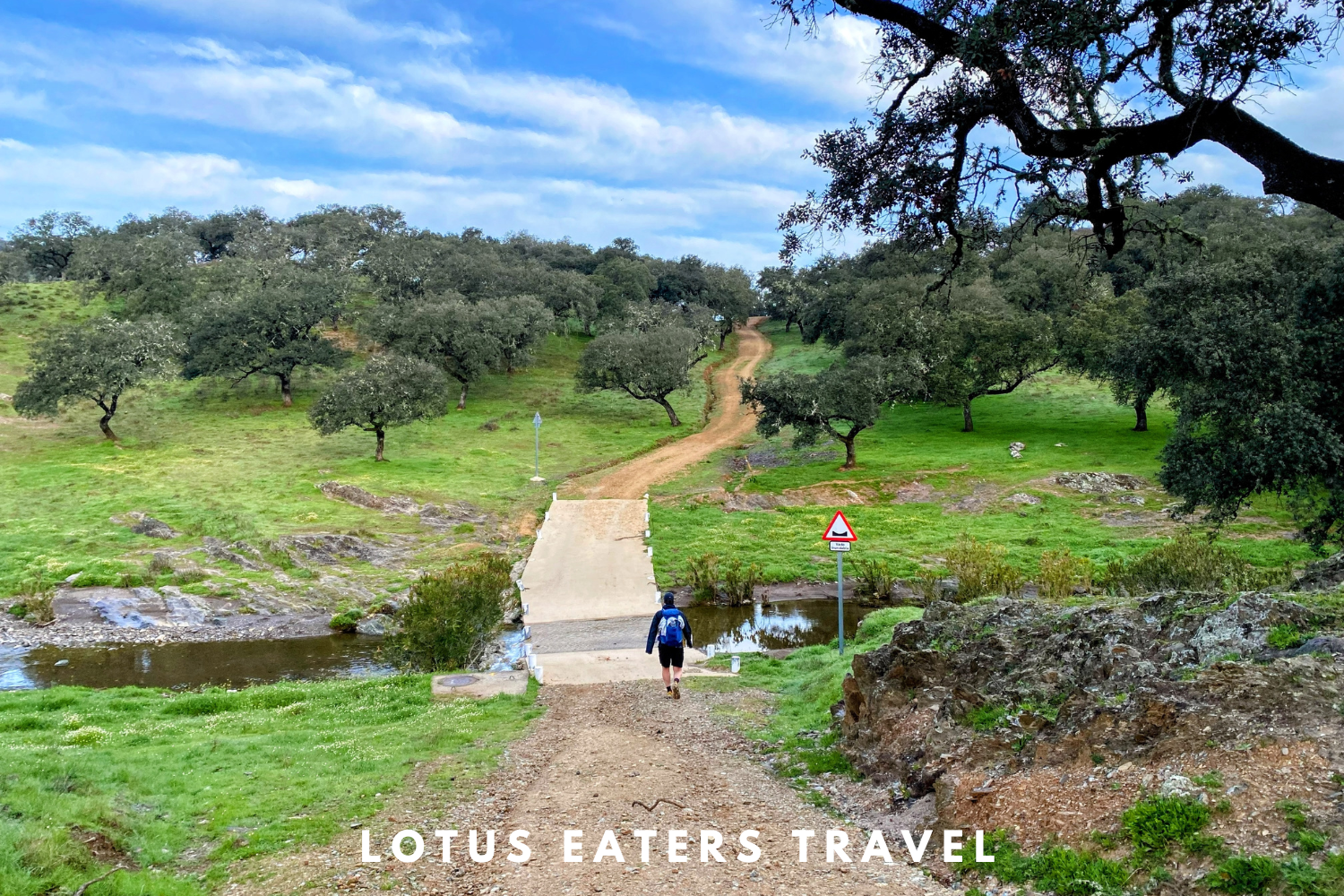
VIA DE LA PLATA STAGES: SEVILLA TO MERIDA.
The Via de la Plata begins in the beautiful Andalusian city of Seville and heads north across Spain, eventually joining either the Camino Francés or the Camino Sanabrés on the way to Santiago de Compostela.
The opening section from Seville to the Roman city of Mérida covers around 210km and is most commonly walked in nine days, averaging about 23km per day. However, there is plenty of flexibility to walk shorter or longer days depending on your fitness, accommodation choices and time available.
For our walk, we chose to cover the distance in six days, averaging around 35km per day. While this is longer than the traditional stages, it worked well for us and is manageable for experienced walkers.

Over the 210km, expect roughly one quarter of the route on road or asphalt, with the remainder on dirt tracks, farm paths and trail. The total ascent is about 2800m, with 2600m of descent, meaning the overall terrain is fairly gentle compared with many other Camino routes.
What this section lacks in dramatic mountains it makes up for in atmosphere. The walk passes through wide open countryside, traditional dehesa farmland, quiet villages and historic towns. Wildlife is plentiful and there are long stretches where you may see very few other walkers.
Below we break down the stages from Seville to Mérida, including route descriptions, highlights, amenities and accommodation options.
Stages Overview
| Stage | Route | Distance |
|---|---|---|
| Stage 1 | Sevilla → Guillena | 22 km |
| Stage 2 | Guillena → Castilblanco de los Arroyos | 19 km |
| Stage 3 | Castilblanco de los Arroyos → Almadén de la Plata | 28 km |
| Stage 4 | Almadén de la Plata → Monesterio | 33.5 km |
| Stage 5 | Monesterio → Fuente de Cantos | 20.5 km |
| Stage 6 | Fuente de Cantos → Zafra | 24 km |
| Stage 7 | Zafra → Villafranca de los Barros | 20 km |
| Stage 8 | Villafranca de los Barros → Torremejía | 27 km |
| Stage 9 | Torremejía → Mérida | 15 km |
Stage 1: Sevilla to Guillena


KEY DETAILS: 22km, 100m ascent, 100m descent.
ROUTE: A flat and easy route leaving the city of Sevilla via Triana. After leaving Triana, the path follows along the river on scrubland, which many walkers find to be a bit of an anti-climax. Some choose to start in Santiponce to avoid this walk, which personally we didn’t find to be so bad.
After Santiponce, expect trail and some olive groved areas, all the way into Guillena.


HIGHLIGHTS:
- Leaving Sevilla by bridge into Triana is a standout.
- The Roman area of Italica (in Santiponce), would be worth taking time to visit for history lovers.
- Guillena is a friendly town with oodles of orange trees lining the streets.


AMENITIES:
- Amenities can be found in Sevilla central and as you leave the city (many cafes will open early.)
- Santiponce (9km), has cafes and grocery stores.


ACCOMMODATION: A popular albergue in Guillena is Pilgrim’s Hostel Luz del Camino (accepts bookings). Hostal Bar Frances has private rooms.
Stage 2: Guillena to Castilblanco de los Arroyos

KEY DETAILS: 19km, 400m ascent, 100m descent.
ROUTE: From Guillena, you’ll leave via a bridge before heading through an industrial area. This leads to trail and enters into the Sierra Norte region.
We particularly enjoyed the tree lined trails in the latter half of the day, leading to Castilblanco de los Arroyos.

HIGHLIGHTS:
- Lots of trail, which was particularly pretty for the latter half.
- Castilblanco de los Arroyos has a fantastic albergue.
AMENITIES:
Between the two towns, there are no amenities. In Castilblanco de los Arroyos you can find bars and restaurants, many were not open or serving food when we visited in the evening but were reliable for breakfast the next day. There are also grocery stores.
ACCOMMODATION: Castilblanco de los Arroyos has a fantastic donativo albergue (Albergue de peregrinos Castilblanco,) which has a kitchen and terrace and sleeps 16. If you stay at this albergue, you can get access to the local swimming pool (what a bonus in warmer months!)


Albergue Casa Salvadora offers private accommodation as does En casa de la Daguilla.
Our daily stages: It is possible to merge stage 1 and stage 2 to create a longer walking day of 40km as we did. Whilst this is not recommended for most walkers, if you are trained and have walked a lot, it is a manageable distance.
Stage 3: Castilblanco de los Arroyos to Almadén de la Plata

KEY DETAILS: 28km, 550m ascent, 450m descent.
ROUTE: The route starts with a significant stretch of road walking, approximately 9km. As well as around 7km on a dirt track running alongside the road. It is not exciting walking.
The second half of the day is a corker – entirely through stunning national park. We didn’t see any other walkers for the entire route and it felt that we had the entire park to ourselves. This park area has the first river crossing, on stepping stones. Easy when we walked.
The lack of shade on the route today is humbling – be sure to carry plenty of water and walk early if it is warm.
Towards the end is a steep climb, which rewards with views. Then a descent into town.


HIGHLIGHTS:
- The national park area with beautiful flora and fauna is a stand out on the whole route;
- Although the climb is tough, the views are special.
- The set menu at Casa Concha to finish off the day is recommended.

AMENITIES: There are no amenities on route. As much of the route is exposed, it’s very important to carry enough water – we carried 2 litres each and had run out by the time we arrived.


ACCOMMODATION: Almadén de la Plata has a large municipal albergue (you can normally enter and then register in the evening when a hospitalero visits). It costs €10 per person. It has a kitchen, dining room and large bedrooms.
Casa Concha offers very inexpensive private rooms, which can be booked in advance. Incidentally, this is also the best place for dinner in the evening.
Stage 4: Almadén de la Plata to Monesterio

KEY DETAILS: 33.5km, ascent 700m, descent 450m.
ROUTE: This is a long and challenging stage, with a number of surprisingly tough hill climbs along the way. Leaving Almadén de la Plata, we passed the town’s bullring before joining the trail and heading out into the countryside.


It turned out to be a day full of animal encounters. Much of the route passes through areas of dehesa – traditional pastureland dotted with oak trees and used for grazing livestock. Here we saw plenty of snuffling pigs rooting around beneath the trees, and later passed through fields filled with horses.
As we approached El Real de la Jara, a castle perched high on the hill came into view, with the village spread out below it – a striking sight after the long walk through open countryside.


Later in the day, the Via de la Plata crosses the regional border from Andalusia into Extremadura. It’s quite a memorable spot, marked by a small river and the ruins of a castle overlooking the crossing. Thankfully we managed to keep our shoes on, although we did end up with slightly damp feet.
The final stretch into Monesterio is a little tedious, following a gradual uphill approach into town. After such a long stage, we were very glad that our accommodation was right at the entrance.
Monsterio is a town known for Iberico Ham and even boasts a Ham Museum (Museo del Jamon.)

HIGHLIGHTS:
- Seeing two castles in one day, including the hilltop fortress above El Real de la Jara
- The abundance of animals along the route.
- The charming town of Monesterio, where we loved sitting in the Plaza del Pueblo watching storks build their nests on top of the church.
Tip: Accommodation is available at 14km in El Real de la Jara for anyone who would prefer to split the day.
AMENITIES:
- We found one cafe open early in Almaden (Bar Antonino).
- All amenities available at El Real de Jara (14km).
- Venta El Culebrín (25km) is a service station with cafe and groceries.
- Monesterio is a large town with all amenities. We loved the patio at Bar Milano Copas for drinks and burgers.

ACCOMMODATION: Monesterio has a municipal albergue (Albergue Las Moreras de Monesterio) as well as multiple inexpensive private options.
Two popular choices are Hotel Moya or Hotel Monesterio. One is at the entrance of town giving you a shorter walk on arrival, the other at the opposite end giving you a shorter walk the next day.
Stage 5: Monesterio to Fuente de Cantos

KEY DETAILS: 20.5km, ascent 250m, descent 450m.
ROUTE: We expected this to be a fairly uneventful day of walking, but the first section of trail out of Monesterio turned out to be very enjoyable. The early morning was especially peaceful, with only the sounds of animals beginning to stir as we set out along the quiet path.
A river crossing is required at Arroyo del Bodión Chico. When we walked this stage, the water was high enough that we had to take our shoes off and wade across, but not so high that we couldn’t’ cross.


After this point the route becomes a little less interesting. For much of the remaining distance towards Fuente de Cantos we found ourselves walking alongside large fields of solar panels.


HIGHLIGHTS:
- The trail leaving Monesterio is wonderfully peaceful and it is also where we first noticed the distinctive trail markings of Extremadura, which feature a yellow and blue tile with the Arch of Cáparra.
- Fuente de Cantos is a pleasant town. We particularly enjoyed seeing the Art Deco ceramic poster and visiting the Parish Church of Our Lady of the Pomegranate.

AMENITIES:
- We found two cafes open early in Monesterio – Restaurante Mallorca and another towards the trailhead.
- After this, there are no amenities until reaching Fuente. Be sure to carry enough water.
ACCOMMODATION: Fuente de Cantos does not have an albergue. If you want to stay here, you’ll need to book a private room.
Tip: 6km further is Calzadilla de los Barros, which offers a municipal albergue.
Stage 6: Fuente de Cantos to Zafra


KEY DETAILS: 24km, 300m ascent, 250m descent.
ROUTE: The first 6km or so between Fuente de Cantos and Calzadilla de los Barros are flat and rather unremarkable, although the dirt road at least makes for comfortable walking.
Leaving Calzadilla de los Barros we were forced to follow the road, as the Arroyo de Atarja was too high to cross when we passed through. Once we were able to rejoin the Via de la Plata route, the walking returned to easy and mostly flat trail leading towards Puebla de Sancho Pérez.
From there, the final stretch into Zafra involves some pavement walking as you approach the town.


HIGHLIGHTS:
Zafra us a large and pretty town – we enjoyed a visit to Santa Clara Museum (free admission) and lunch on the magnificent Plaza Grande.
AMENITIES:
- Calzadilla de los Barros (6km) has amenities but they may not open early enough for your needs.
- Pueblo de Sancho Perez offers cafes (4km before Zafra.)
- Zafra has all amenities needed.
ACCOMMODATION: Zafra has two albergues – Albergue de peregrinos Vincent Van Gogh or Albergue Convento De San Francisco (the higher rated of the two.)
There are also plenty of choices for private rooms – Hotel La Muralla, Casa Ruy Lopez or even the Parador (if you want to splurge).
Stage 7: Zafra to Villafranca de los Barros

KEY DETAILS: 20km, ascent 250m, descent 350m.
ROUTE: Leaving Zafra, the Camino soon heads out along comfortable dirt tracks through gently rolling countryside. This region of Extremadura is well known for viticulture, so vineyards dominate much of the landscape along today’s walk (although the vines were at reast when we visited).
The terrain is mostly easygoing, with only one modest hill separating Zafra from Los Santos de Maimona. After this point the route continues across quiet farmland until reaching Villafranca de los Barros.
This is considered a relatively short stage on the Via de la Plata. Although it is possible to extend the day to Almendralejo, around 36km from Zafra, this is generally not recommended as there is no pilgrim hostel there and it would mean skipping a stay in Villafranca.


HIGHLIGHTS:
- The peaceful agricultural landscape typical of Extremadura.
- Villafranca de los Barros itself is a pleasant town with a relaxed feel and a number of bars and cafés where locals gather.
AMENITIES:
Amenities in Zafra, or 4km further along in Los Santos de Maimona.
ACCOMMODATION: The albergue in Villafranca de los Barros is closed (at time of writing.) Casa Perin offers inexpensive private rooms ((with discounts for single occupancy) and is a popular choice for walkers.
Our daily stages: We opted to merge stage 5, 6 and 7 together to form two days of walking of 27km and 37km, staying in Calzadilla de los Barros.
Stage 8: Villafranca de los Barros to Torremejía


KEY DETAILS: 27km, ascent 100m, descent 200m.
ROUTE: This stage is long and mostly flat, crossing open farmland typical of the Extremadura plains. After leaving Villafranca de los Barros, the Camino follows long, straight dirt tracks through agricultural land.
Apart from the first few kilometres, the walking can feel quite repetitive as the route continues across exposed countryside with very little shade. On warmer days it is advisable to start early and carry plenty of water.
There are no intermediate services along the main route today. If needed, walkers can make a short detour of around 5km to reach Almendralejo for supplies (but I’d recommend just packing enough for the day).
AMENITIES: There are no amenities between the two towns (as noted above).
ACCOMMODATION: Albergue Restaurante Rojo Plata is the main choice.
Our daily stages: We opted to merge stages 8 and 9 together to walk one long day from Villafranca de los Barros to Mérida. Although the distance is long, the terrain is not challenging. The downside of this is that a long walking day won’t give you much time to spend in the gorgeous city of Mérida – but it may be suitable if you want to walk a long day and take a rest day in the city. And the bright side, is avoiding a stay in Torremejía.
Stage 9: Torremejía to Mérida


KEY DETAILS: 15km, ascent 100m, descent 200m.
ROUTE: Today is a short and straightforward stage as the Camino approaches the historic city of Mérida, the capital of Extremadura.
The first half of the walk follows the N-630 corridor before the route continues across open countryside directly towards the city. The terrain is flat and easy to navigate, although there are no intermediate services along the way.


HIGHLIGHTS:
Arriving in the magnificent Roman city of Mérida. The approach to the city across the Roman bridge is really special. For us even more so, because last time we visited we had walked into Merida on the Camino Mozarabe, we saw pilgrims arriving from the Via de la Plata and decided in that moment to come back.
We love the city of Mérida – this was our second time visiting. You can find our guide to the best things to do in the city here.
AMENITIES: No amenities until reaching Mérida, which will have everything you need.
ACCOMMODATION: There is a municipal albergue in Mérida – we haven’t stayed, but are aware it doesn’t have the best reviews.
However, Mérida has some of the best value private accommodation on the route. We stayed at Hostal Emeritae (recommended) and there are many choices for between €30-40.
More Camino resources


If you’ve landed on this page, you may be interested to know that we’ve got oodles of comprehensive guides to the Camino de Santiago on this website. Routes guides for major routes, packing guides, training information and more.
>>FIND OUR CAMINO DE SANTIAGO PAGE HERE<<
Written by Emma
Wine Lover. Yogi. Hiker. Writer.
British travel writer and long-distance hiker, native to Kent. Emma has walked the Camino de Santiago more than ten times, completed trails across Europe from the Corfu Trail to the Fisherman’s Trail, and covered thousands of kilometres on foot. She always writes from first-hand experience. Her goal? Inspire just one person to go on their first long-distance hike.


Most of our planning is done using other blogs, but you can’t beat a guide book at the bottom of your case.
Find them here on Amazon.

USEFUL LINKS FOR FLIGHTS, ACCOMMODATION AND TRANSPORT


FOLLOW US ON SOCIAL MEDIA
Please note that some links on our website are partnered with affiliates. Using an affiliate links does not make it more expensive for you to purchase. We receive a small commission whenever you buy something which in turn allows us to keep writing independent travel guides and your support is greatly appreciated.