
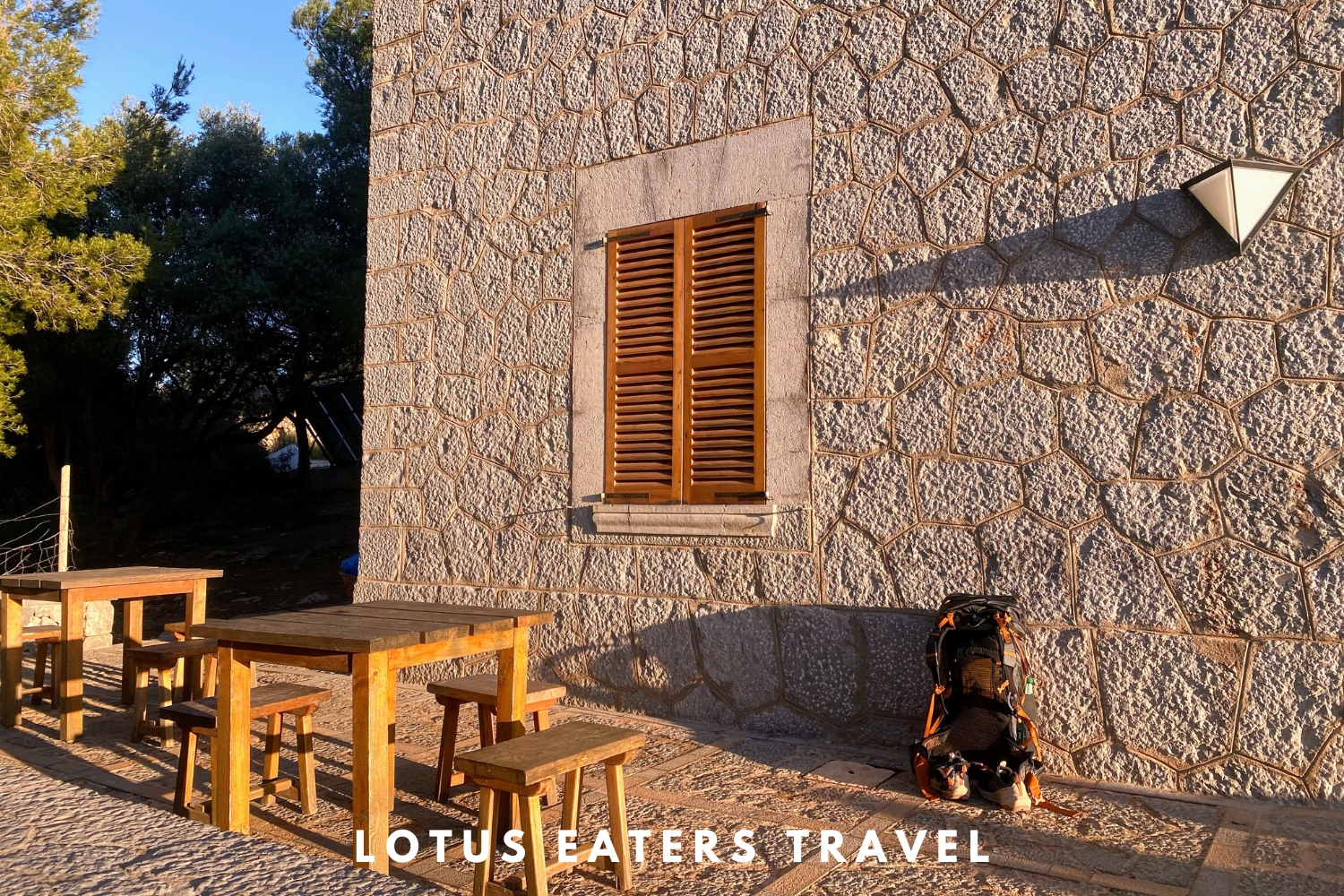
WHAT TO EXPECT FROM THE REFUGES ON THE DRY STONE ROUTE (GR221)
If you’re planning to walk the GR221, chances are you’ll spend at least a few nights in the refuges (refugis). They are a key part of the experience on the Dry Stone Route.
Simple, social and sometimes a little chaotic, they are not luxury stays. But they are memorable, affordable and, in many ways, part of what makes this route so special.


What to expect from the refuges on the GR221?
The mountain refuges on the GR221 are basic, but welcoming. We found that they provided a place to relax and socialise, as well as sleep. And they have everything you need. Overall, we were truly grateful that they exist and allowed us to walk this route affordably.
Key to enjoying them, is to remember that they aren’t hotels. Facilities aren’t perfect and normally they are run by one host who is trying to keep the place clean, check everyone in and cook food. And it can’t always be an easy job to please tired hikers!
How much does it cost to stay in the GR221 refugis?


The refugis have a standard rate for each bed – €14 for an adult, or €9 for a child. In addition, tourist tax is paid when you arrive to the refugi (currently 28 cents per person.)
Note: all refugis take card, but some will not take cash (Can Boi for example).
Do you need to book in advance?

Yes, absolutely.
Refugis on the GR221 can be booked up to four months in advance, and they fill quickly. If you are walking in peak seasons such as April, May, September or October, you will need to book as soon as bookings open.
We booked in December for an April trip and still found limited availability.
Turning up without a booking is very risky. In most cases, you will be turned away as refugis are often fully booked for the entire season.
Book directly through the Consell de Mallorca website here.
Tip: if you can’t find space, or don’t fancy the refuges – find our guide to alternatives here.
Dorm rooms and sleeping


I won’t lie, sleeping in the dorm space at the mountain refugis, can be a bit like the wild west. You might get an amazing night of sleep, or a terrible one.
Beds
Beds are generally comfortable but basic. Almost all are bunk beds, with a few exceptions.
At least once, you will end up with a creaky bed.
One slightly odd feature in some refugis is that two beds are pushed together. This means you could end up sleeping right next to a stranger. In practice, the hosts try to place people who know each other together, but it does not always work out.
Sometimes we were given a choice of beds, but more often we were assigned one.
Top bunks are not suitable for children and can be surprisingly high.
Dorm sizes vary. Some refugis have large shared rooms, while others have smaller rooms with 4 to 6 beds.
Bedding
Each bed comes with a pillow, and both mattresses and pillows are plastic covered, which is fairly standard.
You have two options:
- Bring your own sleeping bag or sleep sheet
- Rent sheets from the refugi for €4.50 per night
You are not allowed to sleep without either.
There are also communal duvets with covers, but these are not changed between guests.
Facilities

Facilities vary slightly between refugis, but overall they are basic and functional.
Bathrooms


Bathrooms are simple but generally clean.
They are separated into male and female areas, each with:
- Around two showers
- A couple of toilets
- Sinks
Hot water is not guaranteed. Some showers are warm, others are not.
Hand soap is always available, but you will need to bring your own toiletries such as shower gel and shampoo.
Communal space

Each refugi has a communal indoor space, usually with tables and chairs where people gather in the afternoon and evening.
This is where you will eat, relax, plan the next day and, most likely, chat with other hikers.
Many refugis also have an outdoor space or terrace, which is perfect after a long day of walking. Our favourites were Muleta (sea views) and Son Amer which has a gorgeous garden.

Plugs & wifi
There are usually a few plug sockets in dorm rooms, but not one per bed.
You will often find more plugs in communal areas, and people tend to take turns charging devices.
Tip: bring a power bank and a long charging cable. This is especially useful if you are in a top bunk.
All the refugis we stayed in had WiFi. It is not particularly fast and may be switched off at night, but it is good enough for basic use like messages, photo backups and downloading podcasts.
Laundry
There are no proper laundry facilities.
However, you can hand wash clothes in the sinks and hang them outside. Most refugis have a drying rack or clothes horse somewhere, just ask if you cannot find it.
Check in times and rules

There are a few things to be aware of.
Check in
You cannot check until 16:00 and should arrive by 19:00. The next day, you must leave the room by 10:00. Of course, most hikers get up between 06:30 and 07:30 anyway.
Tip: it’s possible to arrive before 16:00 and remain in the communal space, or to leave your backpack.
Rules
There are a few standard rules:
- Shoes must be left in a designated area
- Backpacks are not allowed on beds
- You must use a sleeping bag or rented sheets
- Lights are usually out by 22:00 or 22:30
- Doors are locked at night
Tip: bring flip flops or sandals for walking around inside.
Food in the GR221 refugis
One thing we had heard about the mountain refugis, is that we would go to bed hungry – this was never the case!
Breakfast

Breakfast is served from around 07:30 or 08:00 and costs €5.50.
It usually includes:
- Bread (often a bit stale)
- Butter, ham and cheese
- Biscuits
- Orange juice (not fresh)
- Coffee from the bar
Verdict: convenient, but not amazing value.
We would recommend booking breakfast at Can Boi, Tossals Verds and Son Amer. You can skip it at Muleta and Ponta Roma, where there are better options nearby.
Picnic

You can pre-order a packed lunch for €8.
This typically includes:
- Two sandwiches
- A small bottle of water
- A piece of fruit
Verdict: easy, but not great value and not particularly tasty.
We would only recommend this for more remote stages, particularly leaving Tossals Verds and Son Amer.
Dinner


Dinner is normally served at 20:00, until 21:00. You must be there at this time. It’s served family style and people will go back for seconds – so it’s best not to arrive late!
You can expect to be served bread, a salad of some sort, plus a main course. Desert is always a piece of fruit. We had chicken, fish and meat dishes – all hearty and mostly tasty.
Tip: vegetarians can pre-order meals.
The dining spaces are communal areas with large tables to share. Normally water is served with the meal – I believe that technically you can choose between a glass of wine or water, but we were only offered wine with one meal out of five (so if you want it – you need to ask.)
Verdict: Meals cost €9.50 and I think are real value for money. Food was hearty and filling. But, you don’t have to take it – Can Boi, Muleta and Ponta Roma are all within walking distance of villages and restaurants. Just keep in mind that meals out will cost more.
Buying drinks in the refugis

One pleasant surprise was finding out that you can buy drinks in the refugis – they offer a range of soft drinks, water and beers and wine. Some can even create a cocktail! It’s a bit mad. Prices are reasonable too.
There are no dedicated drinking water taps, but we just filled up in the bathrooms. Or you can buy bottles at the bar.
Note: you can’t take your own alcohol into the refugis.
Overview of refugis on the GR221
1/ Galatzo
Capacity: 50 beds
Location: can be reached by Variant 2 of Galatzó.
Note: Most hikers don’t stay here as it’s on a variant of the route.
2/ Coma d’en Vidal
Capacity: 24 beds
Location: between the Serra dels Pinotells and the crest of Puig des Castellet.
Note: This refugi has to be booked out fully (all 24 beds), you can’t book just one bed. Hence, most hikers won’t stay here.
3/ Can Boi (Deià)

Capacity: 32 beds (4 dorms).
Location: On the outskirts of the village of Deià (10 minutes walk).
Highlights: Proximity to Deià and tranquil setting.
4/ Muleta (Port de Sóller)


Capacity: 30 beds (1 dorm).
Location: Muleta cliff tops, a 15 minute walk to Muleta and Port de Soller.
Highlights: Sunset views and wonderful outdoor space.
5/ Tossals Verds

Capacity: 42 beds (7 rooms)
Location: Stage five (for most) between Muleta and Son Amer. Rural location.
Highlights: Stunning rural location, gardens and mountains. Very peaceful.
6/ Son Amer (near Lluc)

Capacity: 52 beds (6 rooms).
Location: One km from Lluc Sanctuary, on stage 6 of the route for most.
Highlights: Views to Lluc, gardens on both sides of the property, modern facilities.
7/ Ponta Roma (Pollença)

Capacity: 38 beds (5 rooms).
Location: Close to the roman bridge in the town of Pollença (a 10 minute stroll to town).
Highlights: Location in Pollença.
Written by Emma
Wine Lover. Yogi. Hiker. Writer.


More Mallorca content


USEFUL LINKS FOR FLIGHTS, ACCOMMODATION AND TRANSPORT


FOLLOW US ON SOCIAL MEDIA
Please note that some links on our website are partnered with affiliates. Using an affiliate links does not make it more expensive for you to purchase. We receive a small commission whenever you buy something which in turn allows us to keep writing independent travel guides and your support is greatly appreciated.
Leave a Reply