
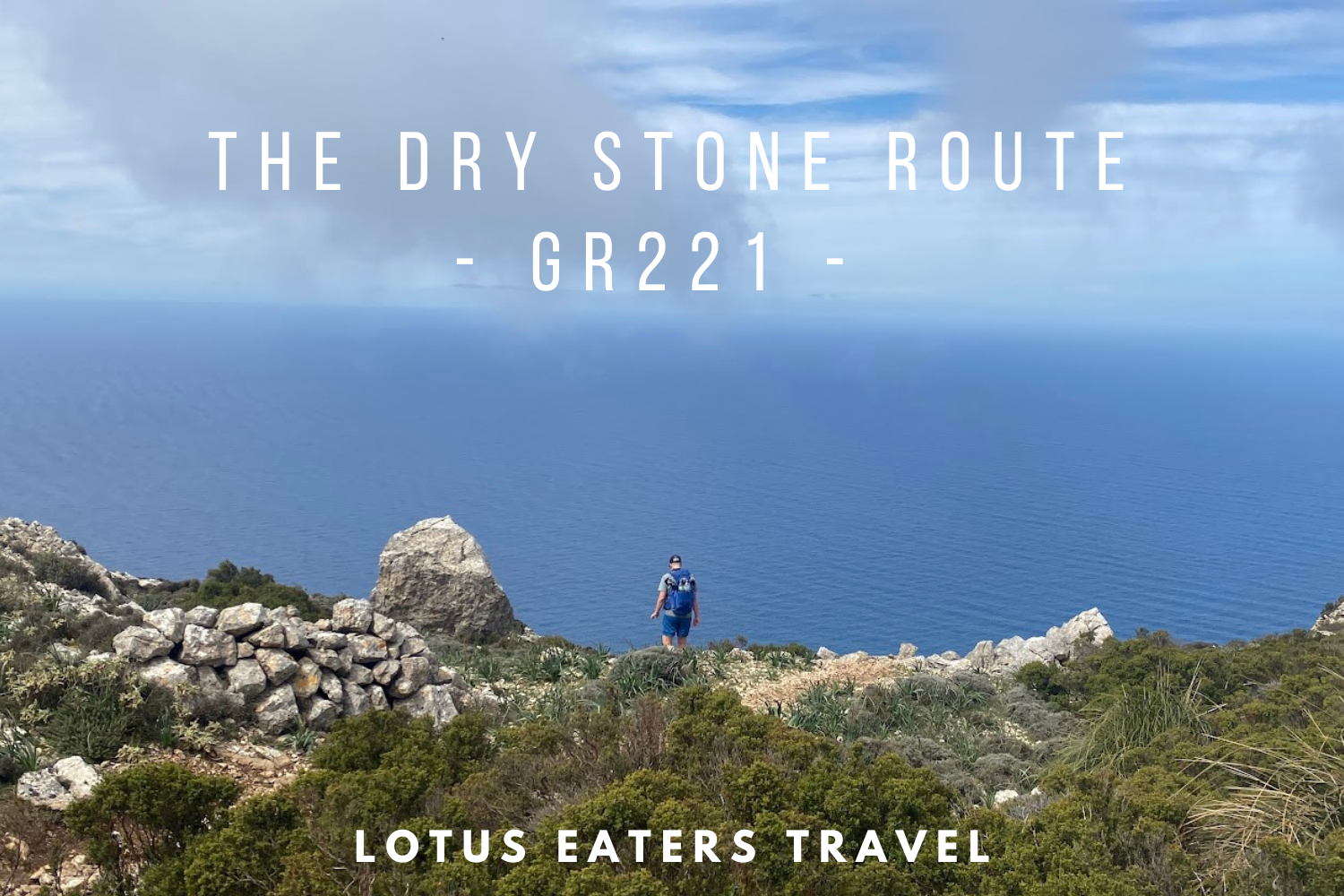
EVERYTHING YOU NEED TO KNOW ABOUT THE DRY STONE ROUTE (GR221) MALLORCA.
We’ve just completed the GR221, the Dry Stone Route, walking coast to coast across the island of Mallorca. It felt like the perfect adventure. Mountain terrain, beautiful villages, and the occasional swim in the sea.
We fell hard for Mallorca. It is simply stunning.
After 99 miles, we came away feeling like we had achieved something genuinely meaningful. Each day brings a challenge, but in the best possible way.


In this guide, you’ll find answers to the most common questions about the route, along with links to our detailed stage guides, accommodation tips and packing advice.
Where is the Dry Stone Route (GR221)?

The Dry Stone Route is a long distance hiking trail on the island of Mallorca. It runs across the north of the island through the Serra de Tramuntana, a UNESCO-listed mountain range.
Officially, the route begins in Port d’Andratx in the northwest and finishes in Port de Pollença in the northeast.
That said, some walkers choose to start from Andratx town instead, which is a common alternative.
How difficult is the GR221?

If you plan to walk the full route, it is challenging.
There are easier sections. Day one from Port d’Andratx and the final stretch into Port de Pollença are more manageable. But overall, the combination of distance and terrain makes this a demanding hike.
The paths are often rocky and uneven. Most days include significant climbs, sometimes reaching around 4,500 feet of elevation gain. Descents can be just as tough, often lasting several miles and requiring concentration.
Over the course of the route, you’ll climb roughly 19,000 feet (or 5,800 metres in total)- equivalent to ascending around two-thirds of Mount Everest, or climbing Ben Nevis more than four times.
It is not technical in the sense of climbing. However, you do need to be sure-footed, have good endurance, and feel comfortable with the occasional short scramble.
Who is the route for?

This route is best suited to:
- Adventurous travellers looking for a rewarding multi-day hike
- Experienced or reasonably fit hikers
- People who are open to a mix of challenge, simplicity and beauty
You do not need to be an expert, but you do need to be prepared.
How long is the GR221?

If you walk the entire route from Port d’Andratx to Port de Pollenca is 99 miles or 159km. But there are many variants along the way that can change alter the total distance.
How many days does it take?

Most people complete the route in 9 to 10 days.
That said, you can adjust the pace depending on your fitness and itinerary. Some walkers choose to hike shorter sections. A popular option is Sant Elm to Sóller.
Others choose to finish in Pollença town instead of continuing to Port de Pollença, as the final stage is relatively short.
Our full stage-by-stage guide is linked here.

Before starting, I had some concerns about navigation. In reality, it turned out to be much more straightforward than expected.
The route is marked with red and white blazes, along with wooden signposts and directional arrows. You will also see distance markers on many stages.
We used AllTrails as a backup and checked it a few times each day, mainly to track elevation and confirm turns. The offline maps feature is very useful, especially where there is no signal.

Is luggage transfer available?
It is possible to arrange luggage transfer on this route.

Firstly, if you book a self-guided or guided hiking holiday – you will normally have luggage transfer included.
Alternatively, you can book luggage transfer with the company Mallorca Hiking, even if you’re walking independently.
What kind of accommodation is available and cost?

| Type | Cost |
| Private hotels | Between €80 and €250 (more for luxury) |
| Refuges/refugis (municipal) | €14 for a bed (€9 for a child) |
| Private hostel | (Esporles) €35 for a bed |
| Camping/ Wild Camping | One or two campsites, but most campers wild camp |
Over nine nights, we spent €700 on accommodation for two people. This included five nights in refugis, one in a private hostel and three hotel rooms.
You can find our detailed guide to what to expect from the refuges here. And a guide to where to stay if you’re looking for private accommodation here.
Do you need to book accommodation in advance?

Yes, and this is important.
The refugis can be booked up to four months in advance, and they fill quickly. We walked in April and booked in December. Many people who turned up without reservations were turned away.
You can find our guide to staying in the refugis here.
Private accommodation in villages such as Valldemossa, Deià and Sóller should also be booked ahead. Availability is limited and prices rise quickly.
In larger coastal towns like Port de Sóller and Port de Pollença, you may find last minute options, but expect higher prices.
What about other costs


Mallorca is a little more expensive than mainland Spain. Here are some typical costs as we found them on the island:
| Item | Cost |
| Main course at a restaurant | €15-25 |
| Glass of wine | €4-6 |
| Small beer | €2-3 |
| Coffee | €2-3 |
| Bottled water | €0.30 (supermarket) or €1.50 in a smaller store |
The refugis also offer food and drinks, here are the standard costs as of 2026:
| Item | Cost |
| Dinner | €9.50 |
| Picnic | €8 |
| Breakfast | €5.50 |
| Beer | €2.10 |
| Bottle of wine | €8.50 |
| Bottle of water | €2.50 |
| Towel and linen rental | €2 and €4.50 (per night) |
Best time of year to walk

In theory, the route can be walked all year round. In practice – timing matters.
Summer is simply too hot for long days of hiking. Winter can bring cold temperatures and even snow at higher elevations.
Refugis are usually closed from November and reopen around April 1st.
The best times to walk are:
- Spring: April and May
- Autumn: September and October
Packing for the route
Packing for this route can be tricky, taking into account different weather at altitude and on the coast.
We’ve written a detailed guided to packing for the GR221 here.
Water & supplies

Some days pass through villages where you can restock, but others are long and remote.
We carried between 2 and 3 litres of water each per day, sometimes dropping to 1.5 litres if we knew we could refill. Most days, we finished with very little left.
It is important to carry enough food. On longer days, especially those lasting up to 9 or 10 hours, you will go through more than you expect.
If you stay in refugis, you can pre-book a picnic. We recommend doing this for stages leaving Tossals Verds and Lluc. Otherwise, you can buy supplies from bakeries and supermarkets along the way.
Safety & heat

There are two main things to take seriously on this route.
First, heat. Even in spring, we had a day where the sun was intense after hours of exposure. Stay hydrated, wear appropriate clothing and take breaks in shade when needed.
Second, remoteness. Some sections have no signal and very few people around.
We carried head torches, whistles and power banks. We did not carry a GPS device, but it could be worth considering if you plan to walk alone.
Always check the weather before setting out, carry enough supplies, and make sure your travel insurance covers multi-day hiking and altitude up to around 4,000 feet.
Social side

This route can be as social or as quiet as you want it to be.
We were surprised by how many hikers we saw each day. There is a mix of day walkers and people completing the full route.
In refugis, it is easy to meet others, especially if you join communal meals. We met groups of friends, couples and families along the way.
At the same time, it is still very possible to find solitude on the trail.
Training & physical prep

This is not a route to take on without preparation.
By day two, it was clear just how useful strength and hill training had been. Carrying a backpack uphill for hours is a different kind of effort.
The best preparation includes:
- Hill walking
- Leg strength training
- Endurance work
Some days can involve up to 10 hours of movement.
Interestingly, descents were often harder than climbs. Trekking poles can make a big difference and are well worth considering.
More GR221 guides

- Packing for the GR221
- Our Nine Day Itinerary for the GR221
- Refuges on the GR221
- Our nine day itinerary
Written by Emma
Wine Lover. Yogi. Hiker. Writer.
British travel writer and long-distance hiker, native to Kent. Emma has walked the Camino de Santiago more than ten times, completed trails across Europe from the Corfu Trail to the Fisherman’s Trail, and covered thousands of kilometres on foot. She always writes from first-hand experience. Her goal? Inspire just one person to go on their first long-distance hike.


More Mallorca content


USEFUL LINKS FOR FLIGHTS, ACCOMMODATION AND TRANSPORT


FOLLOW US ON SOCIAL MEDIA
Please note that some links on our website are partnered with affiliates. Using an affiliate links does not make it more expensive for you to purchase. We receive a small commission whenever you buy something which in turn allows us to keep writing independent travel guides and your support is greatly appreciated.
Leave a Reply