
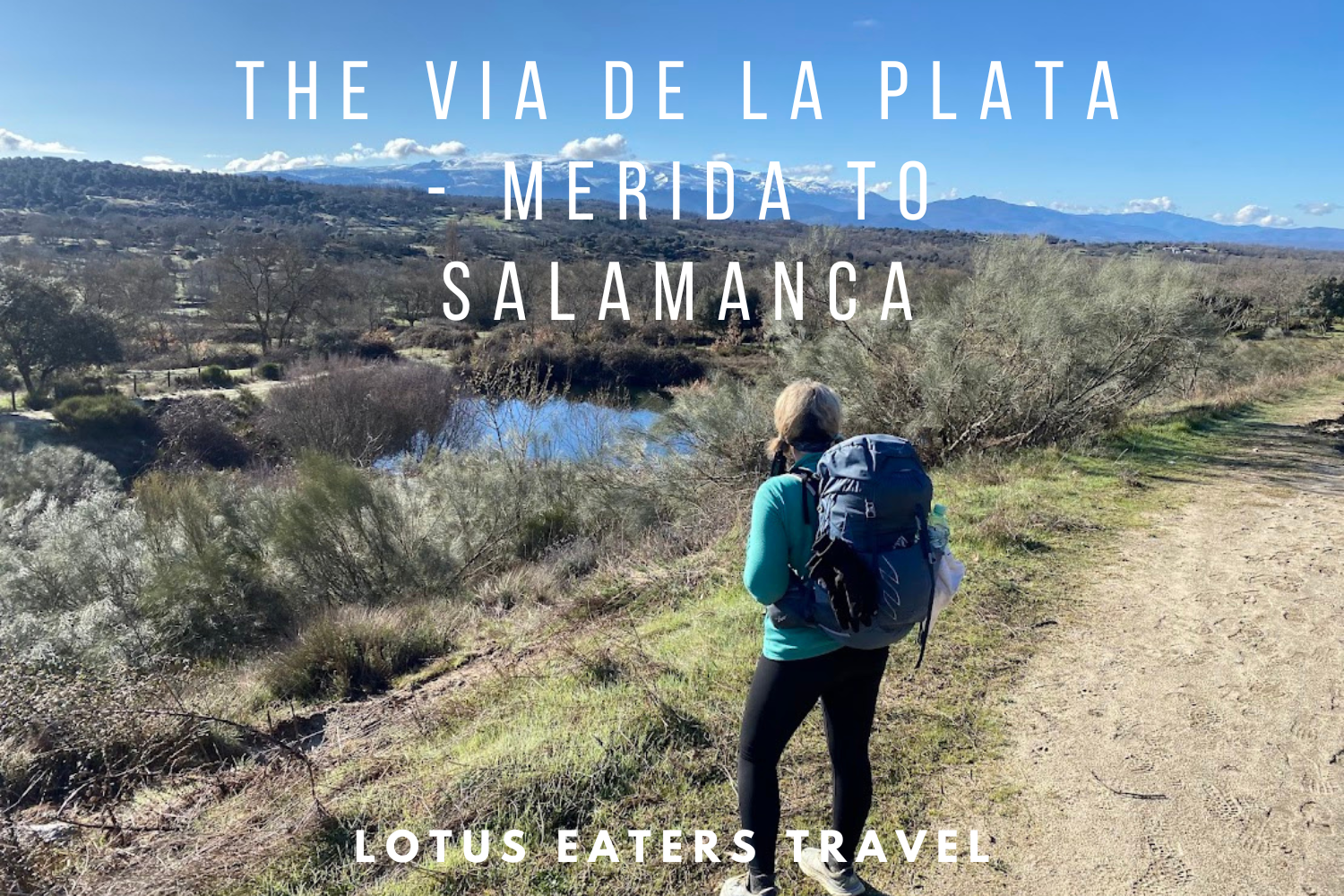
VIA DE LA PLATA STAGES: MERIDA TO SALAMANCA.
Walking the Via de la Plata from Mérida to Salamanca is one of the most memorable sections of this historic Camino route. Over nearly 300 kilometres, pilgrims pass through the quiet landscapes of Extremadura before gradually entering the hillier terrain of Castilla y León. Roman ruins, wide pastoral plains, medieval villages and long stretches of peaceful trail define this part of the pilgrimage.
Compared with some other Camino routes, this section requires a little more planning. Accommodation can be sparse in places, daily distances are sometimes longer, and certain stages offer limited opportunities to break up the walking. However, this is also part of what makes the route so special. The quieter trails, open landscapes and sense of solitude create a very different Camino experience.

In this guide, you will find an overview of the typical stages between Mérida and Salamanca, along with practical information to help plan your walk. I have also included notes on some of the more challenging logistical sections, route variants, and river crossings that are useful to be aware of when planning your journey.
Below, you can find an example of the daily stages many pilgrims follow along this section of the Via de la Plata.

Typical daily stages
The distance between Mérida and Salamanca is typically completed over 10 walking days. The total distance is approximately 287km, with around 3900m of ascent and 3300m of descent.
Roughly 70km of the route follows roads or pavement, while the majority is walked on trails, dirt tracks, and rural paths.
Some sections naturally determine where pilgrims stop for the night. For example, between Cáceres and Cañaveral there are limited accommodation options, so most pilgrims end up staying in the same places. In contrast, the later stages from Aldeanueva del Camino onwards to Salamanca offer greater flexibility, with more villages and accommodation along the route.
Below you will find an example of the most common daily stages between Mérida and Salamanca. These are based on the stages we planned to walk ourselves, although we had to adjust our plans slightly due to injury along the way.
Planning your daily stages

This section of the Via de la Plata requires a little more planning than some other Camino routes. Accommodation can be limited in places, and there are a few long stretches without services. For some pilgrims, this may mean arranging a transfer or adjusting distances if a stage feels too long to walk comfortably.
With a little preparation, however, it is entirely manageable and remains one of the most rewarding parts of the route.
Challenging sections

There are two areas where planning your daily stages requires particular attention.
Between Cáceres and Cañaveral the distance is 45.5km, and there is only one pilgrim hostel along the way, located in Casar de Cáceres.
For most pilgrims this creates two main options:
- Walk a short 12km stage to Casar de Cáceres, followed by a longer 33.5km stage to Cañaveral
- Attempt the full 45.5km in one day, which is possible but demanding
Some pilgrims choose to break up the distance by arranging transport from Cáceres.
Carcaboso to Aldeanueva del Camino
Another section that requires planning lies between Carcaboso and Aldeanueva del Camino, a distance of roughly 37km.
Many pilgrims break this stage by staying near Cáparra, most commonly at Hostal Asturias, which offers private rooms a short distance off the route. However, booking here can sometimes be difficult due to limited availability.
Another option is to detour to Oliva de Plasencia, which adds around 6km in total, where the Albergue San Blas provides pilgrim accommodation.
We also met several pilgrims who chose to leave the Via de la Plata temporarily and walk the Vía Verde between Plasencia and Béjar as an alternative way to bypass this more complicated section.
Route Variants

There are two notable route variants between Mérida and Salamanca that pilgrims may wish to consider.
Variant to Riolobos
Roughly halfway between Grimaldo and Galisteo, a small variant leads to the town of Riolobos. Taking this option adds a few kilometres to the route but allows pilgrims to stay overnight in the town.
Variant via Pedrosillo de los Aires
After Fuenterroble de Salvatierra, a second variant branches off to the right and passes through Pedrosillo de los Aires and Monterrubio de la Sierra.
This option is slightly shorter than the main route, reducing the distance by around 3km, before rejoining the main Camino in Morille. Pedrosillo de los Aires has a particularly charming albergue and bar, which makes it a popular stop.
Traditionally most pilgrims followed the main route, but the variant has been growing in popularity in recent years.
River crossings
It is also helpful to be aware that there are several small river and stream crossings along this section of the Via de la Plata. Most are minor streams, known locally as arroyos, and are usually easy to cross using stepping stones.
However, after periods of heavy rain these crossings can become more difficult. One area where this can happen is around 6km after Fuenterroble de Salvatierra, where the trail can flood. After a few dry days the water level usually drops and the crossing becomes straightforward again.
Overview of stages
| Stage | Route | Distance |
|---|---|---|
| 1 | Mérida → Alcuéscar | 35km |
| 2 | Alcuéscar → Cáceres | 37km |
| 3 | Cáceres → Casar de Cáceres | 12km |
| 4 | Casar de Cáceres → Cañaveral | 33km |
| 5 | Cañaveral → Galisteo | 27km |
| 6 | Galisteo → Cáparra | 29km |
| 7 | Cáparra → Puerto de Béjar | 32.5km |
| 8 | Puerto de Béjar → Fuenterroble | 29.5km |
| 9 | Fuenterroble → Morille | 29km |
| 10 | Morille → Salamanca | 19.5km |
Stage 1: Mérida to Alcuéscar

KEY DETAILS: 35km, ascent 550m, descent 300m.
ROUTE:
Leaving Mérida, we initially found the route a little confusing. New arrows directed us under a bridge, only for the path to be blocked shortly afterwards. If in doubt, head towards the Albarregas Roman Bridge, where the route becomes clearly signposted.
The next 7km follow a pedestrian path alongside the road. It is easy walking but not the most scenic section of the day.
The route then reaches Lake Proserpina, where a pleasant trail circles the shoreline. Several bars are located around the lake, although they tend to open mainly on weekends or during summer. Keep an eye out for the Roman dam of Proserpina, an impressive reminder of the region’s long history.
From here, quiet country roads and trails lead towards Aljucén, one of the prettiest villages on this stage. After leaving the village, the route enters Cornalvo Natural Park, where the surroundings become noticeably wilder and more peaceful.
This stage can also be divided into two shorter days by staying in El Carrascalejo (13km) or Aljucén (16km).


HIGHLIGHTS:
- We loved seeing the magnificent aqueduct as we left the city;
- El Carrascalejo and Aljucén are both charming villages.
AMENITIES:
- All amenities available in Mérida – we grabbed coffee and toast at Bar Arcade which opens early.
- At 13km El Carrascalejo has a restaurant (not open in mornings or Mondays.)
- At 16km, Bar El Parque serves food from 13:00 and coffee otherwise. A small shop is found in Aljucén (near the albergue).
- Amenities available in Alcuéscar.

ACCOMMODATION:
Alcuéscar offers a few different options. Albergue Alcuéscar Comunidad Religiosa “Esclavos de María y de los Pobres” contains a pilgrim albergue with capacity for 100. Alternatively, Albergue turistico Alcuescar vía de la plata offers private rooms or dorm beds.
Stage 2: Alcuéscar to Cáceres

KEY DETAILS: 37km, ascent 300m, descent 300m.
ROUTE:
This is a long stage, though the gradients are mostly gentle, and it can be shortened by stopping overnight in Valdesalor (25km). Much of the day follows attractive dirt tracks through quiet countryside, with wooded stretches and several Roman milestones along the way.


The villages of Casas de Don Antonio (8km) and Aldea del Cano (14km) sit slightly off the main route but are worthwhile detours if you need a break or refreshments. The walking up to Valdesalor is particularly enjoyable, while the final section towards Cáceres involves only a modest climb before the approach into the city, which can feel surprisingly long over the last few kilometres.
About 5km before arrival there are wonderful views across to Cáceres, making the eventual entry into the city especially rewarding.
Once in Cáceres be sure to take time to visit the sights. We loved visiting the cathedral, which offers discounts with a credential (€5 entry) and the modern art museum.


HIGHLIGHTS:
The view to Cáceres from around 5km before is really special, as is entering the city.
AMENITIES:
A good day for amenities:
- Casas de Don Antonio (8km in)
- Aldea do Cano (14km in and a touch off route)
- Valdesalor (25km in) (Bar Salor can be a little unreliable on opening hours but there is a lovely cafe/ grocery store here.
- Cáceres has everything you might need and some fantastic restaurants.
ACCOMMODATION:
Cáceres is a city with plentiful private accommodation. Albergue las Veletas offers dorm style accommodation. But there are many inexpensive private rooms, like Doña Norma or Soho Boutique Casa Don Fernando (with a great location on Plaza Mayor).
Cáceres also offers a few luxurious properties, if you wanted to splurge. For example, the Parador, or Palacio De Godoy Caceres (which offers a fabulous spa experience.)
Stage 3: Cáceres to Casar de Cáceres


KEY DETAILS: 12km, ascent 150m, descent 230m.
ROUTE:
An easy route with minimal climbing, mainly on dirt tracks. Some will choose to skip this section using a bus or transport.
Casar de Cáceres is known for cheesecake – there’s even a museum dedicated to it. We had already had more than our fill in Cáceres (it seemed to be on every menu!)
AMENITIES:
No amenities until reaching Casar de Cáceres.
ACCOMMODATION:
There are a few private options, Apartamentos Andrada and Casa Batalla. You can also find a pilgrim albergue, Pilgrims Albergue of Casar de Cáceres.


KEY DETAILS: 33km, ascent 400m, descent 400m.
ROUTE:
Note – on this section the albergue at Embalse de Alcántara is currently closed.
Leaving Casar de Cáceres, the route follows pleasant dirt tracks towards the Alcántara reservoir. After passing the reservoir, the landscape opens up and the trail continues across a wide plateau, offering a real sense of space.
In the final kilometres, the view towards Cañaveral is particularly inviting and provides a welcome boost as you approach the town.


AMENITIES:
No amenities until Cañaveral – be sure to pack sufficient food and water.
ACCOMMODATION:
Most pilgrims stay at Hostel Cañaveral, which offers a private room or dormitory beds.


KEY DETAILS: 27km, ascent 400m, descent 450m.
ROUTE:
The stage begins on a path running alongside the road before climbing up to the Alto de los Castaños. About halfway to Grimaldo there is a small stream crossing with stepping stones – take care here, as it can be slippery (I managed to fall in and ended up with very wet gear!).
After around 8km, the village of Grimaldo appears just off the main route, reached by an easy path into the village if you wish to stop there. From here, pleasant trails continue through open countryside towards the historic walled town of Galisteo, where the stage ends.
AMENITIES:
It is possible to divert off route to Grimaldo (1km or so additional walking) to find some amenities (but note that cafes don’t open early.)
ACCOMMODATION:
Albergue Turístico Galisteo is a pilgrim hostel. Alternatively, La pension del Parador offers inexpensive private rooms.
Stage 6: Galisteo to Caparra


KEY DETAILS: 29km, ascent 320m, descent 200m.
ROUTE:
Leaving Galisteo, a quiet local road leads towards the village of Carcaboso. From there, the stage becomes increasingly peaceful, following long stretches of dirt tracks through a mix of open countryside, wooded sections, and attractive pastureland.
Around halfway through the stage you pass beneath the striking Roman quadriform arch of Cáparra.
Most pilgrims will stay at Hostal Asturias, a couple of kms off route. But note you can also detour to Hostel San Blas (6km extra.)
AMENITIES:
Amenities in Aldehuela del Jerte (6km in) and Carcaboso (11km in). After this, nothing until reaching the end of the stage.
ACCOMMODATION:
If you want to avoid detouring off the route too much, the main accommodation choice is Hostal Asturias (a couple of kms off route – they also offer a transfer).
Stage 7: Caparra to Puerto de Béjar


KEY DETAILS: 32.5km, ascent 650m, descent 150m.
ROUTE:
It was today that we really noticed the scenery change, as the route crosses from Extremadura to Castilla y León. It was like all of a sudden, mountains came into view. The temperatures also cooled down – and we found ourselves ordering Cola Cao instead of a hot drink.
A long section (around 10km) involves walking on the road. It is quite a narrow road with not much verge, but infrequent traffic when we walked.

Baños de Montemayor is a charming town. At certain times of the year, you can visit the natural spa. The ascent out of town is glorious, lovely views.


HIGHLIGHTS:
- We started to see the snowy mountains today and noticed a real change in scenery.
- The ascent from Baños de Montemayor is very special.
AMENITIES:
- Amenities in Aldeanueva del Camino (20km in)
- Baños de Montemayor is a larger town (29km in)
- Puerto de Béjar has an excellent bar and a small shop.
ACCOMMODATION:
A pilgrim hostel (Albergue de peregrinos de Puerto de Béjar) is found 1km or so before the village (directly on the Via de la Plata).
In the village (1km or so off route via trail), is the delightful Hotel Rural Candela y Plata (a little fancy for a Camino, but we got a very good deal last minute.)
Stage 8: Puerto de Béjar to Fuenterroble de Salvatierra


KEY DETAILS: 29.5km, ascent 500m, descent 400m.
ROUTE:
If you have stayed in the village of Puerto de Béjar, you can reconnect with the Via de la Plata on a short trail.
The first 9km seemed to pass very quickly for us, as we walked through woodland on easy trail. After this, dirt paths with open landscapes lead to Valverde de Valdelecasa. Quiet roads lead to Valdelacasa, and dirt tracks to Fuenterroble de Salvatierra.
AMENITIES:
- Cafe in La Clazada de Bejar (9km in)
- Cafe in Valverde de Valdelecasa (18km in) and Valdelacasa (21km in).
- Fuenterroble de Salvatierra has a few nice bars.


ACCOMMODATION:
Albergue parroquial Santa María is one of the better known albergues on this route. A popular stop with a communal supper.
Stage 9: Fuenterroble de Salvatierra to Morille


KEY DETAILS: 29km, ascent 200m, descent 150m (if walking the bifurcation).
ROUTE:
Today there is a choice between two routes. The variant to the right takes you through two additional villages – Pedrosillo de los Aires and Monterubio de la Sierra. The first of which has a charming albergue and bar.
This variant is a little shorter – taking roughly 3km off the total distance. It re-joins the main route in Morille.
There are a couple of river sections after Fuenterroble de Salvatierra that can present problems if it has been raining.

Our stages: We actually chose to split this day and stayed overnight in Pedrosillo de los Aires – a charming village with a small 9 person albergue. I’d really recommend it. The next day, we walked from Pedrosillo to Salamanca (a longer day but manageable).
AMENITIES:
- Friendly bar in Pedrosillo de los Aires (18km in)
- Monterrubio de la Sierra (23km) has a bar, but we found it closed.
- Morille has a bar.
ACCOMMODATION:
Albergue municipal de Morille is a popular albergue. Morille is where the variant and main route reconnect and many pilgrims choose to come here rather than the previous town (San Pedro) on the main route.
Stage 10: Morille to Salamanca


KEY DETAILS: 19.5km, ascent 200m, descent 350m.
ROUTE:
This final stage offers relaxed and mostly gentle walking through open farmland.
Shortly after leaving Morille, you reach a small river crossing which required us to remove our shoes. If water levels are too high, it is possible to reach a nearby road bridge in around 15 minutes.


The route continues through farmland towards Miranda de Azán, where a short detour leads to several bars and cafés. The landscape here reminded us a little of the Camino Francés. Some pilgrims find this section monotonous, but we enjoyed the wide open views.
The final kilometres into Salamanca can be muddy after rain, but the reward comes when you reach the Roman Bridge at the entrance to the city. Crossing the bridge with the cathedral spires rising above the skyline is a memorable way to finish this section of the Via de la Plata.


HIGHLIGHTS:
You can see Salamanca’s cathedral spires in the distance from 5km or so back. And the walk across the Roman Bridge is unforgettable.
AMENITIES:
Miranda de Azan has some pleasant bars/ cafes and a shop, it requires a small detour from the route.
ACCOMMODATION:
Salamanca is of course a large city with plenty of very good accommodation. Salamanca Pilgrims’ Hostel has a wonderful location close to the cathedral. If you’re planning a rest day or finishing in Salamanca, there are lots of private rooms available. We liked Hostal Concejo.
Written by Emma
Wine Lover. Yogi. Hiker. Writer.


Everything you need to know about walking the Via de la Plata
EVERYTHING YOU NEED TO KNOW ABOUT WALKING THE VIA DE LA PLATA. The Via de la Plata is one of the longest and quietest Camino routes in Spain. It offers a very different experience to the more popular northern paths, with wide open landscapes, long stretches of solitude, and a slower, more traditional rhythm of…

Where to get your Camino credential in Sevilla + FAQ’s about starting there
WHERE TO GET YOUR CAMINO CREDENTIAL IN SEVILLA + FAQ’s ABOUT STARTING THE VIA DE LA PLATA THERE. If you are starting the Via de la Plata in Sevilla, one of the first things you will need is a Camino credential (pilgrim passport). This small booklet records your journey as you walk to Santiago de…
Via de la Plata Stages: Sevilla to Merida
VIA DE LA PLATA STAGES: SEVILLA TO MERIDA. The Via de la Plata begins in the beautiful Andalusian city of Seville and heads north across Spain, eventually joining either the Camino Francés or the Camino Sanabrés on the way to Santiago de Compostela. The opening section from Seville to the Roman city of Mérida covers…
Most of our planning is done using other blogs, but you can’t beat a guide book at the bottom of your case.
Find them here on Amazon.

USEFUL LINKS FOR FLIGHTS, ACCOMMODATION AND TRANSPORT


CHECK LATEST FLIGHTS
ACTIVITIES TO CONSIDER
FOLLOW US ON SOCIAL MEDIA
Please note that some links on our website are partnered with affiliates. Using an affiliate links does not make it more expensive for you to purchase. We receive a small commission whenever you buy something which in turn allows us to keep writing independent travel guides and your support is greatly appreciated.