
EVERYTHING YOU NEED TO KNOW ABOUT WALKING THE VIA DE LA PLATA.
The Via de la Plata is one of the longest and quietest Camino routes in Spain. It offers a very different experience to the more popular northern paths, with wide open landscapes, long stretches of solitude, and a slower, more traditional rhythm of walking.
This guide pulls together everything you need to know before setting off, from route options to costs, packing, and what to expect day to day.
Where is the Via de la Plata

The Via de la Plata, or Silver Way, is a Camino de Santiago route that begins in Sevilla in the south west of Spain, in Andalucía. From there, it travels north through Andalucía, Extremadura, Castile y León and Galicia.
At Granja de Moreruela, the route splits. You can continue north west towards Astorga, where it joins the Camino Francés before heading on to Santiago de Compostela. Alternatively, you can take the Camino Sanabrés towards Ourense, eventually re-joining the final stretch into Santiago de Compostela.
It is also becoming increasingly popular to begin further east, walking from Almería, Granada, Málaga or Córdoba on the Camino Mozarabe, and joining the Via de la Plata in Mérida.
How difficult is the Via de la Plata?


The Via de la Plata is often described as one of the easier Caminos in terms of terrain, particularly in the southern sections through Andalucia and Extremadura. There are long, flat stretches and very few steep climbs early on.
However, this can be misleading. While the route is not especially technical, many pilgrims find it more challenging overall than routes like the Camino Francés or Camino Portugués.
The difficulty comes from a combination of factors rather than any single element.
Distance and endurance
The full route from Sevilla to Santiago de Compostela is close to 1,000 kilometres, depending on your chosen variant.
Walking this distance over five to six weeks requires endurance more than anything else. Even if individual days feel manageable, the cumulative fatigue builds over time. Recovery becomes just as important as the walking itself.
Long daily stages
One of the defining challenges of the Via de la Plata is the distance between towns.
In the southern half of the route especially, it is common to face stages of 25 to 35 kilometres, with limited options to shorten them. Unlike other Caminos, there are fewer places to stop early if you are tired or dealing with injury.
This means you need to be comfortable walking longer distances day after day.
Limited infrastructure
Compared to more popular routes, the Via de la Plata has fewer cafés, shops and albergues.
This adds a layer of complexity. You need to think ahead, carry enough water and food, and plan your stages more carefully. It also means fewer opportunities to rest during the day. But it’s worth saying that not every section of the route is like this – some days you’ll be spoilt for choice for cafes!
Carrying a backpack
Luggage transfer is not consistently available along the full route, particularly in the earlier stages.
As a result, most pilgrims carry their own packs for the journey. Over long distances and in warm conditions, this significantly increases the physical effort required. Packing light becomes essential.
Heat and exposure
The southern sections of the Via de la Plata are very exposed, with long stretches offering little shade.
Outside of winter and early spring, walking in the heat can be one of the biggest challenges. Even in milder months, the sun can feel intense over long, open stages.
Managing your pace, starting early and staying hydrated are all key to coping with these conditions.
Changing terrain in the north
As you move into Castile y León and Galicia, the character of the route begins to change.
There is more variation in elevation, with longer climbs and descents, and the weather can become cooler and less predictable.
Mental challenge
Finally, there is a mental aspect to the Via de la Plata that should not be overlooked.
Long, straight paths and wide open landscapes can feel meditative, but also repetitive. Without the constant flow of other pilgrims or frequent stops, motivation can dip at times.
Terrain and surfaces


The Via de la Plata is not technically difficult, but the terrain plays a big role in how the route feels day to day.
You can expect:
- Long stretches of gravel tracks and dirt paths
- Sections of historic Roman road
- Some road walking, particularly when entering and leaving towns
- Extended exposed sections with very little shade (for us, this was one of the key differences between this route and the northern Caminos.)
Who is this route for?

The Via de la Plata is not the easiest Camino, but it is one of the most rewarding for the right kind of walker.
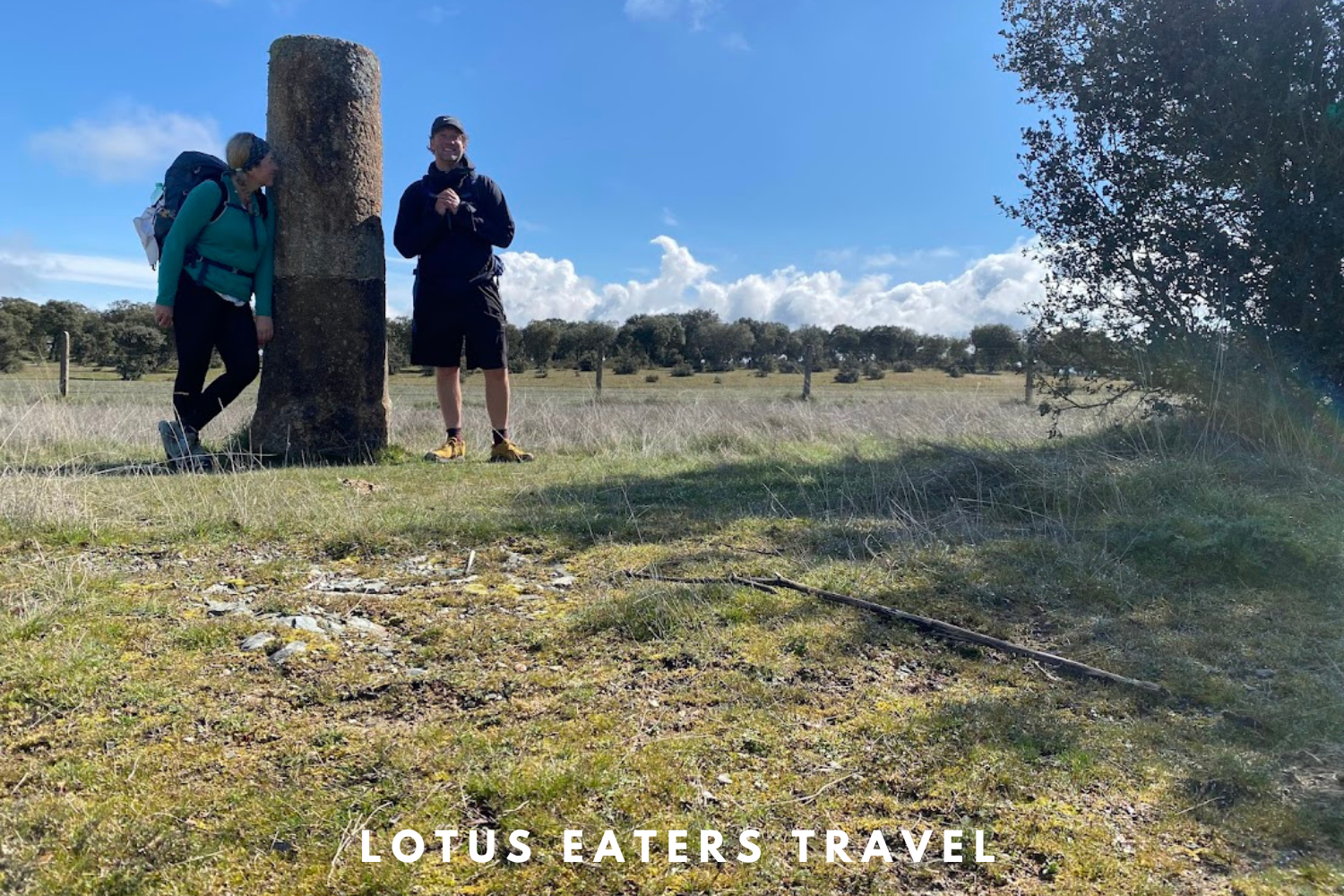
We walked it as a couple, and along the way we often talked about whether we would have enjoyed it alone. John felt it wouldn’t have suited him solo – he values the social side of the Camino and prefers to regularly meet other pilgrims along the route.
For me, while I’m less dependent on the social aspect, I was more aware of the idea of walking alone as a woman, particularly in such remote stretches. That said, we did meet several solo female pilgrims, all of whom told me they felt completely safe and comfortable on the route.
It is particularly well suited to:
- Pilgrims who value solitude and quieter trails;
- Those with some long distance walking experience;
- People comfortable with planning ahead and being more self sufficient.
It may be less suitable for:
- First time Camino walkers who want a highly social experience;
- Those who prefer short, flexible daily stages;
- Anyone uncomfortable with limited or long stretches without services.
If you are looking for a more traditional, less crowded Camino, with a strong sense of journey from south to north, the Via de la Plata is a fantastic choice.
How long is the Via de la Plata?


The distance varies depending on your route choice, but the traditional Via de la Plata from Sevilla to Astorga is roughly 700 kilometres. From there, continuing to Santiago de Compostela via the Camino Francés adds another 250 kilometres or so.
If you take the Camino Sanabrés from Granja de Moreruela, the total distance to Santiago is approximately 970km.
How many days does it take?

Most pilgrims take between 35 and 45 days to complete the full route from Sevilla to Santiago de Compostela.
This depends on your pace, rest days, and whether you take the Camino Sanabrés or continue via Astorga. Some walkers break the journey into sections over multiple trips.
You can find our daily stages for sections of this route below:
- The Via de la Plata from Sevilla to Merida
- The Via de la Plata from Merida to Salamanca
- The Camino Frances
- The Camino Sanabres from Ourense

Waymarking on the Via de la Plata is generally reliable and I would say as consistent (for the most part) as other more popular routes.
You will follow the familiar yellow arrows. Each region also has it’s own style of markers, for example in Extremadura you’ll see square blocks with the Caparra Arch. Certain cities also have unique markings, for example in Cacares.
In rural areas, sometimes signage can be spaced further apart. And of course, you are unlikely to be walking behind other pilgrims (as you might on the Camino Frances for example), so it can be easier to lose your way.
For this reason, we would strongly recommend using an offline navigation app such as Wise Pilgrim or Buen Camino as a backup.
Is luggage transfer available?


Luggage transfer is not available across the entire route.
However, services do operate from Astorga onwards to Santiago de Compostela, and also from Ourense to Santiago on the Camino Sanabrés. Before these points, you should expect to carry your own pack for most of the journey.
What kind of accommodation is available?


The Via de la Plata offers a mix of accommodation, including municipal and private albergues, as well as hotels and pensions.
That said, the infrastructure is a little more limited than on the more popular Camino routes. You cannot expect the same choice of albergues as you would find on the Camino Francés or Camino Portugués. Some stages require careful planning to ensure you have somewhere to stay.
How much does accommodation cost?
Albergue prices vary along the route.
Many operate on a donativo basis, where you contribute what you feel is appropriate. Most pilgrims leave around €10. Others charge a fixed rate, typically between €6 and €12, although some can be higher, reaching €16 to €18 per bed.
Private rooms generally range from €30 for two people up to around €60. Interestingly, we found that prices tended to be lower in larger cities such as Salamanca, as there is more choice comparative to smaller towns. And of course, if you want to, you can splurge on accommodation in some areas on the way too.
Do you need to book accommodation in advance?
The Via de la Plata has a more relaxed approach to booking than other routes. Many albergues do not accept reservations at all.
If you plan to stay in private rooms, it can be wise to book certain stages ahead, particularly in areas with limited accommodation such as between Carcaboso and Aldeanueva del Camino. It is also worth planning around busy periods like Easter.
In larger cities such as Mérida, Cáceres and Salamanca, there is plenty of choice, so advance booking is less important (but be aware that weekend rates can be higher.)
We chose to plan our stages and book about half of our stays in private rooms. However, when injury forced us to change plans, this became difficult to manage. If walking again, we would likely avoid booking in advance and enjoy the flexibility, which is increasingly rare on Camino routes.
What about other costs?


Overall, the Via de la Plata is more affordable than many northern routes.
As a rough guide:
- Breakfast of coffee and tostada costs around €3
- Lunch from supermarkets or simple cafés is inexpensive
- Dinner menus average around €15, including a drink
- A few tapas and a couple of drinks can come to around €10 per person (expect to pay between €2-3 for a good glass of wine.)
When staying in albergues, daily costs typically come to €25 to €30 per person.
Best albergues on the Via de la Plata


Some standout albergues along the route include:
- Albergue de peregrinos in Castilblanco
- The large municipal albergue in Almadén de la Plata
- Pedrosillo de los Aires
- The municipal albergue in Calzadilla de los Barros
On the Camino Sanabrés, the Galician municipal albergues between Ourense and Santiago de Compostela are consistently excellent.
There are also several well regarded albergues we did not stay in but heard great things about, including those in Fuenterroble de Salvatierra, Puerto de Béjar, Morille and Salamanca.
Best time of year to walk

The Via de la Plata has a longer walking season than many Camino routes due to its southern starting point.
It is possible to walk sections in winter, particularly in Andalucia and Extremadura. Spring and early autumn are generally ideal, offering mild temperatures, longer daylight hours and more comfortable walking conditions.
We walked from February into March and enjoyed a mix of sunshine, cool evenings and early spring flowers. As we moved north, we even saw snow in the mountains of Castile y León.
Summer is absolutely best avoided. Temperatures can be extreme, there is little shade, and long stretches without amenities make it potentially dangerous.
Packing for the route

Packing for the Via de la Plata follows the same general principles as other Camino routes, but with a few important differences.
We recommend sticking to a simple system, such as two sets of hiking clothes, with an extra pair of underwear and socks. Depending on the season, you will also need warm layers like a fleece and trousers, as well as waterproof gear.
A sleeping bag is strongly recommended. Unlike some other routes, blankets and bedding are not always provided in albergues (or at least there may not be enough for everyone), so it is best to be prepared.
Another key consideration is the variation in weather. As the route runs from south to north, conditions change significantly. Andalucía can be warm and dry, while Castile y León and Galicia can be cooler, wetter and at higher altitude. Packing layers that allow flexibility is essential.
Water and food planning

One of the most important practical considerations on the Via de la Plata is access to water and food.
There are stages, particularly in Extremadura, where you may walk 15 to 20 kilometres without passing a café, shop or open bar. Fountains cannot always be relied upon, and some may be dry or not potable.
A few simple rules make a big difference:
- Carry at least 2 litres of water on longer stages;
- Check ahead for places to stop, especially in smaller villages;
- Do not assume anything will be open – have reserve snacks just in case.
Getting this right is essential for both comfort and safety.
Safety and heat
The southern half of the Via de la Plata is very exposed, with long stretches offering little to no shade.
Outside of winter and early spring, heat becomes a serious factor. But even when we walked in February, we found temperatures in the low 20s, which felt hotter on the train.
In late spring and autumn, it is still manageable with planning. In summer, it can become dangerous.
Practical precautions include:
- Starting early;
- Wearing sun protection, including a hat;
- Taking regular breaks and monitoring how you feel;
- Avoiding the hottest part of the day where possible.
Social experience and solitude

This is one of the defining features of the Via de la Plata.
Compared to routes like the Camino Francés or Camino Portugués, the number of pilgrims is much lower. Some days you may only see a handful of other walkers, and occasionally none at all.
For many people, this is exactly the appeal. The route offers space, quiet and time to think. When you do meet other pilgrims, there is often a stronger sense of connection and shared experience. And most walkers take the time to speak to everyone they meet.
However, if you are looking for a highly social Camino, with busy albergues and a constant flow of people, this route may feel isolating at times.
Camino credential and Compostela


You will still need a pilgrim passport (credencial) to walk the Via de la Plata and to receive your Compostela in Santiago de Compostela. You can find credentials for sale in Sevilla (find our guide here.)
Stamps are available in albergues.
The usual requirements for the Compostela apply, including completing at least 100 kilometres on foot, plus the last stage into Santiago.
Foot care and physical preparation

The long stages on the Via de la Plata make physical preparation especially important.
Unlike other routes, it is not always easy to shorten a day if you are struggling, so being ready for consecutive long distances is key.
A few practical considerations:
- Train with back to back walking days before your trip;
- Prioritise blister prevention from the start;
- Build in rest days, or shorter days, where possible, especially over a longer journey.
More on the Via de la Plata

- 11 things that surprised us about the Via de la Plata
- The Via de la Plata from Sevilla to Merida
- The Via de la Plata from Merida to Salamanca
- The Camino Frances
- The Camino Sanabres from Ourense
More Camino resources


If you’ve landed on this page, you may be interested to know that we’ve got oodles of comprehensive guides to the Camino de Santiago on this website. Routes guides for major routes, packing guides, training information and more.
>>FIND OUR CAMINO DE SANTIAGO PAGE HERE<<

Would you like us to plan your walk for you?
Embark on a journey of a lifetime with Lotus Eaters Travel Planning, where we turn your dream of long-distance walking into a meticulously planned reality.
Our passion for exploration, love for diverse cultures, and commitment to providing an unparalleled experience drive us to offer personalized consultation services for some of the world’s most iconic walking trails
Written by Emma
Wine Lover. Yogi. Hiker. Writer.
British travel writer and long-distance hiker, native to Kent. Emma has walked the Camino de Santiago more than ten times, completed trails across Europe from the Corfu Trail to the Fisherman’s Trail, and covered thousands of kilometres on foot. She always writes from first-hand experience. Her goal? Inspire just one person to go on their first long-distance hike.


The Camino Mozarabe: what we liked + didn’t like
THE CAMINO MOZARABE: WHAT WE LIKED + DIDN’T LIKE. The Camino Mozarabe was one of those routes that we weren’t quite sure what to expect from before we started walking. It turned out to be full of surprises, from mountain views and ancient Roman history to tiny villages, brilliant food and some seriously challenging walking.…

Hiking Samaria Gorge: our experience taking a tour
HIKING SAMARIA GORGE: OUR EXPERIENCE TAKING A TOUR. Samaria Gorge is probably the most well-known hike in Crete, and it was high on my list when we planned our trip to the island. The route runs through the White Mountains, starting at Omalos at around 4,000 feet above sea level and finishing at Agia Roumeli…
The Camino Primitivo: what we liked + didn’t like
THE CAMINO PRIMITIVO: WHAT WE LIKED + DIDN’T LIKE. The Camino Primitivo has a reputation for being one of the tougher Camino routes. It’s hillier, quieter and, in places, a little more challenging than some of the better-known routes into Santiago de Compostela. And it’s also one of our favourites. It became an instant hit…
Most of our planning is done using other blogs, but you can’t beat a guide book at the bottom of your case.
Find them here on Amazon.

USEFUL LINKS FOR FLIGHTS, ACCOMMODATION AND TRANSPORT


FOLLOW US ON SOCIAL MEDIA
Please note that some links on our website are partnered with affiliates. Using an affiliate links does not make it more expensive for you to purchase. We receive a small commission whenever you buy something which in turn allows us to keep writing independent travel guides and your support is greatly appreciated.