
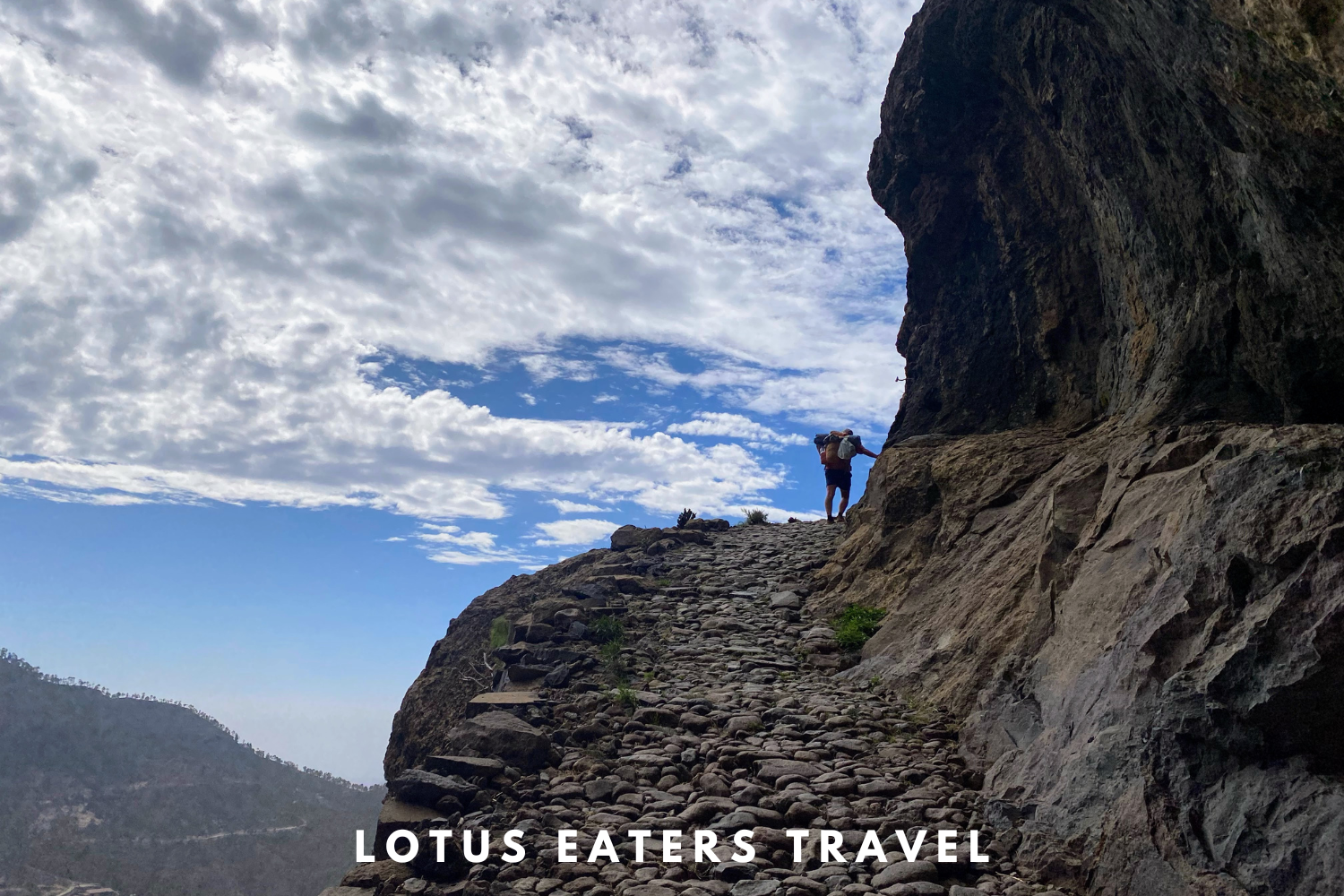
THE GR131 CANARY ISLANDS: WHAT WE LIKED + DIDN’T LIKE.
The GR131 isn’t a single hike – it’s seven of them, stitched together with ferries.
We knew that going in, but we didn’t really understand what it meant until we were standing on a black lava field on Lanzarote, then days later swimming off a beach on Fuerteventura, then after that freezing in a tent below Teide. Same trail name. Completely different hike every time.
The GR131 quickly became one of our favourite long-distance hikes. But as much as we loved it, it isn’t a trail that’s right for everyone. The logistics can be frustrating, accommodation is often difficult to organise, and carrying enough food and water through remote sections adds another layer of challenge.
In this review, we’re sharing the things we loved most about hiking the GR131, the aspects we found more difficult, and our overall verdict after spending several weeks on the trail. If you’re wondering whether the GR131 deserves a place on your hiking bucket list, this should help you decide.
What we liked

The GR131 isn’t the easiest long-distance hike to plan, but once you’re out on the trail, it’s hard not to fall in love with it. Here are the things we enjoyed most.
A PROPER CHALLENGE


The GR131 is a demanding hike. Between the steep volcanic climbs, long descents and the added weight of carrying camping gear, every day felt like we’d earned our rest.
There were moments when it felt relentless, especially on some of the longer stages, but that’s exactly what made the route so rewarding. Reaching the top of a volcanic ridge or watching the sun set over the Atlantic after a hard day’s walking gave us a real sense of achievement.
If you’re looking for a hike that pushes you without requiring technical mountaineering skills, the GR131 strikes a great balance.
ISLAND ADVENTURING


One of the things that makes the GR131 so unique is that it isn’t just one long-distance trail. It’s seven completely different hiking adventures linked together by the sea.
Each ferry crossing felt like turning the page to a new chapter. We’d leave one island just as we felt we’d got to know it, then arrive somewhere with a completely different landscape, atmosphere and character.
It’s hard to think of another long-distance hike where you can walk across volcanic deserts one week, pine forests the next, and finish among dramatic mountain ridges overlooking the ocean.
COASTAL SECTIONS

Although much of the GR131 heads inland, we loved the moments when it returned to the coast.
I’ll never forget finishing days of hiking on Fuerteventura with a swim in the ocean, or eating dinner overlooking the sea. Some of our favourite evenings were spent wandering harbour towns with tired legs, watching the ferries come and go before setting off again the following morning.
The contrast between rugged mountain trails and the coastline is one of the route’s biggest strengths.
VARIETY & SCENERY


It’s difficult to overstate just how much the landscape changes, both between islands and within a single day’s walk.
One morning we’d be crossing black volcanic lava fields that felt more like another planet than Europe. By the afternoon we’d be walking through forests of Canary Island pine or descending into lush green valleys.
Every island has its own personality, and none of them felt repetitive. Even after several weeks on the trail, we were still being surprised by the scenery.
A WORLD AWAY FROM TOURISM
The Canary Islands have a reputation for package holidays, beach resorts and winter sunshine. Walking the GR131 completely changed our perception of the islands.
Most of the trail feels wonderfully remote. There were days where we’d barely see another person, walking through tiny villages, volcanic landscapes and mountain ridges that felt a million miles from the busy beaches below.
It was one of the biggest surprises of the trip. We’d arrived expecting great hiking, but we hadn’t expected the islands to feel quite so wild.


THE WEATHER
We hiked the GR131 from January into February and were incredibly lucky with the weather.
Most days were in the low twenties, making it ideal hiking weather. It was warm enough to walk comfortably in shorts and a T-shirt, but cool enough to sleep well at night. If you’re looking for a winter sun hiking destination without travelling too far from Europe, it’s difficult to beat.
That said, the weather can change remarkably quickly at higher elevations, particularly around Teide on Tenerife. We spent a couple of nights absolutely freezing in our tent, wearing every layer we owned. It’s all part of the adventure, but definitely worth packing for a wider range of conditions than you might expect.
CANARIAN HOSPITALITY
Amenities can be few and far between on the GR131, which somehow made them even more memorable when we found them.
Some of my favourite moments were the simple ones. Spotting a tiny café on the map after hours of walking. Stumbling across a family-run restaurant we hadn’t expected. Sitting outside with a coffee, watching the world go by before heading back onto the trail.
Wherever we stopped, we were met with genuine warmth. People never seemed to mind us turning up looking windswept and carrying enormous backpacks. More than once, someone offered to charge our phones while we stopped for lunch, or took the time to ask about our journey.
AFFORDABLE TO HIKE
Given that the Canary Islands are such a popular holiday destination, we were pleasantly surprised by how affordable the GR131 turned out to be.
Accommodation in the resort towns often included some excellent budget options, and because many stages pass through remote areas, we actually spent less on food than we normally would on a long-distance hike.
When we did stop at cafés or restaurants, prices were generally very reasonable. As long as you’re happy camping for part of the trip or staying in simple accommodation, the overall cost of hiking the GR131 is lower than you might expect.
EASY TRANSPORT
Before we started, we imagined getting between seven different islands would be a logistical headache.
In reality, it was surprisingly straightforward.
The ferry network was excellent throughout our trip. Crossings were reliable, comfortable and easy to book, and we never had any problems making connections. We also used local buses a handful of times, including travelling from Las Palmas to the start of the Gran Canaria section, and found them equally easy to navigate.
For an island-hopping adventure, the transport network was one of the biggest pleasant surprises.


PEACE AND QUIET
At times, it genuinely felt as though we had the trail completely to ourselves.
We crossed paths with a handful of day hikers, particularly on Tenerife, and met one person walking the length of Fuerteventura on the GR131. Other than that, we spent hours, sometimes entire days, without seeing another long-distance hiker.
For us, that solitude became one of the route’s greatest strengths. It gave the GR131 a real sense of adventure and made those dramatic volcanic landscapes feel even more remote.
What we didn’t like so much
We had an incredible time hiking the GR131. In fact, it’s one of the best long-distance trails we’ve ever walked. But it’s also one of the most logistically challenging. Here are the things we found difficult, and what we’d want future hikers to know before setting off.


ACCOMMODATION CHALLENGES
Accommodation is, without question, the biggest challenge on the GR131.
Broadly speaking, you have three options. You can stay in private accommodation and use taxis or public transport to reach the trail. You can combine hotels or guesthouses with some nights camping. Or you can book an organised tour, with someone else taking care of the logistics.
The problem is that there simply isn’t enough accommodation along the route to match natural daily walking stages.
On some of the larger islands, such as Gran Canaria, it’s possible to base yourself in towns and travel to and from the trail. On others, that simply isn’t realistic.
Wild camping isn’t generally permitted in the Canary Islands. That said, it does happen on the GR131, largely because it’s the only practical way for many thru-hikers to complete the route.
CARRYING SUPPLIES
Some stages of the GR131 pass through incredibly remote landscapes, which means carrying enough food and water quickly becomes part of daily life.
There were plenty of occasions where we’d walk for a day or two without passing anywhere to restock, so we relied heavily on lightweight camping meals, topping up with café and restaurant stops whenever we had the chance.
Water was the biggest challenge, particularly on camping days. We often carried four or five litres each to make sure we didn’t run short before reaching the next reliable refill point.
If you’re planning the route, our stage guides include information on where to find food, water and other amenities on each island.
COST OF FERRIES
One of the best parts of the GR131 is hopping from island to island, but the ferry costs did catch us by surprise.
Short crossings, such as Lanzarote to Fuerteventura, were excellent value at around €8 per person. Longer journeys, however, could cost €50 or more.
To be clear, we thought the ferry services themselves were excellent. The boats were comfortable, reliable and well organised. The cost isn’t unreasonable when you consider the distance, but it’s something worth factoring into your budget if you’re planning to walk several islands.
LOGISITCAL CHALLENGES FOR OUTER ISLANDS
Our original plan was to hike all seven Canary Islands that have a GR131 trail.
In the end, though, we finished after La Gomera and had to leave La Palma and El Hierro for another trip.
The biggest issue is that both islands require connections through Tenerife. We would have needed to ferry from Tenerife to La Palma, back to Tenerife, and then out again to El Hierro. By the time we’d added up the travel time and ferry costs, we reluctantly decided to call it a day.
It’s still something we’d love to go back and complete.
TOURIST RESORT TOWNS
I’m slightly torn on this one.
After spending days walking through remote volcanic landscapes, arriving somewhere with a hot shower, good food and a cold drink always felt pretty great. At the same time, some of the tourist resorts felt a world away from the places we’d just walked through.
Because the ferries generally arrive in the main resort towns, it’s difficult to avoid staying in them.
Some we really enjoyed. Corralejo, on Fuerteventura, is a lovely seaside town with plenty of character. Others weren’t quite our style. Los Cristianos, in Tenerife, felt dominated by high-rise hotels and package tourism, and we struggled to find somewhere that felt authentically Canarian.
Of course, that’s entirely subjective. Plenty of people love these towns. They just weren’t always our favourite part of the trip.


NO SOCIAL SIDE
One thing we hadn’t expected was just how few other thru-hikers we’d meet.
Part of the appeal of the GR131 is its sense of solitude, and we genuinely loved having huge stretches of trail almost entirely to ourselves. But unlike many other long-distance hikes, there aren’t mountain refuges or hostels where walkers naturally come together at the end of the day.
I’m sure there were other people hiking the route, but because everyone camps in different places or stays in different towns, we rarely crossed paths.
As we were walking as a couple, this wasn’t something that really bothered us. If I were hiking solo, though, I think I’d miss having that shared trail community. Equally, if complete solitude is what you’re looking for, you’ll probably see this as one of the route’s biggest strengths.
The GR131: Our Review
So, after all that, what’s our verdict on The GR131?
TRAIL MARKINGS + NAVIGATION: 6/10 – trail markings on the route were useful, but we did resort to using a mapping app a lot of the time.
DIFFICULTY: 9/10 – the route is tough. Hilly. Rugged terrain. And exposed sections. Added challenge of carrying your gear.
ACCOMMODATION + AMENITIES: 6/10 – on some islands, the route would be impossible without camping, or using private transport.
VARIETY + LANDSCAPE: 9/10 – the route has so much variety, especially if you walk more than one island.
PLEASURE + LEISURE: 7/10 – there are some villages and towns on route, as well as access to coastal sections.
Detailed GR131 Guides


If you plan to walk the route, check out our detailed GR131 guides below:
- Gran Canaria GR131
- Fuerteventura GR131
- La Gomera GR131
- Combining the GR132 and GR131 on La Gomera
- A planning guide to the GR131
Written by Emma
Wine Lover. Yogi. Hiker. Writer.
British travel writer and long-distance hiker, native to Kent. Emma has walked the Camino de Santiago more than ten times, completed trails across Europe from the Corfu Trail to the Fisherman’s Trail, and covered thousands of kilometres on foot. She always writes from first-hand experience. Her goal? Inspire just one person to go on their first long-distance hike.


More GR131 Guides


Something went wrong. Please refresh the page and/or try again.
USEFUL LINKS FOR FLIGHTS, ACCOMMODATION AND TRANSPORT


FOLLOW US ON SOCIAL MEDIA
Please note that some links on our website are partnered with affiliates. Using an affiliate links does not make it more expensive for you to purchase. We receive a small commission whenever you buy something which in turn allows us to keep writing independent travel guides and your support is greatly appreciated.
Leave a Reply