
THE SPIRITUAL VARIANT OF THE CAMINO PORTUGUESE: ALL YOU NEED TO KNOW.
A bit of a spoiler alert, but the Spiritual Variant for us was, a highlight of the entire walk.
We’d been walking the Camino Portuguese Coastal Route, joining the Central Route in Redondela, and by the time we reached Pontevedra, we were ready for a bit of a change. The route had become noticeably busier, and although we’d expected this – it’s not our first time on the route, and we were walking in September – we hadn’t quite expected just how crowded it would feel mentally to be walking alongside so many other people.
So, when we reached the turn off for the Spiritual Variant, we didn’t need much convincing. And what a good decision it turned out to be.
The Spiritual Variant takes you away from the main Camino route and into a much quieter part of Galicia, passing through villages, vineyards, forests and the beautiful monastery at Armenteira.


There’s also a rather special ending to this section of the Camino: instead of walking the entire way to Padron, pilgrims can take a boat along the Arousa River, following the route traditionally associated with the translation of St James’ remains.


For us, it wasn’t just about having fewer people around us. After a few busy days on the Camino, the quieter trails gave us the headspace we’d been craving. We found ourselves walking for long stretches without seeing another pilgrim, and there was something really lovely about being able to slow down and enjoy the surroundings again.
The Spiritual Variant is also a little different from the rest of the Camino Portuguese. There’s a decent climb, some beautiful forest walking, a lot of vineyards and, of course, the boat journey. If you’re considering adding it to your Camino, there’s a little more planning involved – but in our experience, it was absolutely worth it.
Here’s everything you need to know about walking the Spiritual Variant, including the history behind the route, how difficult it is, where to stay, how the boat works and how we split the route over three days.
The Spiritual Variant: Route Overview
Total Distance: The route is 74km (46miles), of which 46km is walked and the remaining 28km by boat.
Time required: Most walkers will spend two days and two nights on the route, taking a boat on the morning of the third day. We chose to spend three days walking, and and took a boat on the fourth day.
Start and finish: The route starts 2km after Pontevedra and the boat will drop you in Pontecesures – a further 1-2km on foot will bring you to Padron, which is back on the Camino Central route.
History & background of the route


The Spiritual Variant is a relatively modern addition to the Camino route, but the reason for its existence goes much further back.
The route is closely connected to the story of St James and the journey his remains are said to have taken after his death. According to tradition, his disciples brought his remains by boat to Galicia. The route followed by this boat is known as the Traslatio, and the final section of the Spiritual Variant follows this same waterway.
This is why the boat journey from Vilanova de Arousa to Pontecesures isn’t simply a convenient way of avoiding a day’s walking. It’s actually considered part of the pilgrimage route, following the traditional route associated with the translation of St James’ remains.
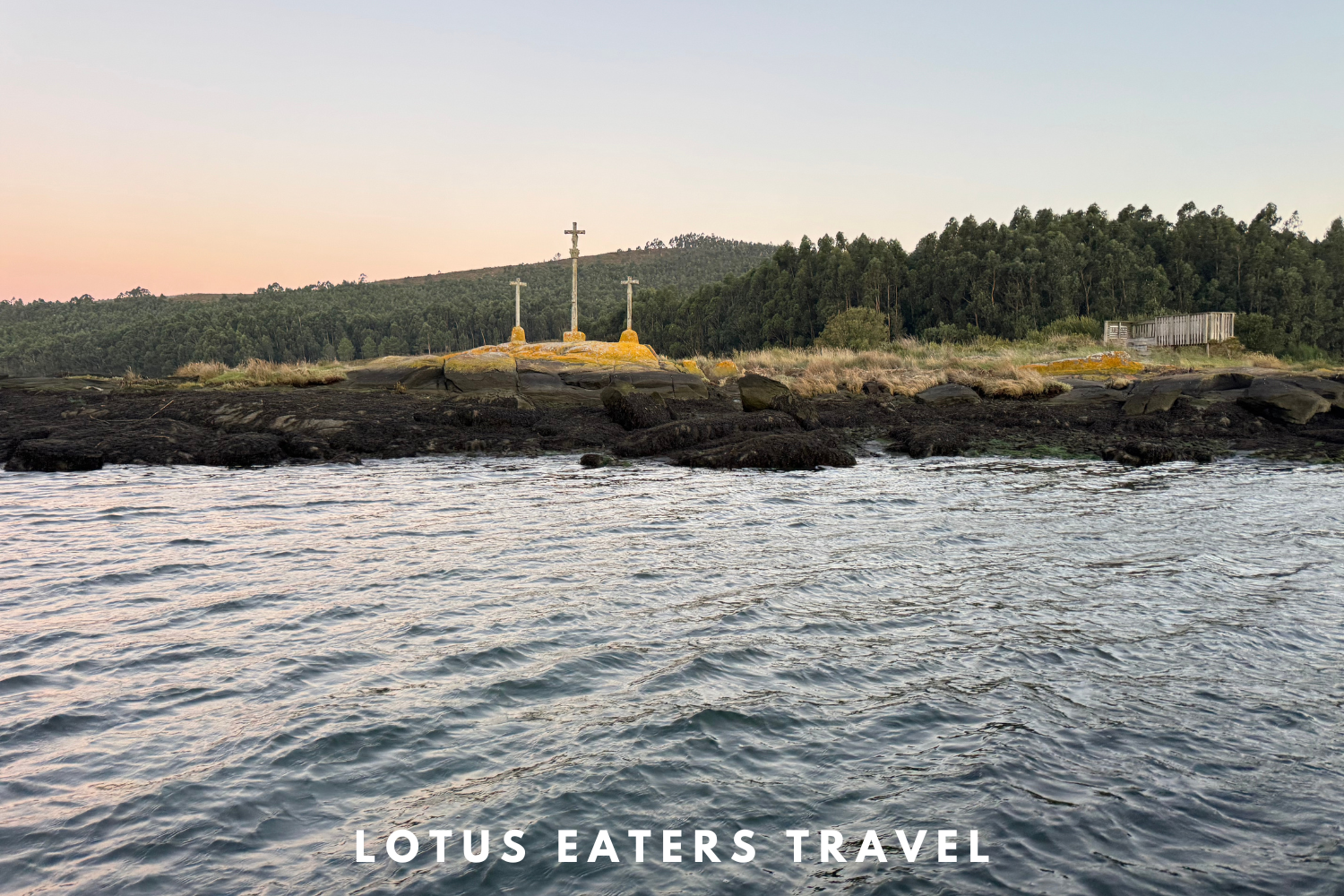
There are reminders of this history along the way, including the stone crosses that can be seen from the boat as you travel along the river. The boat companies also provide some commentary about the history of the Traslatio, which helps to put this final part of the route into context.
The Spiritual Variant also passes through some places with their own strong religious and historical connections. Armenteira is perhaps the most obvious example, with its 12th-century monastery, while Vilanova de Arousa has a particularly strong connection to the story of St James because of its role in the traditional journey of his remains.
Is the Spiritual Variant worth the detour


I think I’ve rather given the game away in the introduction to this blog post, but for us, the detour was absolutely worth it.
We had walked the Camino Portuguese coastal route, merging with the central route in Redondela. On the one day that we walked the central route from Redondela to Pontevedra, we were overwhelmed by the number of people on the trail. We knew it would be busy as we were walking in September – which is peak time. But, still, it felt like a lot.
Two kilometres out of Pontevedra, and we were so thrilled to see the Spiritual Variant turn off. We turned left and counted how many people continued on the main route. After the turn off, we saw a handful of people, but we were soon spread out on the trail and walking alone.
For me, it was just the “headspace” that I’d been craving.
Aside from being a quieter route, the variant also takes in some incredibly interesting places – Combarro (historic fishing village), Amenteira (with its 12th century monastery) and oodles of vineyards. We also enjoyed exploring Vilanova de Arousa, a town with a strong connection to the Camino.
For me, a big draw for walking the Spiritual Variant was to return to the coast again. We had such good weather and I just wasn’t quite ready to say goodbye to the ocean – the Spiritual Variant visits the coast twice, at Combarro and Vilanova de Arousa.
And of course, if you’re walking the Camino de Santiago for religious purposes, there’s a clear reason to walk this section.
You can find more information about what we liked and didn’t like about the Spiritual Variant here (published soon.)
How difficult is the Spiritual Variant

In general, the Camino Portuguese is not thought of as a “difficult route.” Compared to other Camino routes, it is a shorter overall distance, it is flatter and the terrain isn’t particularly challenging.
The Spiritual Variant is a little harder than the central route. Mainly because it’s a little hillier. The walk between Combarro and Armenteira includes a 500m climb. It’s worth keeping in mind that this climb is sustained over 5km, so it’s not particularly steep but it does require continued effort over an hour or so.
We chose to stay overnight in Combarro, so that we could tackle the climb early in the morning and for us, this was a great decision. I know others choose to take a taxi to skip this section – obviously that is a personal decision, but keep in mind that if you want to gain your Compostela in Santiago, then you need to walk 100km consistently.
Aside from this climb, the route isn’t difficult. The terrain is straightforward, with more trail than the central route. We found it very manageable, having split the route into three shorter days.
Signposting on route


The Spiritual Variant is signposted, but it has its own unique route markers that look a little different to the traditional Galician Camino ones. Instead of stone markers, you’ll see a wooden post with “Variante Espiritual”, a scallop shell and a yellow arrow.
Although there are route markings, I’d really recommend having access to a map. The Spiritual Variant does have a couple of twists and turns that are easy to miss – especially as there are fewer people on route, so you often find yourself walking alone.
Luggage Transfer on the Spiritual Variant

Although this route is less popular, you can still have your luggage transported between hotels if you choose to.
Correos, the Spanish postal service, operates on the Spiritual Variant. Top Santiago are also able to transfer luggage.
Accommodation & budget


There are some great accommodation choices along the Spiritual Variant.
As we were walking as a couple, we chose to stay in private rooms in hotels and albergues on route. Our total spend was €200 for three nights accommodation – this was three private rooms, all with private bathrooms.
There are also albergues with dorm spaces on route in Combarro, Armenteira, Ribadumia and Vilanova de Arousa (including a municipal albergue in Vilanova de Arousa.) Anyone wishing to stay in albergues can walk the route in two or three days.
In terms of budget, the route is similar to the rest of the Portuguese route in Galicia. But keep in mind that you’ll need to budget €30 for the boat ride (unless you plan to walk this section.)
Spiritual Variant and getting the Compostela
In order to receive the Compostela when you arrive to Santiago, it is still possible to walk the Spiritual Variant. It is also completely acceptable to take the boat, as part of the Camino route. Taking the boat will not compromise your ability to get a Compostela, as it is a recognised part of the route.
Be sure to continue to get stamps in your credential twice a day and to get the stamp at the end of the boat ride too.
Spiritual Variant Daily Stages
This was my third time walking a version of the Camino Portuguese route – and from the outset, I had decided to take things much more slowly this time. Instead of averaging 25km-30km as we normally would, we kept our distances to between 10km and 20km, probably averaging around 17km.
When it came to the Spiritual Variant, I wanted to continue this slow and steady approach. We opted to spend three days walking the Spiritual Variant, catching the boat on our fourth day. Many walkers tackle the Spiritual Variant in two days, but we personally didn’t want to rush this beautiful section.
Here’s how we approached three days on the route.
Day One: Pontevedra to Combarro


KEY DETAILS: 11.5km distance, 200m ascent
Highlights
- Almost as soon as we left the central route, we felt that we could breathe a sigh of relief as the trail became much quieter. We were able to walk alone for the first time in a couple of days.
- Some lovely sections of eucalyptus forest and glimpses into Galician countryside
- Mosteiro de San Xoán de Poio is a 7th Century Monastery on route to Combarro – when we passed on a Sunday there was a service on so we couldn’t visit, but normally you can visit between 10:00 and 13:00 or 16:30 and 19:30. Tickets are €3.50.
- Combarro is a charming village and well worth exploring – we visited on a Sunday, which was possibly a bit of a mistake as it was incredibly busy. If you can, arrive on a weekday. And if you do visit on the weekend – consider making lunch reservations.


Amenities
- Amenities available in Pontevedra, but if you leave early you may not find many cafes open. After crossing the bridge out of the city, there is normally a café open (although it tends to get busy.)
- Around 4km after the Spiritual Variant turn off is a lovely hotel with a cafe, Hotel Rural Campaniola. In this village, there are other cafes/ restaurants, but when we walked the hotel was the only thing open.
- After this, amenities appear on the outskirts of Combarro and then in the village itself, there are multiple restaurants, cafes, bars, grocery stores and a bakery.
Accommodation


It’s worth noting that the centre of Combarro village is not actually on the Camino route, so you’ll have to come a little off route to stay in the village.
We stayed at Hotel Stellmaris – found just through the village and close to the beach. Personally, we liked the location, but it is a little walk from the route. We had a sea view room which had a wonderful view.
There are a few other hotels in the area – Combarro Mar and Hotel Combarro – the latter is on the entrance to the town, which is convenient for the Camino route.
For dorm style accommodation, there is one albergue – Hostel Nuestra Señora del Camino.
Alternative: Pontevedra to Armenteira
Many pilgrims choose to skip Combarro and walk straight to Armenteira. Personally, I think this is a bit of a shame as Combarro is really lovely – and there’s a chance to enjoy a night on the coast. But I can also see the draw of staying overnight in Armenteira. The total distance would be 21km.
In Armenteira, there are two excellent options for private accommodation – Albergue CAROI HOSTEL & ROOMS Armenteira and Pousada Armenteira. As well as the Albergue De Peregrinos San Ero Armenteira.
Day Two: Combarro to A Ponte de Cabanelas


KEY DETAILS: 19km distance, 500m ascent
Highlights
- The route starts with a climb out of Combarro, which lasts around 5km. This is on a mix of quiet residential roads and later, trail. The trail section is really lovely.
- Armenteira is a highlight – there are a couple of cafes there, which we very much needed after the climb! And of course, the 12th Century Monastery.
- The Ruta de Pedra e Agua (route of stone and water) is absolutely stunning – you walk along the river, in shaded forests and there are a number of waterfalls on route. Look out for former mills too (the stone part of the route.)
- After this, we suddenly found ourselves surrounded by vines – this is a popular area for growing Albariño. And there are wineries just off route that you can visit.


Amenities
- We left Combarro early in the morning and there were no coffee shops open – I suspect that some will open at around 07:30 or 08:00, but if you plan to leave before then, you’ll need to pack refreshments for the way (or arrange breakfast in your hotel.)
- After this, the first amenities are in Armenteira – where you can find Bar O Comercio. I was surprised to learn that this bar doesn’t have a great rating on Google, because we had fantastic toast and coffee here.
- Peneira Restobar is located at around 15km, we continued to Hospedaje Rústico – Restaurante Os Castaños (16km) which has a fantastic lunch menu for €15 (you can also try their house wine which is made locally.)
- If you are staying in Ponte de Cabanelas, there are a few cafes – we liked Cruceiro Vello Café-Bar which overlooks the football pitches.
Accommodation
We chose to stay in A Ponte de Cabanelas at Hostal Santa Baia, which is around 500m off route. It offers reasonably priced private accommodation and a decent buffet breakfast. There are cafes nearby for the evening.
If you want dorm style accommodation, consider Albergue Camino Espiritual. Again, this is a little off route.
If you wanted a slightly shorter day, Hospedaje Rústico – Restaurante Os Castaños is 3km short of A Ponte de Cabanelas. We paused here for lunch and it looked like a pleasant place to stay.
Alternative: Combarro to Armenteira
As an alternative, you could split this day and pause overnight in Armenteira. If you wanted to spend longer exploring the monastery, or joining the 19:00 pilgrim’s blessing, this could be an option. This would give you a longer walking day into Vilanova de Arousa the next day – but that section is quite straightforward so could be walked quickly.
Day Three: A Ponte de Cabanelas to Vilanova de Arousa


KEY DETAILS: 14km distance, 200m ascent
Highlights
- A pleasant and straightforward day of walking, on quiet footpaths along the river, passing vines and then through small villages.
- There are beaches as you enter the town, ideal if you want to stop and cool down, or while away a few hours whilst waiting for check in to your accommodation.
- Vilanova de Arousa is a town with close links to the Camino de Santiago, because it is where St James’ remains were transported from. As such, you’ll see lots of references around the town.
Amenities
- There are bars at regular intervals throughout the day (apart from the last 4-5km), but check opening hours.
- On entrance to Vilanova de Arousa there are beach bars located along Playa del terron, but they are open on a seasonal basis.
Accommodation
Vilanova de Arousa has a number of accommodation options. We stayed at Albergue Salazon in a private room (they also have dormitory space.) It’s very handy for the marina, where the boats leave in the morning.
A Corticela is an alternative private albergue with dorm space. There is a municipal albergue in town too – find it here.
For private accommodation, Hotel Leal – La Sirena has good reviews. We almost chose to stay here, but it is a little far from the marina. Closer to town, there are a number of private apartments – like this one.
Vilanova de Arousa to Pontecesures boat


On the fourth day, we took the pilgrim boat from Vilanova de Arousa to Pontecesures.
It’s useful to know that two companies operate on the route.
Barca del Peregrino is a larger passenger boat, which offers seating inside the boat and on deck. The costs is €30 and there are normally a few sailings per day (in peak season). If you are walking when the weather is a bit inclement, this is definitely a better choice as you can sit inside the boat.
We opted to take a boat with Amare Turismo Nautico. A fellow pilgrim described this as the “charter boat” option compared to the “ferry.” The Amare boat is a speed boat that holds 8-10 people only. I suspect you get a better chance to see the views along the river, than on the bigger boat. And, the boat is fast – we arrived to Pontecesures in under an hour. But, it’s completely exposed to the elements so you will want to wrap up warm. This boat leaves at 08:00 and costs €32.
Both boat companies offer some sort of commentary as you travel along the river, so you’ll get to learn a little about the history of “traslatio” and to see the historic stone crosses along the way.
Whichever boat you choose, it’s best to book in advance as tickets do sell out.
Tip: if you don’t want to stay overnight in Vilanova de Arousa, Barca del Peregrino sometimes have a 12:30 or 16:00 sailing.
Where to stay after the Spiritual Variant
Depending on your pacing, it is entirely possible to take the boat from the Spiritual Variant and arrive to Santiago de Compostela the same day. The total distance from Pontecesures (where the boat docks) to Santiago de Compostela is 28km.
Most pilgrims choose to split the distance between Pontecesures and Santiago, staying overnight somewhere.
We opted to stay at a lovely rural albergue in Angueira de Suso, which gave us an 11km walk, after the boat ride. This gave us time to enjoy visiting the church in Padron and relaxing with a long breakfast. We also arrived to our albergue early to enjoy the garden.
One of our favourite albergues, O Lagar de Jesus, is just 8km from Pontecesures. This might be a good option if you want a very short day, or you take the 12:30 boat from Vilanova de Arousa.
If you wanted to get a little further towards Santiago, there are lots of options. O Farmello is 14km from Pontecesures – which leaves 14km remaining to walk into Santiago de Compostela the next day.
Written by Emma
Wine Lover. Yogi. Hiker. Writer.
British travel writer and long-distance hiker, native to Kent. Emma has walked the Camino de Santiago more than ten times, completed trails across Europe from the Corfu Trail to the Fisherman’s Trail, and covered thousands of kilometres on foot. She always writes from first-hand experience. Her goal? Inspire just one person to go on their first long-distance hike.


More Camino Travel Guides


USEFUL LINKS FOR FLIGHTS, ACCOMMODATION AND TRANSPORT


FOLLOW US ON SOCIAL MEDIA
Please note that some links on our website are partnered with affiliates. Using an affiliate links does not make it more expensive for you to purchase. We receive a small commission whenever you buy something which in turn allows us to keep writing independent travel guides and your support is greatly appreciated.
Leave a Reply