
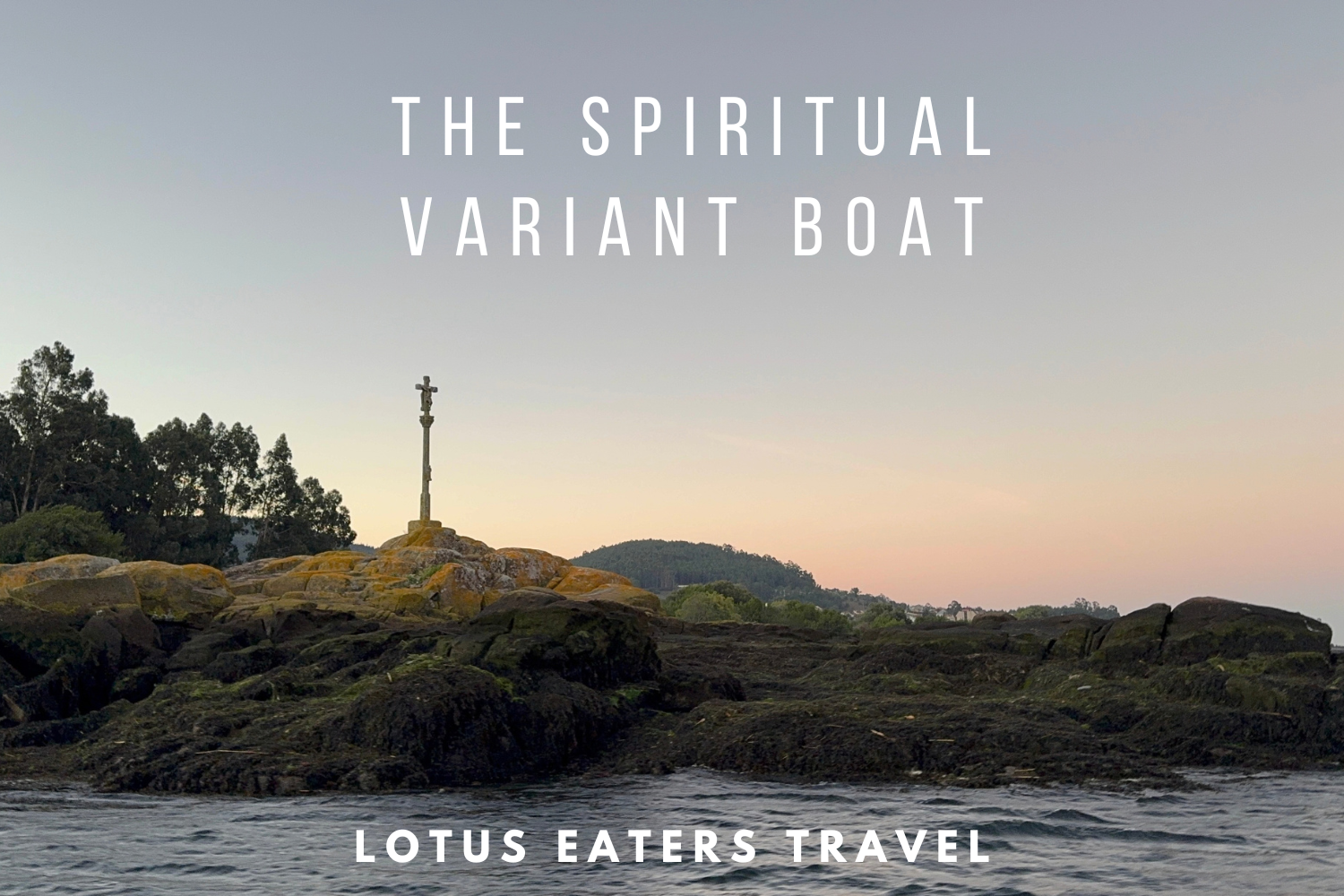
A SHORT GUIDE TO TAKING THE PILGRIM BOAT ON THE CAMINO SPIRITUAL VARIANT.
I will admit, I made a bit of a mistake when it came to arranging our journey on the pilgrim boat from Vilanova de Arousa to Pontecesures.
There are two companies operating the route: one has a larger, more comfortable vessel, while the other uses a smaller speedboat. The latter is quicker, and I would argue more fun, but perhaps a touch less relaxing.
Somewhere in my brain, I did know there were two companies. But in a rush to book, I went for the speedboat.
Whilst I was perfectly happy with this choice, John’s face dropped when he saw the lovely, comfortable boat that we could have been on. I tried to style it out, reassuring him that we’d have more fun and that our boat was practically private, with only eight passengers.
I’m not sure I entirely pulled it off.
Still, by the end of the journey, I was pretty pleased with my decision.
In this guide, I’ll share everything we learnt about taking the pilgrim boat from the Camino Spiritual Variant and reconnecting with the Camino Portugués Central Route – including which boats you can take, how to book, what to expect and a few things I wish we’d known beforehand.
Key information

The pilgrim boat connects the Spiritual Variant with the Camino Portuguese Central Route.
START POINT: Vilanova de Arousa
END POINT: Pontecesures (2km before Padron.)
DURATION: Between 1 hour and 1 hour 20 minutes, depending on which boat you choose. Although our boat actually arrived within 50 minutes.
SIGNIFICANCE: The route is often called the “traslatio” route, which refers to the translation by sea of the remains of The Apostle St James.
Is it “cheating” to take the boat
First things first: no, taking the boat is absolutely not cheating.
The boat journey is a recognised and integral part of the Camino Spiritual Variant. In fact, travelling by boat is significant to the story of the Camino, as the route follows the journey traditionally associated with the transportation of the remains of the Apostle St James. This is known as the Traslatio.
And if you’re hoping to receive your Compostela in Santiago, taking the boat doesn’t prevent you from doing so. Just make sure you get your pilgrim credential stamped for the boat journey. The skipper will normally offer this at the end of the crossing.


Can you walk instead?
Technically, yes. It is possible to walk from Vilanova de Arousa to Pontecesures rather than taking the boat.
We haven’t done this ourselves, though, and from what we’ve heard, it isn’t considered the most enjoyable section of the Camino. It is also apparently not particularly well signposted.
For us, taking the boat was part of the experience – and it also made for a much more interesting way to continue the journey. And, I’ll be honest, it was nice not to walk for once!
The two boat options

The most important thing to know, is that there are two boat companies that operate this route.
Barca del Peregrino is probably the most well known. They offer a larger boat, which has an inside area (covered) and a deck up top, for those who want to enjoy better views. This boat takes 1 hour 20 minutes, but is thought to be quite a comfortable option.
During peak season, the Barca del Peregrino boat runs a number of sailings – often 08:00 or 09:00, 12:00 and 16:30. Although this is not consistent every day, so check in advance. The later sailings are ideal for pilgrims who don’t want to stay in Vilanova de Arousa overnight.

Amare Turismo Nautico offer an alternative. A daily crossing at 08:00, on a smaller and speedier boat. This crossing takes around 1 hour and each boat takes 8-10 passengers. You get great views of the river on this boat, but there’s absolutely no cover. But if it’s raining, or even just particularly cold, you’ll definitely know about it.
Personally, I really enjoyed the speedboat experience. It felt more like an adventure than simply getting from A to B. John may still disagree.
Booking the pilgrim boat
We would definitely recommend booking your boat in advance, particularly if you’re travelling to a specific schedule or need to reach Santiago by a particular date.
There are stories of pilgrims turning up without a booking and finding that the boats are full, meaning they have to wait until the following day.
We saw this for ourselves to some extent. When we took the boat in September, there were three boats leaving at around the same time – and all of them were full.
Even if you only book a day or two ahead, we’d recommend doing so rather than simply turning up and hoping there will be space.
You can book directly through:
Barca del Peregrino or Amare Turismo Nautico.
How much does the boat cost?
At time of writing, the two boat companies offer similar prices for the crossing. The Barca del Peregrino costs €30, whilst the faster Amare Turismo Nautico costs €32.
Boarding the boats

Both boats leave from a similar place in Vilanova de Arousa – normally here (google maps link).
Your boat company should send you the exact meeting point and boarding instructions when you book. We also received a confirmation/reminder email before our journey.
We took the 08:00 crossing and were asked to arrive around 20 minutes before departure.
This worked well. We arrived with plenty of time to spare, got ourselves organised and were all on board ready to leave on time.
As with any part of the Camino, I’d recommend giving yourself a little extra time rather than arriving at the last minute – especially if you’re carrying a full backpack and aren’t completely sure where you’re going.
What to look out for on the journey
The boat journey isn’t just a convenient way to skip a section of walking. It’s actually one of the more interesting parts of the Spiritual Variant.
Keep an eye out as you travel along the River Arousa and Ulla and the surrounding estuary, because there is plenty to see.
The stone crosses

One of the things we were particularly looking out for were the stone crosses that mark the Traslatio route.
There are 17 stone crosses along the route, and apparently each one is slightly different.
We managed to spot 10 of them during our crossing.
They can be easy to miss, particularly if you’re busy chatting or taking photographs, so keep your eyes open as you travel. Seeing them makes the historical and religious significance of the journey feel much more tangible.
Floating mussel farms
You’ll also pass the distinctive floating mussel farms, known as bateas.
These are an important part of the local fishing and shellfish industry, and you’ll see rows of floating structures across the water.
Depending on the conditions and the route your boat takes, you may also see people working in the water and fishing for clams.
It’s a lovely reminder that you’re travelling through a landscape that isn’t simply there for pilgrims – it’s a working river and an important part of everyday life in Galicia.
The Viking connection

Another interesting sight along the route is the Viking House, which commemorates the historical Viking raids and connections with this part of Galicia.
It’s one of those things that you might otherwise completely miss if you were simply following the walking route, so the boat journey gives you a different perspective on the history of the area.
And, of course, there is the scenery itself. The river, birds and surrounding hills make the crossing feel like a proper part of the Camino rather than simply a form of transport.
Our experience on the speedboat


I’ll admit that when I saw the larger Barca del Peregrino boat, I did wonder whether I’d made the wrong choice.
It looked incredibly comfortable. Our boat, by comparison, was tiny.
But once we were out on the water, I was actually very glad we’d chosen the speedboat.
There were only eight passengers on our crossing, which made it feel quite intimate. We had excellent views throughout the journey, and travelling at speed added a little excitement to what could otherwise have been a fairly sedate hour on the water.
The downside was the weather.
Because there is no cover, you need to be prepared for whatever Galicia decides to throw at you. Even if it’s warm when you leave, the wind on the water can make it surprisingly chilly. The weather was a balmy 32 degrees centigrade on the day we took the boat, and yet we were freezing in the morning on the boat.
And if it rains? Well, you’re going to get wet. So perhaps John’s initial disappointment was understandable.
Tips for pilgrims taking the boat

1/ Take layers if you’re on the Amare speedboat
Even on a warm day, it can feel surprisingly cold on the water once the boat is moving.
Take a couple of layers that you can easily put on or remove, rather than relying on the weather in Vilanova de Arousa.
I’d also recommend having a rain cover on your backpack. You could get caught in rain, but you may also get some spray from the river.
2/ Plan your walking stages around the boat
The boat isn’t simply something you can turn up and take whenever you fancy it.
The number of departures varies between the companies and depending on the time of year, so check the sailing times before you finalise your accommodation and walking stages.
If you’re taking an early morning boat, remember that you’ll need to be in Vilanova de Arousa the night before.
Alternatively, a later departure may allow you to walk into Vilanova that morning – but you’ll need to consider how far you’ve walked and how much time you’ll have before the boat leaves.
3/ Don’t assume you’ll get breakfast before an early boat
If you’re taking the early morning sailing, don’t assume you’ll be able to stop for breakfast beforehand.
We took the 08:00 boat, so there wasn’t much time for a leisurely breakfast before boarding.
It might be worth carrying some breakfast with you, particularly if you have a long walking day ahead once you reach Pontecesures.
We waited until we arrived in Pontecesures and the coffee and toast tasted so good.
4/ Get your pilgrim stamp
This is an easy one to forget in the excitement of getting on and off the boat.
Make sure you get your credential stamped.
The skipper should offer this at the end of the journey, and it provides evidence that you completed this section of the Spiritual Variant by boat.
More information on the Spiritual Variant

You can find our detailed daily stages guide for the Spiritual Variant, including where we stayed below.
>>>> Daily stages guide for the Spiritual Variant
Written by Emma
Wine Lover. Yogi. Hiker. Writer.
British travel writer and long-distance hiker, native to Kent. Emma has walked the Camino de Santiago more than ten times, completed trails across Europe from the Corfu Trail to the Fisherman’s Trail, and covered thousands of kilometres on foot. She always writes from first-hand experience. Her goal? Inspire just one person to go on their first long-distance hike.


More Camino Travel Guides


USEFUL LINKS FOR FLIGHTS, ACCOMMODATION AND TRANSPORT


FOLLOW US ON SOCIAL MEDIA
Please note that some links on our website are partnered with affiliates. Using an affiliate links does not make it more expensive for you to purchase. We receive a small commission whenever you buy something which in turn allows us to keep writing independent travel guides and your support is greatly appreciated.
Leave a Reply