
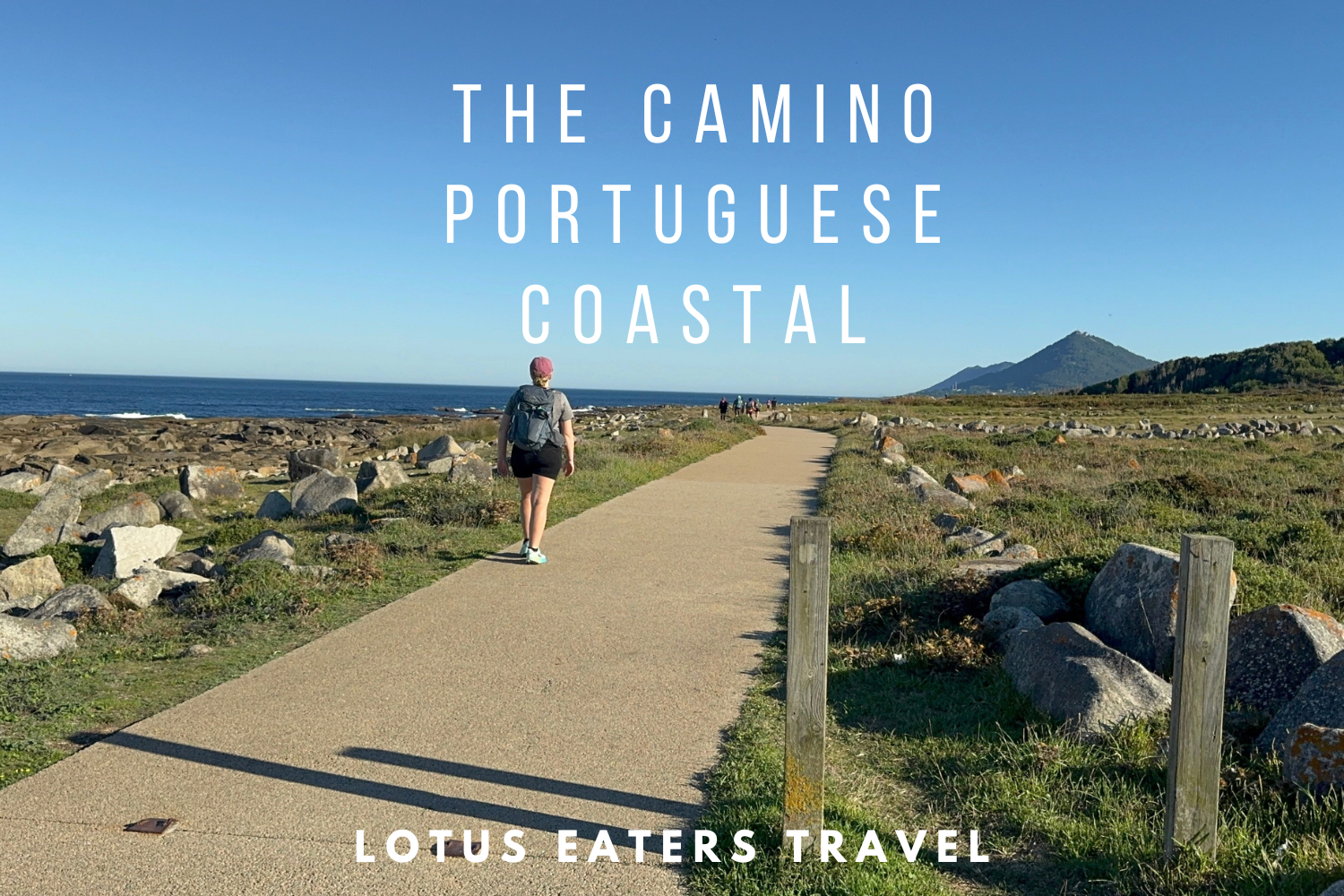
THE CAMINO PORTUGUESE (COASTAL ROUTE): WHAT WE LIKED + DIDN’T LIKE.
I first walked the Camino Portuguese Coastal route in March 2024. In late 2026, I returned to the route.
The first time, I walked a few days with my mother, and the rest solo. This time around, John and I walked together.
We don’t often return to routes, especially not Camino routes. But there were so many places that I had visited alone that I longed to show John. And this time around, I’d be walking whilst pregnant – suffice to say, I needed a route that I knew wouldn’t throw too many unexpected challenges my way. A route that I could adapt into nice, short walking stages, where I could stay mostly in private rooms and spend some time relaxing in the afternoons.


And that, I knew, was the Camino Portuguese Coastal route.
In this blog post, I’ll highlight what we liked about the route (on both the first and second occasions) and what we found slightly more challenging.
A quick bit of context – this refers to the route between Porto and Santiago de Compostela, which is the section most commonly walked.
What we liked
Here’s everything we loved about the Camino Portuguese Coastal Route.
COASTLINE VIEWS


From the moment I left Porto, walked along the river and hit the Atlantic, I was reminded of exactly why I chose this route – and chose it again.
The coastal views are second to none along the route. It’s true that the views are often quite different to those on other coastal hikes. For example, the Fisherman’s Trail in Southern Portugal has unmatched coastal views, often from a cliff top. This type of view can be majestic.
But on the Portuguese Coastal Camino, you’re more often nose-level with the sea. The route is flat, and often follows promenades or boardwalks – so it’s less about panoramic views, and more about eyeballing the ocean as you walk, and willing yourself not to stop one more time to stare at the sea.
(I found this hard!)
BEACHES TO RELAX ON

One of the most important things for me when choosing a long-distance hiking route is knowing how I can spend my “down time.” There are certain Camino routes – the Camino Frances, for example – where there is often little to do once you’ve finished walking.
One of the reasons I do love the Camino Portuguese Coastal route is that, for beach lovers, there is always something to do in the afternoon. I loved walking a short day, finishing at around midday and spending the entire afternoon with sand between my toes.
And if you get good weather, there’s nothing quite like taking an “Atlantic cold plunge” to end the day.
LITORAL ALTERNATIVE ROUTES
There are a couple of sections of the Camino where the Coastal Route, quite ironically, goes inland. Even the first day out of Porto is a little confusing – both the Central and Coastal routes follow inland paths.
But when the Coastal Route does travel inland, normally there’s a “litoral” alternative – i.e. a path that literally follows the coast, which you can take instead.
Every time we took the litoral path, we were chuffed with our decision. It’s a personal choice, but we’d decided to walk the coast, and that’s what we wanted to do. We didn’t want to head inland for any reason – and so, we just followed the coast. And it always seemed to be a good idea.
TOWNS ON ROUTE


Another thing I really enjoyed about the Coastal Camino was the number of towns and little seaside places you pass through along the way.
There are bigger towns and cities, like Vila do Conde and Baiona, as well as smaller beach towns such as Mindelo and Vila Praia de Âncora. It gives the route a nice rhythm, where you’re never too far from somewhere to stop for a coffee, grab some food or simply wander around for a while.
I also really liked that the towns felt like places in their own right, rather than simply existing to serve the Camino. You get a sense of everyday Portuguese and Spanish life as you walk through them, which is one of the things I enjoy most about walking long-distance routes.
VISITING VIGO


Vigo is a large city in Galicia and it appears on the last day of the Camino Portuguese Coastal route. It’s also the last chance to soak up that seaside energy before joining the Central Route.
Many pilgrims join the route in Vigo because it marks the last 100km.
For us, it appeared at the perfect time to take a rest day. We always love visiting cities on rest days, because it just feels nice to shift from the routine of getting up and walking to having a slow morning coffee, exploring a museum or two and enjoying the city energy.
Vigo may be a large city, but it doesn’t have the big-name attractions of somewhere like Barcelona or Madrid. Instead, it’s understated and offers a lot for anyone wanting to explore for a day or so. There are excellent beaches on the way into the city, the Cíes Islands are just a boat ride away, and it has an abundance of great places to eat and drink.
And crucially, private accommodation is very reasonable. We paid €120 for two nights in an apartment, and hotels are available for less.
You can find our guide to visiting Vigo here (published soon).
WALKING IN PORTUGAL & SPAIN


I also really enjoyed the fact that this route gives you the chance to experience two countries in one walk.
Of course, you’re still walking the Camino, and the experience doesn’t suddenly change overnight when you cross the border. But I liked the little differences between walking in Portugal and Spain, and the sense that the route was gradually changing as we made our way towards Santiago.
And then, of course, there’s the fact that you actually cross the border by boat…
BOAT CROSSING


I’m not exactly sure why this is, but I get unnecessarily excited about taking a boat during a long-distance hike. If I’m honest with myself, it’s probably because deep down I just really relish the chance to take a break from walking.
If you walk the Camino Portuguese Coastal, then the mandatory boat ride comes when you cross from Portugal to Spain. And I found that even more exciting – crossing the border of two countries by boat. What a thrill.
Even if it only lasts five minutes!
You can find our guide to the boat crossing here.
FLEXIBLE DAILY STAGES


This route is one of the best long-distance hikes in Europe for flexible daily stages. Which is why I always recommend it to someone walking their first Camino.
The first time I walked, I averaged 25km per day – which is quite common. But this time, we decided to tailor our stages to walk less each day. On one or two days, we walked 10km or so; on others, we walked 20km. But I would say our average was around 15-17km.
For me, walking whilst not at full fitness, this was ideal.
I loved planning the route around where I ended up each day, rather than trying to hit a certain distance target. But what is really lovely is that you can adapt your route on this Camino to suit you – and that’s not the case on every long-distance hike.
PLENTIFUL ACCOMMODATION


The Portuguese Coastal Camino is blessed with fantastic infrastructure, in the form of cafes, public toilets and even water fountains. The little things that make a walker’s life so much easier.
But one of the most important factors on any Camino is whether there’s an abundance of accommodation.
And on this route, there is.
There’s also a great variety. When I walked with my Mum, we stayed at some quite snazzy hotels. When I walked solo, I stuck to dorm rooms in albergues. And on our most recent walk, we predominantly picked basic private rooms.
That said, of all the Camino routes I’ve walked, this one, I think, requires booking ahead most of all. The route has become so much more popular, and even though there is lots of accommodation, there are bottlenecks and shortages – particularly on weekends.
We met lots of people who had come unstuck from not booking, and it’s just stressful.
What we didn’t like so much
Here’s everything we liked a little less about this route. The downsides, if you will.
REPETITIVE SCENERY

As you might expect with a Coastal Camino, you do spend a lot of time walking along the coast.
If you’re someone (like me) who can gaze out to sea for hours on end and the wonder never ceases – you’ll love it.
But if you’re someone who craves a bit more variety, and perhaps isn’t so much of an ocean lover (like John), it might not tickle your pickle quite so much.
LITTLE TIME ALONE


As I mentioned, the first time I walked this route was in March into April – early in the season. The weather was abysmal and, on the coastal section, I barely saw anyone else – although the last 100km was busier.
This time, we chose to walk this route in September. We knew it would be peak time (June and September are the busiest months), but we hadn’t quite expected to feel like we were never alone.
I would never want to moan about lots of people being on the Camino – the more the merrier, really. I love that the routes aren’t exclusive and that they attract people from all walks of life.
But there’s something about the landscape on the Camino Portuguese Coastal route (and indeed the last 100km – see below) that can make it feel a little suffocating.
I think it’s because, as you walk along the coast, you can see a long way into the horizon – and that means that, at peak times and on certain stages, you can see lines of fellow walkers.
This certainly made the atmosphere jovial, and there were plenty of folk to chat to, but on occasion, I just wanted a quiet stretch alone to get into a meditative headspace.
In the end, we started getting up early to beat the crowds. And these hours in the morning were some of the most cherished on the trail.
THE LAST 100KM


For much the same reasons as mentioned in the last point, the last 100km was perhaps the section we were looking forward to the least.
At Vigo, many people join the route – and, for the most part, this seems to include large groups. Now, I don’t want to criticise group walking, but sometimes this did result in large queues at cafes and just a general “busy feeling.”
The other thing to note about the Coastal Camino is that the last 80km or so are inland. The Coastal Route effectively ends at Redondela and joins the Central Route.
And actually, this section of the route has some lovely aspects – more woodland trail, some charming towns like Redondela and Padron, and the lively foodie city of Pontevedra.
This time, having walked the last 100km of the Central Route previously together (in 2022), we decided to walk the Spiritual Variant this time around.
This is a great “hack” if you want to get away from the crowds and divert back to the coast.
You can find our guide to the Spiritual Variant here.
WALKING SURFACES

The route is generally pretty flat, bar one or two small hill climbs. And one of the most challenging aspects of walking it from Porto to Santiago de Redondela in particular, is how much walking on asphalt, boardwalks or pavement there is.
Walking on this kind of terrain, rather than trail, consistently is hard on the feet. And if you choose to walk this route, pay particular attention to your footwear. We met a couple of people who had to change their shoes after just a few days.
LESS CHALLENGING CAMINO


It is perhaps unfair to include this on the list of things we didn’t like. Because ultimately, on both occasions that I’ve walked this route, one of the reasons I’ve picked it is because it’s not the most challenging Camino.
But I wanted to be honest about this aspect.
Of all the Camino routes we’ve walked, the Portuguese routes are flatter and rather straightforward. The challenge comes from the distance you give yourself to walk each day, rather than the terrain.
For me, this time around, I found walking anything more than 15km immensely challenging. And I was hugely appreciative that the Camino Portuguese Coastal allowed me to walk shorter days.
The Camino Portuguese Coastal Route: Our Review


So, after all that, what’s our verdict on the Camino Portuguese coastal route?
TRAIL MARKINGS + NAVIGATION: 9/10 – as always, the Camino routes are incredibly easy to navigate.
DIFFICULTY: 5/10 – aside from the distance, the terrain is not challenging.
ACCOMMODATION + AMENITIES: 9/10 – great infrastructure on route, with plenty of albergues and private accommodation.
VARIETY + LANDSCAPE: 8/10 –the route offers stunning sea views on a nearly daily basis and some variety (the last 100km) has a different feel entirely.
PLEASURE + LEISURE: 9/10 – plenty to see on route with interesting ways to while away the afternoons. And a dip in the ocean is always a treat.
Written by Emma
Wine Lover. Yogi. Hiker. Writer.
British travel writer and long-distance hiker, native to Kent. Emma has walked the Camino de Santiago more than ten times, completed trails across Europe from the Corfu Trail to the Fisherman’s Trail, and covered thousands of kilometres on foot. She always writes from first-hand experience. Her goal? Inspire just one person to go on their first long-distance hike.


More Camino Travel Guides


USEFUL LINKS FOR FLIGHTS, ACCOMMODATION AND TRANSPORT


FOLLOW US ON SOCIAL MEDIA
Please note that some links on our website are partnered with affiliates. Using an affiliate links does not make it more expensive for you to purchase. We receive a small commission whenever you buy something which in turn allows us to keep writing independent travel guides and your support is greatly appreciated.
Leave a Reply