
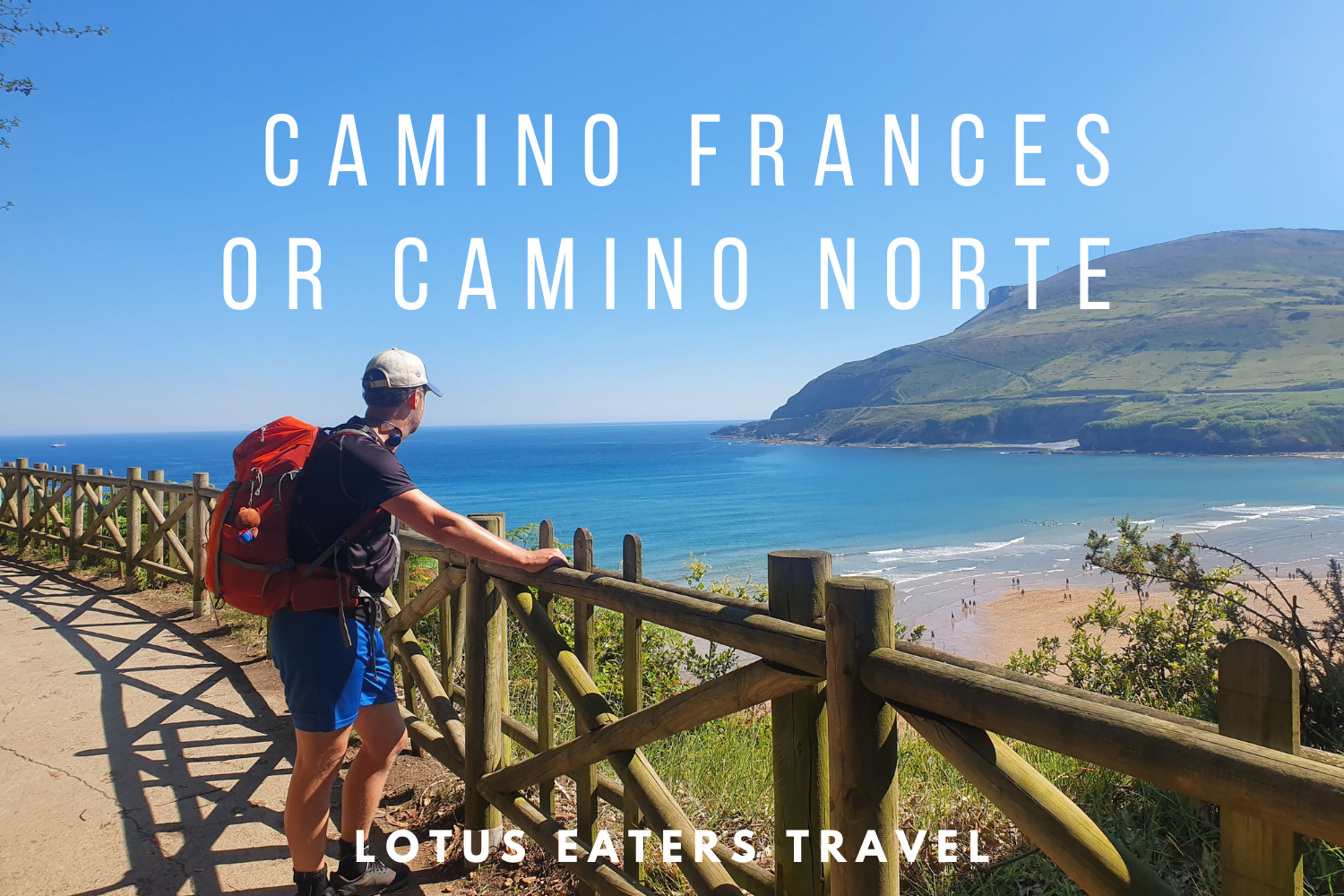
WE’VE WALKED BOTH – SO WHAT ARE THE DIFFERENCES BETWEEN THE CAMINO DEL NORTE AND THE CAMINO FRANCES.
In 2022, the Camino del Norte was our first Camino. Many start with the Camino Francés, but we went straight for the tougher coastal route. Since then, we’ve walked multiple long-distance trails, including the Camino Francés twice.
When people talk about the differences between the Camino del Norte and the Frances, you’ll often here sweeping statements like “you won’t see anyone on the Norte,” or “the Frances is too crowded”. Whilst these two statements might have an element of truth, it’s a bit more nuanced than that.
To give you an example, we first arrived in Arzúa, where the Camino del Norte merges with the Francés, I half expected a parade of pilgrims welcoming us to the busier route. I thought it would be like arriving at Glastonbury Festival, but for pilgrims. Instead, it was just another town, albeit with noticeably more backpackers. But, hoards of them, there were not. That was my first reality check about the Francés, yes, it’s busy, but it’s not an overcrowded highway.
Another misconception? That the Norte is 80% road walking or only for super-fit hikers. Neither is true. While it’s definitely more challenging than the Francés, it’s entirely doable with reasonable fitness and a willingness to tackle a few steep hills. And there are plenty of footpaths!


In this blog post I’ll set out the key differences and similarities between the two routes, to help you choose which one to do first. I say first, because once you’ve had a bite of the Camino cherry, it’s hard not to return!
Overview of both routes

Camino Frances

Beginning in the French Pyrenees at Saint-Jean-Pied-de-Port, the Francés crosses into Spain via the steep but rewarding Napoleonic Route (not available in winter). It weaves through the vineyards of La Rioja, the high plateau of the Meseta, and the hills of Galicia before reaching Santiago de Compsotela.
This route is well-equipped with albergues and services, making it a convenient and social Camino experience. The Frances is ideal for anyone who wants to walk shorter walking stages, because albergues/ accommodation is available at regular intervals.
My favourite section of the Camino Frances is from Leon to Sarria. The city of Leon is fantastic fun with a great food scene. This section onwards is hilly with a lot of trail walking.
Camino del Norte

Starting in Irún, the Norte follows Spain’s northern coastline through the Basque Country, Cantabria, and Asturias before turning inland at Ribadeo and into Galicia. The route features dramatic sea cliffs, rolling green hills, and some strenuous ascents. While services are sparser, the Norte rewards pilgrims with stunning coastal scenery and fewer crowds.
I love the coastal views on the Norte as well. But for me a highlight is the range of different cuisines along the way. Basque Country offers incredible tapas, Cantabria delightful white wine, Asturias hearty stews and cider and Galicia amazing seafood.


Key differences between the Camino Frances and Camino del Norte
Let’s get to the key differences between the two routes.
Duration & Distance

Camino Francés: 780 km from Saint-Jean-Pied-de-Port to Santiago, typically walked in 30-33 days. But it is also possible to walk slower, up to 40 days or so. Or in a shorter time frame – for example, we walked longer daily stages and covered the distance in 27 days.

Camino del Norte: 835 km from Irún to Santiago, usually taking 32-35 days. We walked in 30 days with daily stages of between 25km and 35km.
The Norte is slightly longer, but the real difference is the daily effort required. On the Francés, you can cruise through flatter days, particularly around the Meseta, with minimal elevation. On the Norte, you’ll have multiple climbs often in a single day – the route is best described as undulating.
That said, there is actually only 10,000 ft elevation difference between the two routes. The total elevation in the Norte is 40,000ft and around 30,000 on the Frances.
Scenery & cities


Camino Francés: Classic Spanish countryside. Think vineyards in La Rioja, sunflower fields and misty Galician forests. Some cities, like Burgos and León, are architectural gems with beautiful cathedrals. A highlight is the city of Pamplona, in the first few days – think tapas bars lining bustling streets. And of course, the running of the bulls festival in summer.


Camino del Norte: Coastal drama for the first 600 km, cliffs, beaches, fishing villages, and ocean views. The final stretch (after Ribadeo) moves inland and feels similar to the Francés. In fact, the two routes actually merge in Arzua and enter Santiago in the same way. And just because it’s a coastal route, doesn’t mean you don’t get to see countryside and forest trails on the Norte – there’s lots of that too.

There are great cities on the Norte too – you reach San Sebastian on the first day and Bilbao around a week later. For me, Santander was a lovely surprise too – it has great nightlife and excellent city beaches. And that’s not to mention charming towns like Santillana del Mar.

If you love the sea and want to spend time enjoying the beaches, the Norte is unbeatable. I loved finishing our walk on the Norte and being able to spend the afternoon at the beach relaxing. If you prefer a mix of landscapes, the Francés offers more variety. And, you can book some lovely albergues with spacious gardens and even swimming pools.
Difficulty & Terrain


Camino Francés: Varied – often described as “easier than the Norte” but keep in mind there are plenty of hills still! You start with the Pyrenees climb, then cross rolling farmland, the flat Meseta, and finally the green hills of Galicia. Daily elevation gain averages 200-300m, with some tougher days.
Many people actually find the Meseta section to be the toughest. There is little shade and the scenery/ flat walking can be monotonous to the point of boredom.


Camino del Norte: Much more rugged, especially in the first half. Some days can throw 500-800m of elevation gain at you. There’s also a mix of dirt trails, coastal cliffs, and a fair amount of paved road, especially near cities like Bilbao and Gijón.
The Norte is undoubtedly harder on the legs, particularly if you’re not used to hills. Personally, I found the road walking was the hardest aspect – it can take a toll on the feet if you’re not used to it.
The Camino del Norte has the most road of all the Camino routes, with approximately 560km on road, versus 250km on trail. That said, there are often (but not always) coastal paths that can be taken instead of road.
Comparatively, the Camino Frances has the most trail. It has 500km of trail compared to 300km of road approximately.
Cost & Accommodation


Camino Francés: The best infrastructure of any Camino. Plenty of albergues (pilgrim hostels), bars, and restaurants. Budget-friendly, with dorm beds from €10-20 and set meals from €12-18.
We often stayed in private rooms for between €30-50 per night for two people. Often albergues are in towns that otherwise tourists would not visit, so accommodation has been purpose built for pilgrims.
Whilst the Frances is good value, there are a few “rip off” cafes and shops on the route – particularly towards the last 200km of the Frances. I remember visiting a bakery where they were trying to charge pilgrims €8 for a pastry! So you have to have your wits about you a little.
Find our list of the best albergues on the Camino Frances here.
Camino del Norte: There are fewer albergues – some shut down in the pandemic and didn’t reopen. Although in the last stages in Galicia you’ll find more. It can be a bit competitive to get a bed in the cheaper or popular albergues, and I remember often getting up early and walking quickly to ensure we got space. Prices can also be higher, especially in touristy coastal towns like San Sebastián and along the coast.

It’s not unheard of to pay a minimum of €70 for a private room. All that being said, this does mean you get a nice room in a seaside town – so in that context it’s quite good value. Anecdotally, we spent more on the Camino del Norte than we have ever done on the Camino Frances or Portuguese route.
Find our guide to the best albergues on the Camino del Norte here.
If you want more flexibility and cheaper accommodation, the Francés wins.
You can find more info on budgeting and costs of the Camino in our guide here.
Crowds

Camino Francés: The busiest route, especially in peak season (May through to September). The summer months used to be high season but nowadays most pilgrims avoid the Frances in high summer because of the heat and go for other routes.
Some stages (particularly the last 100km) feel like a moving procession of pilgrims. Great for socialising but can mean you have to book accommodation ahead to ensure your space.
All of this said, we have walked in September (peak month) and didn’t find the numbers too much. We would often walk a little later in the day than other pilgrims, or change up our daily stages to beat the crowds. And, in recent years the popularity of the Camino Portuguese route has started soaring, comparatively numbers on the Frances haven’t increased as much.
Camino del Norte: This route is much quieter. Some days, we saw fewer than 10 pilgrims. If you want solitude, you’ll get it, especially before reaching Ribadeo.


That said, in summer June through to the end of August, there is a really nice collegiate atmosphere. We loved seeing the same pilgrims every day. There is a chance to socialize, but just with a smaller pool of people. There is something nice about this because it means you might have conversations with people that you otherwise wouldn’t be drawn to.
So let’s talk numbers. In 2023, 225,000 pilgrims walked some of the Frances (keep in mind many of these likely walked the last 100km only), whereas only around 25,000 walked the Norte.
Weather
Camino Francés: More predictable but hot in summer (35°C+ on the Meseta) and cold in winter (-5°C in the Pyrenees).

Camino del Norte: Milder temperatures but more rain, particularly in the Basque Country and Asturias. We walked the Norte in July and had a few days of very heavy rain. I am yet to walk in Galicia at any time of the year and not find rain!
If you want to walk in high summer, the Norte may be the best bet. It can be reliably warm but not too hot, with a nice coastal breeze. In early summer, or autumn – I’d plump for the Frances.
Similarities of the two routes
Sign posting

Both routes are marked with the traditional Camino shell and arrow combo. And, both are well marked. The Norte has more route variants – options where you can follow the coastal path or take an alternative/ more direct route.
Heritage


Both routes are considered as historical pilgrimage routes – with indications that they were used in the 9th and 10th centuries. The Frances is packed with UNESCO-listed sites like Burgos Cathedral, León’s Gothic masterpiece, and the medieval bridge of Puente la Reina. The Norte is also filled with cultural and architectural gems, from the Guggenheim in Bilbao to the old quarter of San Sebastián.
Religion / spirituality


Both Camino routes have traditional and religious aspects. There are lots of historic churches and pilgrim masses on the Frances, with perhaps a little less on the Norte. That said, you’ll still find smaller coastal chapels. And both routes offer the chance to stay in spiritual accommodation, like monasteries. If you walk the last 100km and have stamps to prove it, both routes entitle you to receive your Compostela in Santiago.
Duration
Another similarity is the duration – you’ll need around one month to do both routes.
Routes merge at Arzua
Finally, both routes meet in Arzúa, around 40 km from Santiago. So whichever route you choose you will end up walking together with other pilgrims into Santiago!
Camino Frances v Camino del Norte pros and cons
Camino Francés

✅ Easier terrain with fewer steep climbs (but certainly not easy!)
✅ Best infrastructure (more accommodation, food, transport options)
✅ More social, making it easier to meet fellow pilgrims
✅ Rich history with famous religious landmarks
❌ Can feel crowded, especially in peak season
❌ Less solitude and fewer opportunities for quiet walking (but it’s not impossible with a bit of know how!)
Camino del Norte

✅ Stunning coastal scenery for the first 600 km
✅ Quieter, offering more solitude – but with chances to socialize in summer.
✅ More physically challenging, ideal for those who like a tougher hike
✅ Beautiful cities and great food (especially in Basque Country)
❌ Less infrastructure, meaning longer daily stages or pricier accommodation
❌ More rain and unpredictable weather – but cooler and better weather for walking in the summer.
Keen to get walking?
If you’re ready to walk one of these iconic routes, check out my Camino itinerary planning service to help you every step of the way!
We also have loads of free resources and ebooks on our website – head to the Camino section to find them.
Written by Emma
Wine Lover. Yogi. Hiker. Writer.


Via de la Plata stages: Merida to Salamanca
VIA DE LA PLATA STAGES: MERIDA TO SALAMANCA. Walking the Via de la Plata from Mérida to Salamanca is one of the most memorable sections of this historic Camino route. Over nearly 300 kilometres, pilgrims pass through the quiet landscapes of Extremadura before gradually entering the hillier terrain of Castilla y León. Roman ruins, wide…

Where to get your Camino credential in Sevilla + FAQ’s about starting there
WHERE TO GET YOUR CAMINO CREDENTIAL IN SEVILLA + FAQ’s ABOUT STARTING THE VIA DE LA PLATA THERE. If you are starting the Via de la Plata in Sevilla, one of the first things you will need is a Camino credential (pilgrim passport). This small booklet records your journey as you walk to Santiago de…
Via de la Plata Stages: Sevilla to Merida
VIA DE LA PLATA STAGES: SEVILLA TO MERIDA. The Via de la Plata begins in the beautiful Andalusian city of Seville and heads north across Spain, eventually joining either the Camino Francés or the Camino Sanabrés on the way to Santiago de Compostela. The opening section from Seville to the Roman city of Mérida covers…
Most of our planning is done using other blogs, but you can’t beat a guide book at the bottom of your case.
Find them here on Amazon.

USEFUL LINKS FOR FLIGHTS, ACCOMMODATION AND TRANSPORT


CHECK LATEST FLIGHTS
ACTIVITIES TO CONSIDER
FOLLOW US ON SOCIAL MEDIA
Please note that some links on our website are partnered with affiliates. Using an affiliate links does not make it more expensive for you to purchase. We receive a small commission whenever you buy something which in turn allows us to keep writing independent travel guides and your support is greatly appreciated.