
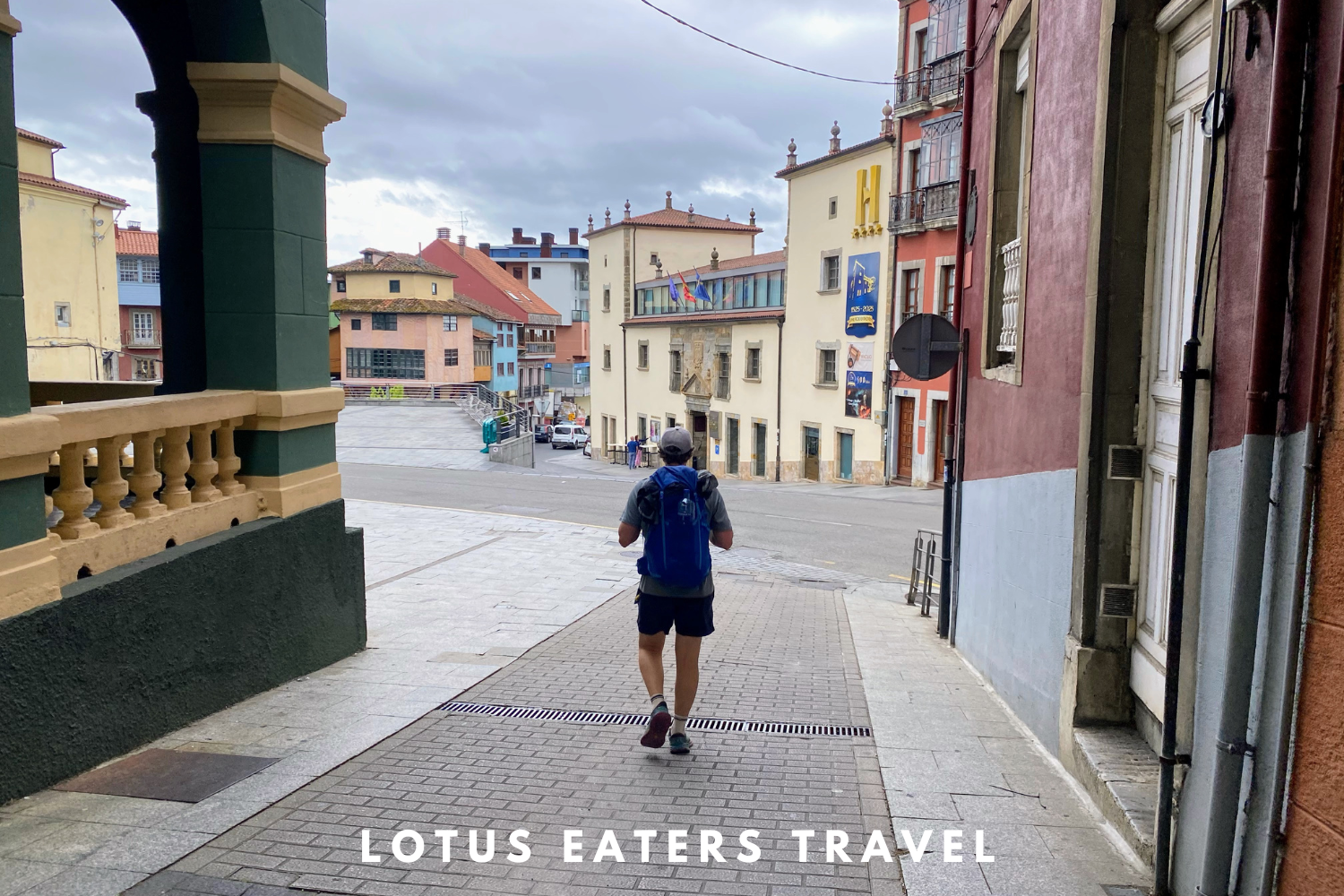
DO YOU NEED TO TAKE A REST DAY ON THE CAMINO PRIMITIVO (AND WHERE TO TAKE IT.)
The Camino Primitivo may be one of the shortest of the major pilgrimage routes to Santiago, but it’s also one of the most demanding.
If you’ve dared to peak at the elevation profiles, you’ll already know: this is not a flat walk. The climbs are frequent, the descents can be just as tricky, and the weather, especially in the mountains, can change on a pin.


Whether to schedule in a rest day is something that most Camino walkers will consider before setting out. So, do you need a rest day on the Camino Primitivo?
Having recently walked the Primitivo and tackled many long distance hikes, we will give our view on whether to take a rest day. And if so, where you should take it.
Why you might need a rest day on the Camino Primitivo


Many pilgrims underestimate the Primitivo. At roughly 320 kilometres, it’s shorter than routes like the Camino Francés, but that doesn’t mean it’s easier.
The ascents between Salas and Pola de Allande, and again from Grandas de Salime up to Fonsagrada, are some of the toughest of any Camino stage. It’s not unusual for even seasoned walkers to feel tired knees, tight calves, and sore shoulders by the midpoint.
The terrain is rough and uneven in parts, and some stages – like the long descent into Grandas de Salime – can feel endless by the end of the day. A rest day allows your body to recover, helps prevent overuse injuries, and gives you a mental break from the rhythm of walking and repacking each day.
From a practical perspective, it can also help you catch up with things – maybe taking some time to catch up on journalling about your trip, speaking to friends and family at home, or even just washing your hair and doing laundry!
But beyond the practical, a rest day is also a chance to actually see the towns and landscapes you’re passing through, rather than just marching past them on the way to the next stage.
Why you might not want to take a rest day on the Camino Primitivo?

There are also a few reasons why a rest day might not be the best choice for you.
Most walkers complete the Primitivo in 12 to 15 days.
From experience on long distance hikes, it’s usually around days 4 to 7 that we start feeling stronger and more capable of longer distances. By days 7 to 15, we’re often thriving. It’s normally not until around week three of a longer Camino that the urge for a lie-in, a slow coffee, and a bit of downtime really starts to kick in.
In short, you might simply not feel that you need a rest day. In fact, taking one could interrupt your rhythm. It’s not uncommon to feel stiffer or more tired after sitting still for a day.
Another consideration is the social side of the Camino. If you pause for a rest, there’s a chance you’ll fall out of step with the Camino friends you’ve been walking alongside. That’s not always the case, of course, many people do take a break in Lugo, but it’s worth keeping in mind. Ultimately, it’s best to focus on your own journey rather than trying to match someone else’s pace.
Finally, a rest day is only as good as where you spend it. If you’re staying in an albergue and get woken at 7 a.m., or if you find yourself in a town with little to do, the day can end up feeling a bit lacklustre. We’ve had rest days like that – and honestly, we sometimes wished we’d just cracked on.
Instead of a rest day, plan in a shorter day


As an alternative to a rest day, we like to plan in a short day during our long-distance hikes.
On the Primitivo, we chose to walk a shorter day into Grandas de Salime. It wasn’t quite a full rest day, but we kept our distance to 15km or so. This meant we arrived to our albergue early and were able to just rest in bed, listen to some podcasts and catch up with journalling (and a bit of work!)
A short day can be a great benefit, whether you take the chance to enjoy a long-lunch, or just rest your weary bones in a bunk bed.
Tip – if you go for this option – be sure to check what time you can arrive to the albergue or hotel. Ideally, look for somewhere that opens from 13:00 or so. If you want even more of a treat, consider a private room.
Where to take a rest day on the Camino Primitivo
There aren’t as many obvious “city stops” on the Primitivo as on other routes, but there are several excellent options for taking a breather, each with its own character and charm.
Oviedo (Before You Start or After the Camino del Norte)


If you’re beginning your Camino Primitivo in Oviedo, it’s worth spending a little time here before setting off. It’s not technically a rest day if you haven’t started walking yet, but a night or two in Oviedo allows you to soak up the atmosphere and visit the Cathedral of San Salvador, where pilgrims traditionally begin the route.
Oviedo is a graceful city, full of elegant plazas and cider houses. It’s a lovely place to enjoy your first Asturian meal and adjust to the slower rhythm of pilgrimage life.
If, however, you’ve walked the Camino del Norte and are continuing onto the Primitivo, Oviedo makes an ideal rest day before you tackle the mountains.
Pola de Allande


Pola de Allande is one of the best and most popular places to rest on the Camino Primitivo. It sits in a picturesque valley surrounded by forested hills, with a friendly and relaxed atmosphere that feels instantly restorative. And it is exactly 100km from Oviedo – which feels like a natural “break point.”
Many pilgrims skip Pola as they take the Hospitales route. This is another reason that we like this town, it feels like a bit of a secret and a reward for anyone who doesn’t take the Hospitales route.
Most pilgrims arrive here the day before tackling Puerto del Palo, one of the route’s highest and steepest ascents. Taking an extra night in Pola de Allande means you can approach that climb fresh and full of energy, rather than half-exhausted from the previous stages.
The town has everything you need for a restful day: small hotels, good cafés, a couple of bakeries, and local restaurants serving hearty Asturian fare. There’s also a muncipal swimming pool – so if the weather is fine, you can take a dip.
Grandas de Salime

By the time you reach Grandas de Salime, you’ve crossed the spectacular descent from the reservoir of the same name. This small town, perched on the edge of the Galician border, makes another excellent place for a pause.
Grandas has a friendly local vibe and a few good options for accommodation. You’ll also find the Ethnographic Museum (not open on Mondays), which could be fascinating if you’re interested in the traditional rural life of Asturias. Resting here means you can face the next day’s demanding climb to Fonsagrada with renewed energy – and of course, a last chance to eat Asturian cuisine.
A Pociña de Muñiz


A Pociña de Muñiz is a beautiful rural albergue in a small hamlet around 15km before Lugo. We stayed here the night before walking into the city and were blown away by the stunning facilities. It has a huge garden with hammocks as well as lots of design touches.
They offer both breakfast and dinner on site, so you can essentially just stay put and enjoy your surroundings.
Private rooms are available for €60 per room. Or you can book a bunk bed in the dorm – they do allow you to book for more than one night. Details and booking is via their website.
Lugo


If you only take one rest day on the Camino Primitivo, make it inLugo. About two-thirds of the way to Santiago, Lugo is a proper city and a UNESCO World Heritage Site thanks to its Roman walls, which hug the old town. You can walk the entire circuit – over 2 km – with wonderful views over the rooftops.
We were really blown away by Lugo and made the bold declaration that it’s our “favourite ever city on the Camino”. Yes, really.
It is super compact, so you don’t feel overwhelmed by choice. Sometimes we find that big cities on the Camino can be a bit overwhelming, especially after days of staying in one-bar towns. But Lugo hits just the right balance of activities v city sprawl.
We loved walking the city walls, visiting the free regional museum (spend a couple of hours there), the markets and the cathedral.
But the biggest selling point of Lugo? Free tapas! In the evening, you get a free bite to eat with every drink ordered at the main tapas bars. And if that’s not worth a rest day, I’m not sure what is.
More Camino resources


If you’ve landed on this page, you may be interested to know that we’ve got oodles of comprehensive guides to the Camino de Santiago on this website. Routes guides for major routes, packing guides, training information and more.
>>FIND OUR CAMINO DE SANTIAGO PAGE HERE<<

Would you like us to plan your walk for you?
Embark on a journey of a lifetime with Lotus Eaters Travel Planning, where we turn your dream of long-distance walking into a meticulously planned reality.
Our passion for exploration, love for diverse cultures, and commitment to providing an unparalleled experience drive us to offer personalized consultation services for some of the world’s most iconic walking trails
Written by Emma
Wine Lover. Yogi. Hiker. Writer.
British travel writer and long-distance hiker, native to Kent. Emma has walked the Camino de Santiago more than ten times, completed trails across Europe from the Corfu Trail to the Fisherman’s Trail, and covered thousands of kilometres on foot. She always writes from first-hand experience. Her goal? Inspire just one person to go on their first long-distance hike.


Walking the Camino de Santiago as a pregnant woman: my experience
WALKING THE CAMINO DE SANTIAGO AS A PREGNANT WOMAN: MY EXPERIENCE A bit of context about me Firstly, a bit of context about me, especially if you’re considering doing this yourself. I first walked the Camino in 2022, taking on the Norte, and quickly became hooked. Since then, I’ve walked more than 10 Camino routes,…

The Camino Portuguese (Coastal route): what we liked + didn’t like
THE CAMINO PORTUGUESE (COASTAL ROUTE): WHAT WE LIKED + DIDN’T LIKE. I first walked the Camino Portuguese Coastal route in March 2024. In late 2026, I returned to the route. The first time, I walked a few days with my mother, and the rest solo. This time around, John and I walked together. We don’t…
A short guide to taking the pilgrim boat on the Camino Spiritual Variant
A SHORT GUIDE TO TAKING THE PILGRIM BOAT ON THE CAMINO SPIRITUAL VARIANT. I will admit, I made a bit of a mistake when it came to arranging our journey on the pilgrim boat from Vilanova de Arousa to Pontecesures. There are two companies operating the route: one has a larger, more comfortable vessel, while…
Most of our planning is done using other blogs, but you can’t beat a guide book at the bottom of your case.
Find them here on Amazon.

USEFUL LINKS FOR FLIGHTS, ACCOMMODATION AND TRANSPORT


FOLLOW US ON SOCIAL MEDIA
Please note that some links on our website are partnered with affiliates. Using an affiliate links does not make it more expensive for you to purchase. We receive a small commission whenever you buy something which in turn allows us to keep writing independent travel guides and your support is greatly appreciated.