

WHY WALK THE CAMINO DE SANTIAGO?
I first wrote this post in 2022, after completing my first Camino. Since then, my partner and I have walked well over 5,000 kilometres across Spain. The Camino has changed – it’s busier, better documented, and further from the secret it once was. But my reasons for walking it have only deepened.
Here’s the updated version: honest, tested, and written by someone who keeps going back.
One: A break from reality – on your own terms


Walking the Camino is a ready-made digital detox. Your daily routine quickly pulls you out of the scroll-and-react cycle that modern life demands.
But here’s something I’ve come to appreciate more with each Camino: the disconnection is a choice. Many pilgrims walk with their phones switched off entirely, or in airplane mode, tuning into the landscape instead – cowbells and birdsong, the crunch of gravel underfoot, the sound of your own breathing on a long climb.
Others stay loosely in touch with home, checking in at the end of a day’s walking. Either way, when you do connect, it feels more intentional and less about doom-scrolling.
This is actually something that I brought home from my first Camino too – I try to leave my mobile phone at the door when I get home in the evening. Or, if I’m on a long walk, I keep it firmly in my pocket.
Two: Emotional and mental clarity
The Camino gives you something that modern life rarely does: time to think. Long, uninterrupted stretches of it. That can be uncomfortable at first – all those feelings you’ve been too busy to sit with suddenly have nowhere else to go. People walk to process a bereavement, a divorce, a career crossroads. Others don’t arrive with an agenda and still find something shifts.
I will always remember meeting someone on my first Camino who was walking in the midst of a break-up. She had met some really great Camino friends on day one or two and had walked with them since, but she told me that she was going to walk the next day alone to have “thinking time.” When I next saw her, she told me it had been so powerful – she had sat looking at a view and let all her emotions take over.
And this effect can stay with you a long time after the Camino too. I remember stepping off a train in Mérida at the end of one of our Caminos, watching the crowd around me – phones out, suitcases rolling, mental to-do lists forming before the train had even stopped – and feeling utterly still by comparison. My thoughts were clearer. My shoulders less tense. The noise of normal life felt suddenly overwhelming.
Three: Physical challenge – and what it teaches you

Some Camino purists will tell you the physical challenge misses the point. I disagree. The longer routes are not to be taken lightly, and completing one requires genuine grit. Whether you’re covering 40km days or taking it slower, your body will be transformed by the time you reach Santiago.
More than that: the way you respond to physical difficulty on the Camino teaches you something. I’ve cried from pain on the trail. I’ve cursed at the terrain in the blazing afternoon heat. I’ve had nights of bad sleep and mornings where I genuinely didn’t know how I’d keep walking. And then something shifts. You adapt. You keep going. That’s where the growth is – not in the arrival, but in discovering what you’re made of on the hard days.
Conversely, we’ve also had a recent Camino experience which taught us another valuable lesson – sometimes it’s OK to quit or change your plans when things get too tough.
Four: Meeting new people

After the pandemic years, this was one of my original reason for walking – and it hasn’t lost its power. Every day, you get to meet entirely new people if you choose to. You can also fall into a “Camino family”: a loose group of people walking at the same pace, sharing meals and miles, becoming friends in the accelerated way that shared pain tends to produce.
But that’s not to say that there’s pressure to socialise or make friends. Just a simple exchange of “buen camino” and a smile with a stranger can be quite powerful.
Five: Communal living – and what it strips away


Here’s something I didn’t appreciate on my first Camino: there’s a genuine pleasure in the bunk bed. When else, as an adult, do you climb into a top bunk, zip up a sleeping bag, and fall asleep to the sounds of strangers rustling below? It’s stripped-back and simple in a way that becomes oddly comforting.
Communal living on the Camino – shared rooms, shared meals, early mornings in a hostel kitchen — is awkward for about half a day. After that, it becomes part of normal life. It reminds you that life doesn’t need to be private or polished all the time. That we are all, in fact, part of something bigger.
Six: The Camino community


Pilgrims are a protected and welcomed group in Spain. Locals greet you with Buen Camino as you pass. Fellow walkers are diverse, warm, and largely non-judgmental. Everyone is generally embraced.
Something I’ve come to understand more with time: the word peregrino carries a quiet dignity. On my first Camino, it didn’t quite sit right with me – I wasn’t sure I’d earned it. But the more I’ve walked, the more I’ve understood it. It doesn’t matter why you started and it’s not really about you. Instead, you’re part of something older than yourself. That sense of belonging, however temporary, is powerful.
Yes, the Camino Francés is busier than ever. But the spirit travels across all routes. If crowds concern you, there are dozens of alternatives that will give you quieter trails and the same warmth from the communities you pass through.
Seven: Yellow arrows

One of the Camino’s simplest pleasures: you just follow the arrows. Painted on trees, buildings, road signs, and rocks, they guide you forwards. It’s hard to get truly lost.
We’ve conquered lots of other long-distance paths in Europe that don’t have such clear way markers. And whilst we’ve still enjoyed them – there’s something fabulous about being able to switch off and walk without a map.
And in a deeper sense, they offer something that modern life rarely does – a clear sense of direction. Just keep walking. Just follow the arrows.
Eight: The freedom of carrying everything you need


On the Camino, it’s just you and your backpack. (Pack light – I can’t stress this enough. Your future self will thank you.) Everything you need fits in one bag. Clothes, sleeping bag, toothbrush.
With each passing day, you realise how little you miss the rest. There’s a freedom in carrying your life on your back – not just physically, but emotionally. The weight of stuff falls away. I find myself returning to a thought that first hit me somewhere on the Meseta: if this was all I had in the world, I’d be okay. That thought is worth more than any gadget I left at home.
Nine: The beauty and breadth of Spain

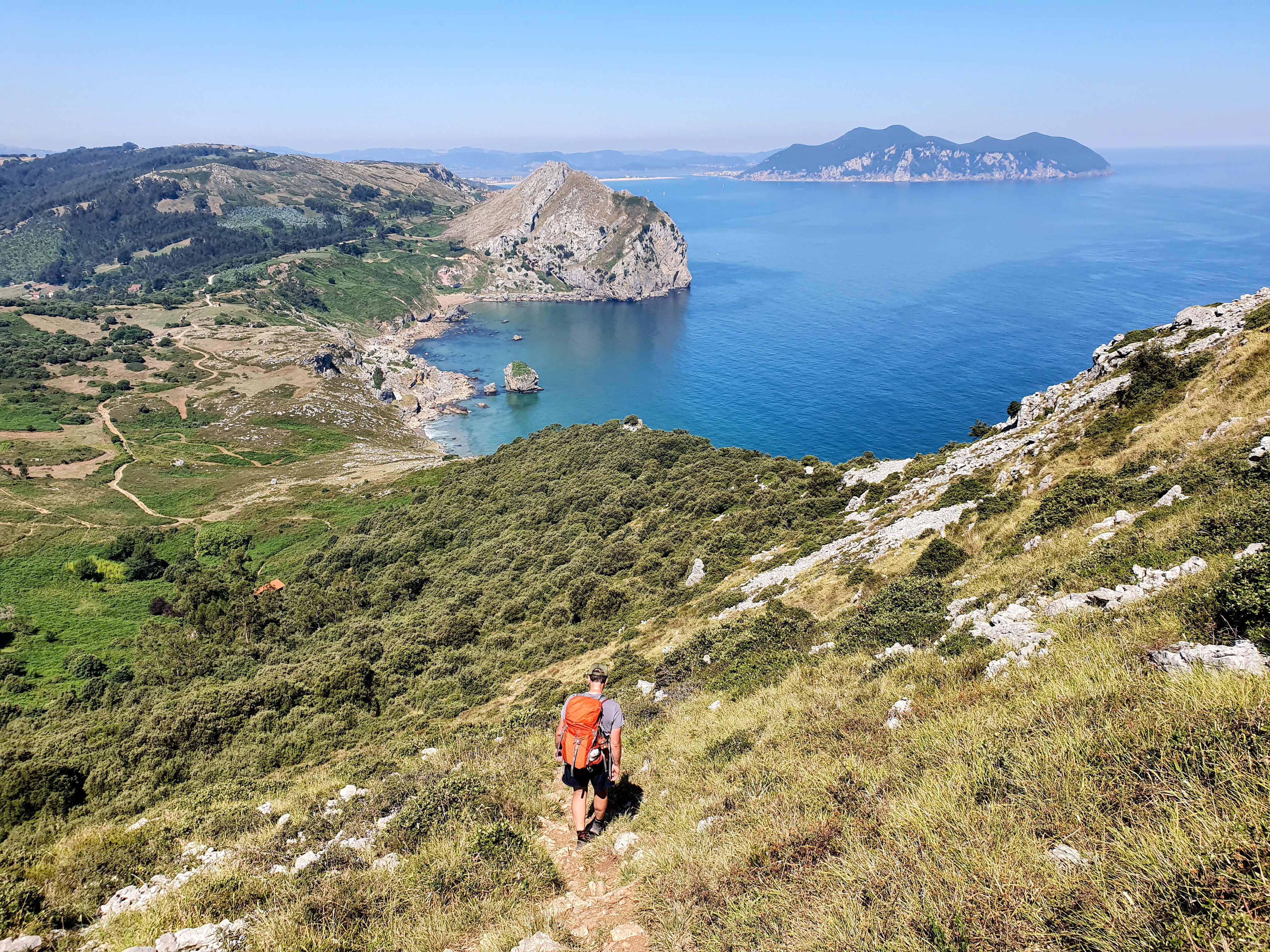
Exploring by foot means you see Spain through an entirely different lens. On the Norte, you’ll find beaches accessible only by footpath. On the Primitivo, you’ll haul yourself over mountain passes to find villages that you otherwise would never have seen. On the Vía de la Plata, you’ll be shocked by how beautiful some of the scenery is.
Each province feels like its own country. Every Camino route offers something different – the emerald green of Galicia, the quiet snowy villages of Andalucía, the vast flatness of the Meseta. And always, there’s food: hearty menú del día lunches, pastries from a village bakery at 7am, cold beers on plastic chairs outside corner bars. A glass of wine will set you back around two euros. The scenery is free.
Watching the sun rise after hiking up a long hill at dawn is something you will never forget.
Ten: Value for money


The Camino can be exceptional value. Municipal albergues cost around €10–15 a night. Donativo options (pay what you can) still exist on many routes. Communal meals in albergues are cheap and filling, and supermarkets are never far away if you want to self-cater.
It’s one of the few travel experiences that is genuinely accessible at almost any budget – and that accessibility is part of what makes the community so diverse.
Eleven: Romance – of all kinds

Whether you’re single or in a relationship, the Camino has something to offer. New romantic connections form on the trail every day – we’ve met countless couples who found each other walking. And if you take on the Camino with a partner, the shared experience – the hard days, the beautiful moments, the strange intimacy of hiking side by side for weeks – has a way of deepening things.
Walking all day might not sound romantic. But the little moments, the shared exhaustion, someone giving you the last bite of their sandwich, or helping you make your albergue bed when you’re too tired- those things are genuinely special.
Twelve: It’s fun


You’ll laugh. You might cry. You’ll be hungry, sweaty, and fairly dirty. Your feet will probably be covered in blisters. Some nights you won’t sleep at all.
But you’ll have the time of your life. And the moment you arrive in Santiago – or wherever your Camino ends – you’ll probably start thinking about the next one.
More Camino resources


If you’ve landed on this page, you may be interested to know that we’ve got oodles of comprehensive guides to the Camino de Santiago on this website. Routes guides for major routes, packing guides, training information and more.
>>FIND OUR CAMINO DE SANTIAGO PAGE HERE<<

Would you like us to plan your walk for you?
Embark on a journey of a lifetime with Lotus Eaters Travel Planning, where we turn your dream of long-distance walking into a meticulously planned reality.
Our passion for exploration, love for diverse cultures, and commitment to providing an unparalleled experience drive us to offer personalized consultation services for some of the world’s most iconic walking trails
John and Emma’s hiking gear. These are items we love to use when we go hiking, find them here on Amazon.






Read more Camino
15 alternatives to the Camino de Santiago
15 ALTERNATIVES TO THE CAMINO DE SANTIAGO. The Camino de Santiago has become something of a legend. It is the route that introduces many people to long-distance hiking for the very first time. And…

25 mistakes I’ve made on the Camino de Santiago
25 MISTAKES I’VE MADE ON THE CAMINO DE SANTIAGO. I think one of the reasons people romanticise the Camino de Santiago so much is because, in many ways, it deserves it. There’s nothing quite…
26 things to do to get ready for your first Camino de Santiago
26 THINGS TO DO TO GET READY FOR YOUR FIRST CAMINO DE SANTIAGO. Planning your first Camino can feel overwhelming. There’s a lot of advice out there, and it’s not always easy to know…
Something went wrong. Please refresh the page and/or try again.
Most of our planning is done using other blogs, but you can’t beat a guide book at the bottom of your case.
Find them here on Amazon.

USEFUL LINKS FOR FLIGHTS, ACCOMMODATION AND TRANSPORT


FOLLOW US ON SOCIAL MEDIA
Please note that some links on our website are partnered with affiliates. Using an affiliate links does not make it more expensive for you to purchase. We receive a small commission whenever you buy something which in turn allows us to keep writing independent travel guides and your support is greatly appreciated.


Leave a Reply