
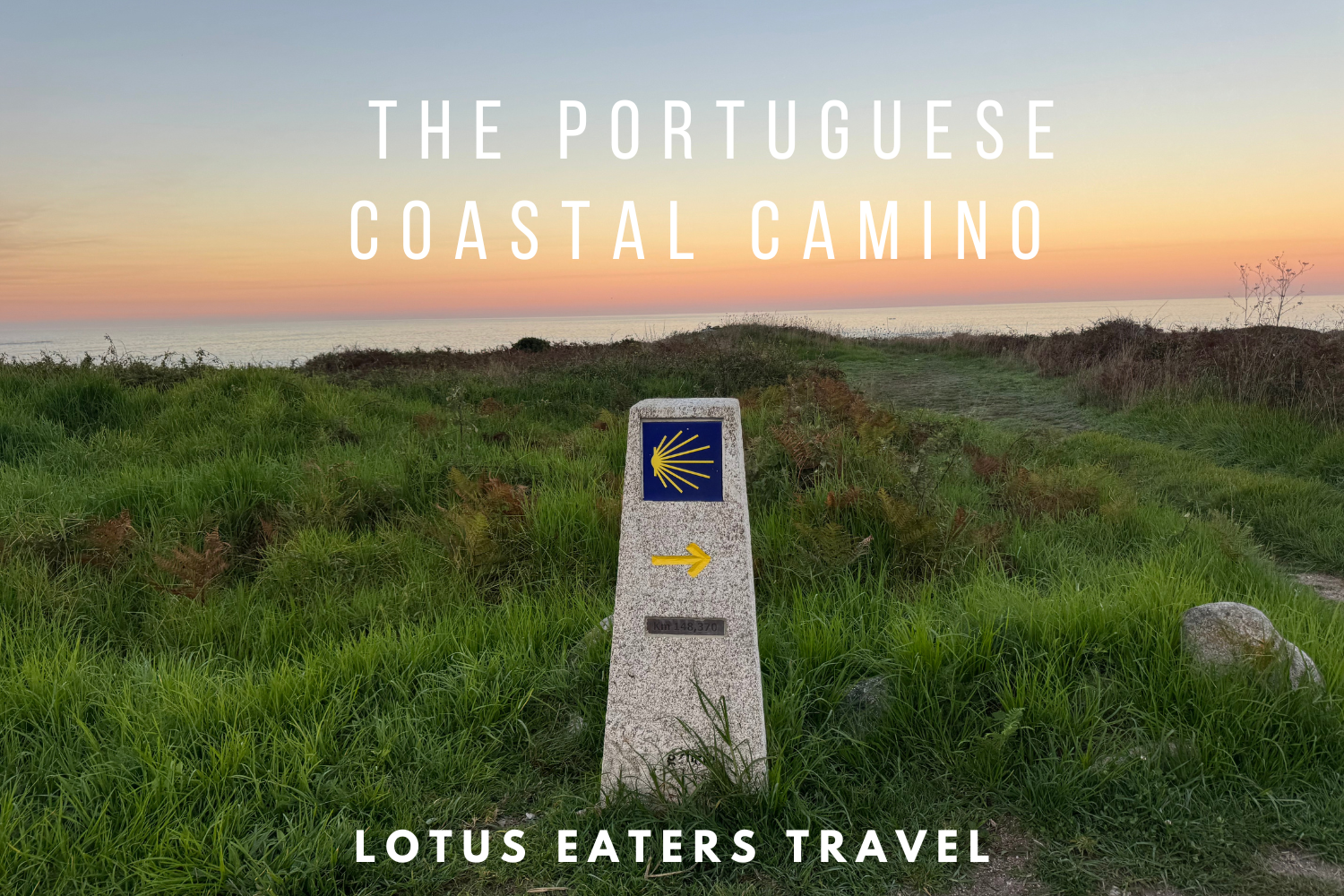
19 THINGS TO KNOW BEFORE YOU WALK THE CAMINO PORTUGUESE COASTAL ROUTE.
When we first walked the Portuguese Camino in 2022, we regularly found ourselves wandering through the woods with nobody else in sight. Fast forward to now, and the Coastal Route is one of the most popular Camino routes there is. You will not be alone, and you will spot other walkers ahead of you for most of the day.


That doesn’t make it any less worth walking. I’ve now done a version of the Portuguese Camino three times, and the coastal route in particular has beaches, fishing villages, very good beer and a ridiculous amount of pastry. It does, however, have a few quirks that catch people out, from a boat crossing to a time zone change to a confusing Litoral variant that I still get wrong.
So here are 19 things I wish I’d known before walking it.
1/ The route has increased in popularity

Both Portuguese Camino routes used to be slight outliers, compared to the ever prominent Camino Frances. But in the last few years, popularity is soaring. We first walked the Portuguese Central in 2022, and it did not feel even the slightest bit busy.
Fast forward to 2026, and these routes are more popular than ever. In particular, the Coastal Route is really trending.
So what does this mean? The main thing is, don’t expect the route to yourself. You will see a lot of other walkers. And, because the terrain is fairly flat, sometimes this can feel a little overwhelming, as you can see everyone in the distance.
If this bothers you, then starting early in the morning can help, or changing up your daily stages so you don’t stay in the most popular places. Keep in mind that May-June and September are by far the most popular months.
On the upside, there’s a safety in numbers aspect to the route being popular. I’ve walked solo on the Camino Portuguese Coastal and felt very protected. And, the atmosphere can also feel really jovial.
2/ Weather on the route can be unpredictable


When people think of Portugal, they often expect a very hot and humid climate. And whilst it’s true that this can be the case, particularly in the south of the country, it’s not always the case in the north.
The coastal route runs more or less directly along the Atlantic Coast, and as such, weather can be a bit unpredictable. Sometimes, it’s utterly balmy. I walked this route in September most recently and we had a unexpected heatwave, with temperatures in the mid-thirties on some days.
But I’ve also walked in March and April and had an entirely different experience. One day I was suntanning in a bikini on the beach just outside Porto, and then next, I was frantically trying to protect my belongings from wild rain and whipping wind.
3/ You don’t have to stick to the standard daily stages

I’m often surprised by how many people think that there is only one way to walk each route, when it comes to daily stages. But actually, there are so many different permutations.
The first time I walked this route, I walked 25km ish each day. The second time, I chose to average only around 17 or 18km, walking 10km so days. And I’ve met lots of people walking much longer stages.
In short, you can choose your stages based on fitness levels, goals for the route and how much time you have. You can also tailor your daily stages around particular places you want to stay or spend time in, whether this is quieter fishing villages or larger beach towns.
4/ You can get your luggage transported

There are numerous luggage services operating on this route. We haven’t used them ourselves, but I’ve certainly seen luggage being moved between hotels and albergues along the coastal route. For anyone who doesn’t want to, or isn’t able to, carry a backpack, this can be a wonderful way to ease the burden.
Two popular options on this route are Top Santiago and Pilbeo. Correos, Spain’s postal service, also operates.
5/ There are beautiful towns and cities on route


The route is lined with places that make you want to stay an extra night. My favourites are Baiona, Vila Praia de Âncora, Esposende, Fão and Viana do Castelo. Viana was John’s favourite, and I can see why. Honestly, you could happily spend longer in any of them, so if you have flexibility in your schedule, this is where to use it.
Baiona deserves a particular mention. It’s a lovely seafront town with a harbour and a fortress, and it’s one of the best places on the route for an evening of tapas. Porto and Vigo are the big cities, and both are worth time, Vigo makes a great rest day.
6/ And lovely rural locations too


Between the towns, the route passes through some quieter and more rural stretches. Two of my favourites are Portecelo and Oia. Oia sits on a wild stretch of Atlantic coastline in Galicia, with a monastery right by the sea, and it feels a long way from the busier sections of the route. It’s also where I had one of the best meals of the whole walk (more on that below).
If you want to escape the crowds, small villages like these are the way to do it. They tend to be quieter in the evenings, and you’ll often find you’re sharing the bar with locals instead of a dozen other pilgrims.
7/ The Litoral Variants can be confusing but are often worth taking


Probably the most confusing aspect of walking the Camino Coastal Route is understanding the difference between the “Coastal” and the “Litoral” sections.
No matter how many times I explain this, I still find myself tripping up!
The Camino Coastal Route, does not always follow the coast exactly. Whilst the “litoral” route does.
Where this particularly matters, is on the first day coming out of Porto. If you want to walk along the river, to the coast and in the direction of Matoshinhos, you will want to take the Litoral Route – you do this simply by following the river (keeping it to your left) and then turning right along the coast. The “Coastal Route” actually follows an inland path on day one, and most don’t recommend taking it.
Further along the way, there are a few days with Litoral or Coastal options. Again, the Litoral sections take you along the beach, whilst the Coastal sections dip inland. Personally, I’d always recommend taking the Litoral, but the are occasions when this might not be the best option.
You can find our daily stages guide here, this explains the specific sections a little more.
8/ The Portuguese section goes so fast


I’ve now walked a version of the Portuguese Camino three times and each time, almost the first thing I notice, is that the time walking in Portugal goes by so fast.
If you start in Porto, honestly, you will be crossing into Galicia before you know it. My advice? Slow down the first section a little so you can optimise your time in Portugal. You can also plan your last night in Caminha, before taking the boat.
And just make the most of those Portuguese pastries before you have to say goodbye to them.
9/ You need to take a boat to cross into Galicia

On both of the Portuguese Camino routes, you cross from Portugal to Spain. On the Central Route, this is via a footbridge. But on the Coastal, you’ll need to take a boat (unless you take a long and convoluted route by land.)
Thankfully, this is normally a pretty easy and enjoyable experience. The boat takes only 5 minutes or so as it crosses the river between Caminha and A Guarda. You can book in advance (recommended in low season), or just turn up on the day (in which case, you may have a short wait.)
You can find more information on the pilgrim boat between Caminha and A Guarda here.
10/ Spain is on a different time zone to Portugal


Mainland Spain uses Central European Time, whilst Portugal is on Western European Time. So what does this mean for anyone walking the Camino?
As soon as you cross into Galicia from Portugal, you’ll need to adjust your watches – because Spain is always one hour ahead of Portugal. This can be a bit discombobulating, but isn’t a major inconvenience. Just be sure to plan your walking stages around this.
11/ You may need to book accommodation

Of all the Camino routes I have walked, I think the Portuguese Coastal is the one that most requires some forward planning when it comes to accommodation.
As mentioned, the route is becoming increasingly popular – and yet, the route doesn’t quite have such good infrastructure as the busiest route – the Frances.
Increasingly, walkers are booking either private rooms or a bunk space in private albergues, in advance. Many of the albergues and hotels are on booking.com now – meaning it’s easy to book in advance. If you don’t plan ahead, you could quite quickly be left without somewhere to stay, or at the very least, not getting your first choice.
There are municipal albergues on this route, but they aren’t huge spaces, and they do quite often end up full. So don’t always count on getting space at one.
You can find two further resources below to help you with this:
- When and why you should book accommodation on the Camino?
- The best albergues on the Camino Portuguese routes.
12/ The route is mostly flat, with a few small hills


The Portuguese Coastal Camino is absolutely one of the flattest routes in the Camino network. For this reason, it tends to attract those walking their first Camino, or people who don’t want a very challenging hike.
That said, it’s worth noting that it is, of course, not entirely flat! Some days you may only climb 100-200m, which is barely noticeable. Other sections are a little harder, the route into Baiona for example, as well as the latter stage between Redondela into Pontevedra. There’s even a steep little slope out of Vigo that caught me off guard.
Just be sure to include a few hills into your Camino training plan.
13/ The terrain can be tough on your feet

In my experience, one of the toughest aspects of the Camino Portuguese Coastal route is the terrain. But, the reason might not be what you expect.
The route has a few sections of cobbles and trail, but mostly, you will be walking on either pavement, quite roads, or boardwalks. Unfortunately, while this terrain is generally easier – you’re burning less calories than you would be on undulating trail. It can be harder on your feet.
I think this is one thing that surprises most people walking this route – after 20km on pavement, your feet can really feel it. Be sure to road test your shoes, have a blister prevention plan and just give your tootsies a little extra TLC.
14/ You can enjoy the beach most days


If you plan to walk the Portuguese Camino Coastal route and you like a bit of beach time, you are in luck. Firstly, I’d suggest packing a swim suit and a small trek towel (which you will most likely pack anyway if you’re staying in albergues.)
On most days, you can find a beach to pause, swim or just relax on the sand. Keep in mind that the Atlantic can choppy, so always be cautious where you swim.
A few of my favourite spots for a dip on route are Mindelo, Vila Praia de Ancora (my goodness the beach is beautiful here), Patos Beach, Praia de Samil (close to Vigo) and Baiona. There are also surf spots along the route too.
Bonus – the sea is normally so cold, that it helps with any feet swelling!
15/ Each region on route has their own food and drink specialities


One of the fun things about this route is watching the menu change as you cross the border. In Portugal, I lived on pastéis de nata and John enjoyed bolas de Berlim, the doughnut-style pastries you’ll find at beach kiosks and cafés. John’s drink of choice was vinho verde, and he stayed loyal to it for the entire Portuguese section.
Cross into Galicia and everything shifts. Tapas becomes the main event, especially in Vigo and Baiona, and Albariño takes over from vinho verde as John’s tipple of choice. Beer also changes, from Super Bock in Portugal to Estrella Galicia in Spain, and I fell completely in love with the 0.0% Tostada. It sounds like a small thing, but after 20km of walking, a cold alcohol-free beer that actually tastes of something is a joy.
The highlight, though, was a thin Galician steak in Oia, which was one of the best meals of the whole trip.
Breakfast changes too. In Portugal, we often started the day with a toasted ham and cheese sandwich on soft, slightly sweet bread (a tosta mista, I think, though I’m happy to be corrected), usually with a coffee and sometimes a pastry on the side. In Spain, breakfast gets more savoury. We tucked into tortilla and tostada con tomate, toast topped with crushed tomato and olive oil, which is simple but exactly what you want before a long day on the way.
16/ The route merges with the Portuguese Central Route at Redondela

At Vigo, you more or less say goodbye to the coastal element of this route and start heading inland. There isn’t a coastal variant as you walk the last 100km or so into Santiago de Compostela.
Instead, the route merges with the Central Route at Redondela. At this point, you’ll notice a few things. Firstly, more walkers – as the routes have merged. Secondly, more trail – there are some lovely sections through forest on the Central Route. Finally, it becomes a little more commercial – you’ll see more Camino souvenir shops, busier pilgrim cafes, and that sort of thing.
I’ll be honest, this isn’t my favourite section of the route. Mainly because of how busy it can start to feel, even in off season. But there are some real highlights – Redondela is a nice town, Pontevedra is a wonderful city full of culture and great food and Padron is an underrated and charming town.
There are also some fabulous rural albergues on this stretch – more on that here.
17/ But if you want more coast, you can take the Spiritual Variant


That said, there is another option, if you want to avoid a large chunk of the last 100km on the Central Route. And that is to take the Spiritual Variant.
Two kilometres or so after Pontevedra, there are two options. Turn right to continue onto the Central Route, or turn left and take the Spiritual Variant. This is a 75km route, which includes a boat ride for around 28km. It takes most walkers two or three days, plus time to take the boat.
The pros of this variant, are that it is much quieter than the Central Route. Perhaps only 5% of all walkers take this option. Another, is that it reunites any sea lovers with their beloved coastline. You can find delightful swimming spots in both Combarro and Vilanova de Arousa.
You can find our detailed guide to walking the Spiritual Variant, including daily stages here.
18/ Take a little cash

I always suggest taking a small amount of Euros in cash on any Camino. But, we really noticed the need for cash in Portugal particularly – most bakeries we visited, and a few beach bars, required cash payment.
After one embarrassing incident counting out coins to pay for our breakfast and not quite having enough (resulting in John hunting for an ATM) – I’d really recommend carrying Euros on this route.
19/ Many private albergues provide bedding and towels


Normally, I would recommend that anyone walking the Camino de Santiago and planning to stay in albergues, should pack either a sleeping bag (or sleep sheet in summer) and a trek towel. But, I’ve noticed now that the Camino Portuguese Coastal Route may be the exception to this rule. This is because, increasingly private albergues are providing bedding and towels.
If you plan to stay in some hotels, and some private albergues, it is worth checking with the albergues whether bedding is provided – if it is, you can save yourself carrying the extras. Both times that I have walked this route, I haven’t needed a sleeping bag for this reason.
Personally, I still carry a trek towel, because I like to have it for the beach.
That said, if you plan to stay in more budget albergues or municipal ones, you are not going to be provided with bedding or towels.
Written by Emma
Wine Lover. Yogi. Hiker. Writer.
British travel writer and long-distance hiker, native to Kent. Emma has walked the Camino de Santiago more than ten times, completed trails across Europe from the Corfu Trail to the Fisherman’s Trail, and covered thousands of kilometres on foot. She always writes from first-hand experience. Her goal? Inspire just one person to go on their first long-distance hike.


More Camino Travel Guides


USEFUL LINKS FOR FLIGHTS, ACCOMMODATION AND TRANSPORT


FOLLOW US ON SOCIAL MEDIA
Please note that some links on our website are partnered with affiliates. Using an affiliate links does not make it more expensive for you to purchase. We receive a small commission whenever you buy something which in turn allows us to keep writing independent travel guides and your support is greatly appreciated.
Leave a Reply